
Beyond the Click: How Social Buttons Engineer Social Capital
Like, Share and Follow: A Conceptualisation of Social Buttons on the Web
This theoretical paper conceptualizes social buttons (Like, Share, and Follow) on Social Networking Sites (SNSs) through the lens of Social Capital Theory. It establishes a taxonomy of these "buttonized" actions and analyzes their distinct impacts on two primary actors: the "clicker" (initiator) and the "clickee" (content owner).
TL;DR
Social buttons—Like, Share, and Follow—are the atomic units of the modern "Social Web." This paper deconstructs these one-click interactions to show how they produce Social Capital. It reveals that these buttons aren't just for feedback; they are sophisticated tools that build identity for the "clicker" and generate fame (or structural capital) for the "clickee."
The "Buttonization" of Social Reality
The transition from the "informational web" to the "social web" replaced simple hit counters with interactive triggers. These "social buttons" do more than record a preference; they metrify affect. They take a complex human emotion—appreciation, agreement, or curiosity—and compress it into a single, quantifiable metric that can be tracked, harvested, and sold.
The authors argue that we must look at two sides of every click:
- The Clicker: The individual who initiates the interaction.
- The Clickee: The person or organization behind the object being clicked.
Framework: The Three Pillars of Social Capital
To understand what happens during a click, the study utilizes the three dimensions of Social Capital:
- Structural Capital: The density and number of connections in your network. (Example: Your "Followers" count).
- Cognitive Capital: Shared language and resources that allow for mutual understanding. (Example: Sharing an expert article).
- Relational Capital: The trust, obligations, and "bonding" between individuals. (Example: Liking a close friend's baby photo).
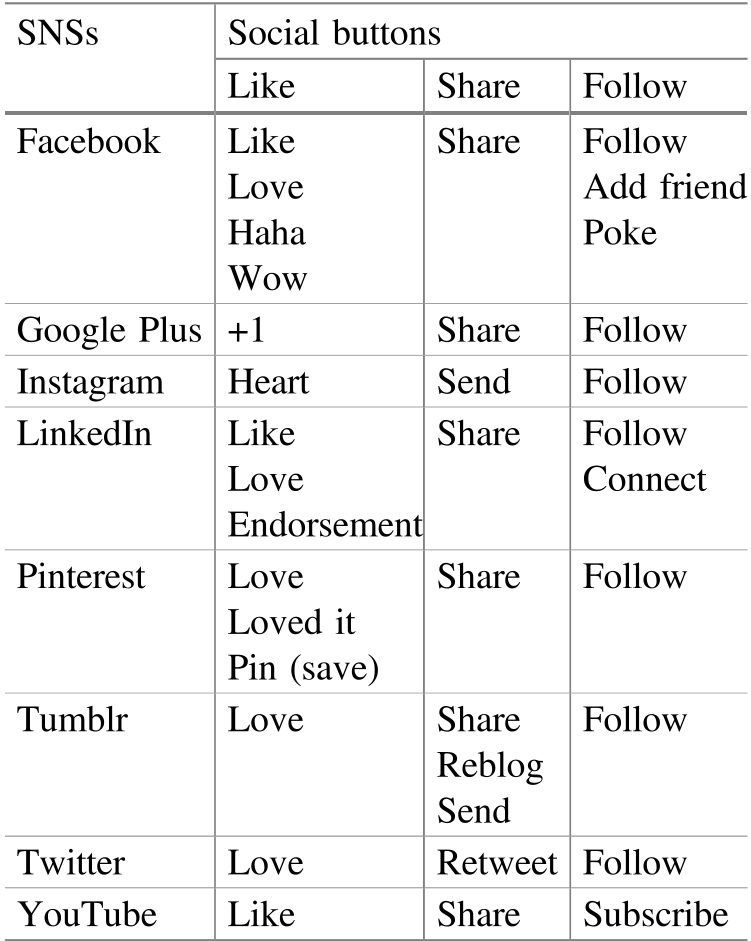
The Anatomy of the Big Three: Like, Share, Follow
1. The Like Button: The Engine of Popularity
Liking is often a low-stakes, emotional reaction.
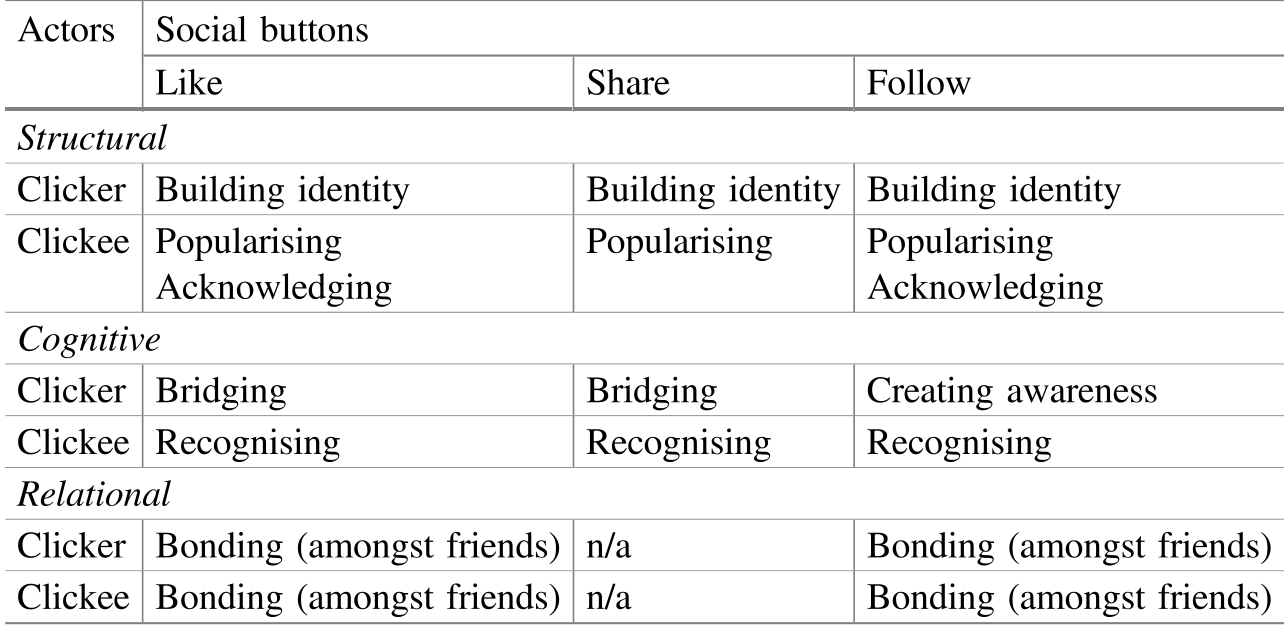
- For the Clicker: It’s about Profiling (building an identity as a supportive person).
- For the Clickee: It’s about Popularization. Mass likes generate fame, which the paper distinguishes from "recognition." Popularity is purely numerical and can lead directly to economic gain (e.g., sponsorship deals).
2. The Share Button: The Bridge Builder
Sharing is a more selective act. You rarely "Share" content with your closest friends (who probably saw it anyway); instead, you "Share" to bridge sub-communities.
- Insight: The Share button is the primary driver of Cognitive Capital. When you share, you are acting as a curator, staking your own reputation on the quality of the content.
3. The Follow Button: Long-term Awareness
Unlike the instantaneous "Like," following is a commitment to a future relationship. It creates Awareness for the clicker and Structural Capital for the clickee. It is often uni-directional (a fan following a celebrity), transforming the clickee into a recognized authority.
Summary Table: Social Implications
The following table summarizes how each button acts as a "productive" force for both parties involved:
Critical Insight: The "Context Collapse"
A fascinating takeaway from the paper is the risk of Context Collapse. Because SNSs mix family, colleagues, and strangers into one list, a click meant for one group (e.g., Liking an edgy joke for friends) might be seen by another (e.g., your boss), leading to social friction. This highlights the double-edged nature of buttons: they simplify interaction but flatten social complexity.
Conclusion
Social buttons are the "low-transaction-cost" maintainers of our digital lives. They allow us to manage thousands of "weak ties" that would be impossible to maintain through traditional communication. For researchers and product designers, this paper serves as a reminder that every UI element is a social intervention that shifts the balance of power and capital in a network.