
Can You Really Trust Your Users? The Myth of the "Trusted" Spam Reporter
Can You Spot the Fakes?: On the Limitations of User Feedback in Online Social Networks
This paper presents a data-driven evaluation of user reporting reliability in Online Social Networks (OSNs), specifically LinkedIn. It introduces a statistical framework to determine if "reporting skill" is measurable and repeatable across signals like fake profile flagging and connection request responses. The study finds that while high-precision reporters exist, they constitute less than 2.4% of the population, questioning the feasibility of large-scale "trusted set" reputation systems.
The concept of the "Wisdom of the Crowds" suggests that collective intelligence can outperform individuals. In the world of Online Social Networks (OSNs), this theory underpins the reporting systems we use every day: see a bot, flag a bot. Researchers have long hypothesized that platforms could identify a "trusted set" of elite users to automate the removal of fake accounts (Sybils).
But is "reporting skill" a real, repeatable human talent, or are these "excellent" reporters just lucky? A landmark study from LinkedIn, presented at the World Wide Web Conference (WWW), dives deep into the data to answer: Can you actually spot the fakes?
The TL;DR: Accuracy is Rare and Hard to Repeat
The study provides a sobering reality check for OSN administrators. By analyzing millions of interactions on LinkedIn, the research demonstrates that:
- Elite reporters exist, but they are a tiny minority. Less than 2.4% of users who flag content show measurable and repeatable skill.
- Most feedback is noise. Collective signals are often too weak for automated action without high risk of "killing" real accounts.
- Repeatability is the bottleneck. Many users are accurate once but fail to maintain that precision over time.
The Statistical Framework: Measuring "Skill"
The author, David Mandell Freeman, argues that for a reporter-based reputation system to work, skill must be two things: Measurable and Repeatable.
To quantify this, the study moves beyond simple accuracy and looks at three metrics:
- Smoothed Precision (): Adjusting for the number of reports so that a user who is 1/1 isn't ranked higher than a user who is 49/50.
- Informedness: Measuring how much better a user is than a random guesser, accounting for the baseline "propensity" to click "reject" or "accept."
- Fisher’s Exact Test: A statistical filter to prove that the user’s ability to distinguish real from fake isn't just a statistical fluke.
 Above: The distribution of Fisher scores shows that as users have more time to react (7 days vs 4 hours), the statistical significance of their reporting skill becomes clearer, yet remains concentrated in a small group.
The Methodology: Flagging vs. Invitations
The study analyzed two distinct types of "reporting" behavior:
- Explicit Flagging: Actively reporting a profile as "Fake Identity" or "Impersonation."
- Implicit Signaling: The act of "Accepting" or "Rejecting" connection requests. This is a "weaker" signal but happens at a much higher volume.
The "Repeatability" Trap
The most insightful part of the methodology was splitting the 6-month dataset into two halves. To be considered "skilled," a user had to perform well in both halves. If they were great in Part A but average in Part B, their initial performance was dismissed as transitory or lucky.
Key Results: SOTA Performance at the Top, Vacuum in the Middle
The data revealed a power-law distribution of reporting quality.
- Flagging Success: Only 5,559 members (out of 227k) satisfied the criteria for being "skilled." However, this tiny group flagged accounts with 82% cumulative precision.
- The Elite Band: A smaller subset of 4,304 flaggers achieved a staggering 97% precision. For these users, the OSN could theoretically automate account takedowns based on a single click.
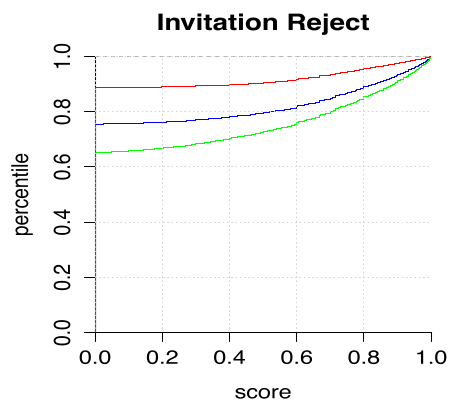
- Invitation Rejection: This signal was much noisier. Only 1.3% of users were skilled at rejecting spam invitations. Interestingly, users were slightly better at identifying "Real" accounts (3.8% skill) than "Fake" ones.
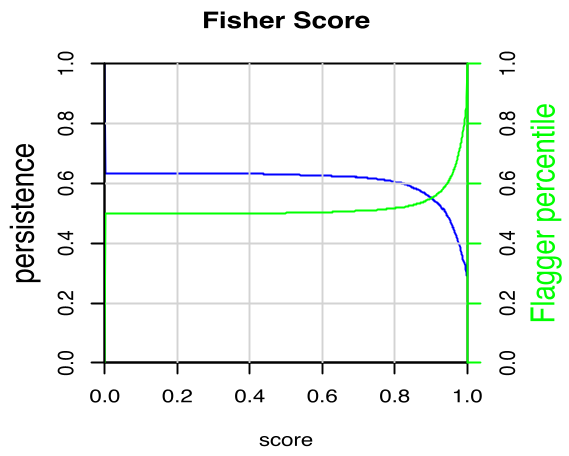 Above: Persistence curves show that "Smoothed Precision" is the most stable metric, but even then, less than half of the users maintain their high performance across different time windows.
Deep Insight: Why Doesn't the "Wisdom of the Crowds" Work Here?
Social networks aren't like Wikipedia. In Wikipedia, contributors are often experts or enthusiasts. In OSN security, reporting is often a frustration-driven action or a low-effort task.
The study indicates that most users don't have the motivation or the "detective instinct" to investigate a profile. Furthermore, spammers are constantly evolving. A user who spots a "clumsy" bot today may not spot a "sophisticated" hijacked account tomorrow.
Limitations and Future Outlook
The study was "organic"—users weren't told they were being tested. The author suggests that User Interface (UI) Cues might help. If platforms provided incentives or showed users why an account looks suspicious, we might see an increase in "reporting literacy."
Conclusion
For developers building reputation systems: Quality > Quantity. Do not build your algorithms on the aggregate sum of reports. Instead, identify the 1% "Elite Reporters" through rigorous statistical testing and give their voices a 100x multiplier. For the rest of the 99%, their reports should be treated as mere suggestions for further review.
Takeaway for the Industry: A reliable "trusted set" of members is too small to solve the spam problem alone. Hybrid systems, combining ML-based classifiers with elite human feedback, remain the only viable path forward.