
Fighting Fire with Light: A Dual-Strategy Approach to Social Media Misinformation
Limiting the Spread of Misinformation While Effectively Raising Awareness in Social Networks
This paper investigates the Misinformation Containment (MC) problem using a novel Competitive Activation Model (CAM). It introduces the Dominating Influence (DI) algorithm, which effectively restricts misinformation spread while maximizing the reach of correct information, achieving SOTA-level performance on large-scale social networks.
TL;DR
Misinformation spreads like a virus, but simply "blocking" it isn't enough. This paper introduces the Misinformation Containment (MC) problem, framing it as a battle between "bad" and "good" information. By introducing a new Competitive Activation Model (CAM) and the Dominating Influence (DI) algorithm, the researchers show how to strategically pick a small set of "protectors" to both halt rumors and maximize public awareness of the truth.
Background: The Invisible War of Beliefs
In the digital age, a single rumor—whether about a financial crisis or a public health emergency—can cause real-world havoc in minutes. Most existing research treats this as a one-sided problem: identify the "infected" and stop them. However, this paper argues that the key is competition. To win, you don't just stop the lie; you must make the truth more attractive and pervasive.
Problem & Motivation: Why Hiding the Truth Isn't Enough
Previous methods (like node-blocking) suffer from two major flaws:
- Passivity: They ignore the need to proactively educate the rest of the network.
- Modeling Oversimplification: They often use simple "tie-breaking" rules for information competition.
The authors argue that users have preferences. If a user is reached by both the truth and a lie, their decision depends on the relative "weight" or "persuasiveness" of the sources. Solving this optimization problem is notoriously difficult—specifically, it is NP-complete, meaning there is no "perfect" solution that can be found quickly for large networks like Facebook.
Methodology: Detecting Gateways and Dominating Influence
The researchers proposed a three-stage solution designed for high performance and scalability.
1. The Competitive Activation Model (CAM)
Unlike standard models, CAM introduces a preference parameter . A node accepts information over if the influence of (weighted by neighbor connections) exceeds its threshold and provides a higher relative activation preference than .
2. DI-Gateway Nodes Detection
To stop a rumor, you must find its "Gateways"—the nodes that act as bridges to the next wave of victims.
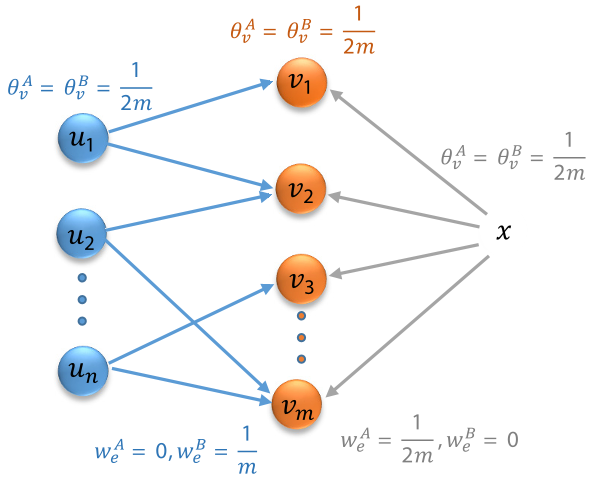 The figure illustrates the reduction used to prove NP-hardness, mapping Maximum Coverage to the MC problem.
3. The DI Algorithm
The algorithm identifies nodes that are hops away from these gateways to provide "pre-emptive strikes" with good information. By utilizing the CELF (Cost-Effective Lazy Forward) heuristic, they avoid recalculating the influence of every node in every step, making the algorithm lightning-fast even on the Amazon product network.
Experiments & Results: Quantitative Victory
The authors tested DI against benchmarks like Random, MaxDegree, and MaxGreedy on three massive datasets: Gnutella (P2P), Facebook (Social), and Amazon (Co-purchasing).
- Containment Power: In the Gnutella network, with just 50 seeds, the DI algorithm limited misinformation to 208 nodes, whereas it would have reached 851 nodes without intervention—a 75.5% reduction.
- Awareness Expansion: While MinGreedy (a baseline) was slightly better at pure blocking, it failed miserably at spreading "good news." The DI algorithm maintained a high level of misinformation blocking while achieving a 300% higher awareness rate than MinGreedy.
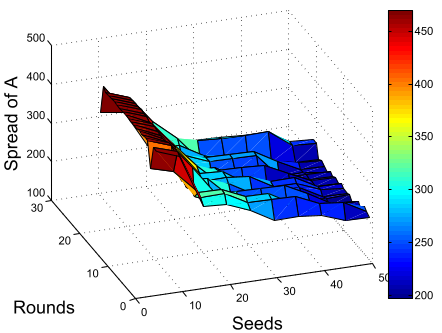 The experimental results show the trade-off and eventual dominance of the DI algorithm in balancing blocking (A-active) and spreading (B-active).
Critical Insight & Conclusion
The real value of this work lies in the Strategic Delay and Gateway Identification. Most rumors are only detected after a delay (). This paper proves that even if the lie has a head start, targeting gateway neighbors several hops away can "intercept" the cascade before it becomes a pandemic.
Takeaway: To secure a social network, don't just react to where the rumor is now; anticipate where it is going and ensure the truth gets there first.
Limitations: The model assumes edge weights and thresholds can be accurately estimated, which remains a significant challenge in real-world sociological data collection. Future work might benefit from combining these graph-theoretic approaches with Natural Language Processing (NLP) to judge the "persuasiveness" of the content itself.