
Linear Decentralized Droop: Simplifying Microgrid Economics without the Complexity
11881_Linear Decentralized Power Sharing Schemes for Economic Operation of AC Microgrids.
This paper proposes two linear cost-based droop control schemes, namely Maximum Cost-Based and Mean Cost-Based schemes, for the economic operation of AC microgrids. By tuning the droop gradients of Distributed Generators (DGs) according to their generation costs instead of power ratings, the schemes achieve autonomous Total Generation Cost (TGC) reduction without requiring real-time communication.
TL;DR
The traditional "equal-share" approach in microgrids is inefficient because it ignores that some generators cost more to run than others. This paper introduces a linear cost-based droop scheme that prioritizes cheaper energy sources by simply adjusting their droop slopes. Unlike previous non-linear attempts, this method is easy to implement, stable, and slashes total generation costs by up to 16.6%.
Problem & Motivation: The "Rating" Trap
In traditional power systems, generators shared the load based on their size (ratings). If Generator A was twice as big as Generator B, it took twice the load. In modern microgrids featuring a mix of diesel generators, fuel cells, and microturbines, this is economically flawed. A small fuel cell might be much cheaper to run than a large diesel engine at partial load.
Prior attempts to fix this used Non-linear Droop Control. While mathematically sound, these methods are a nightmare for control engineers:
- Instability: They use variable gains that can cause power oscillations.
- Information Heavy: They require the exact mathematical cost curve of every device on the grid.
- Complexity: They are difficult to tune and implement on standard industrial controllers.
Methodology: The Elegance of Linearity
The authors' core insight is that we don't need the full cost curve to achieve significant savings. By using just the Maximum Cost or Mean Cost of a DG, we can reshape the standard linear droop equation.
1. The Core Transformation
In a standard droop, everyone aims for the same frequency range (e.g., 51Hz to 49Hz). The proposed scheme gives each DG a custom "floor" ().
If a DG is cheap, its is set higher, making its droop line "flatter." Because all DGs must eventually settle at a single common grid frequency, the DG with the flatter line will naturally be pushed to a higher power output.
2. Architecture
The implementation remains entirely decentralized. Each inverter only needs to know its own cost parameters and the maximum cost found in the system (which can be pre-programmed or updated at very low bandwidth).
 Figure 1: The decentralized microgrid structure where DGs share a common AC bus.
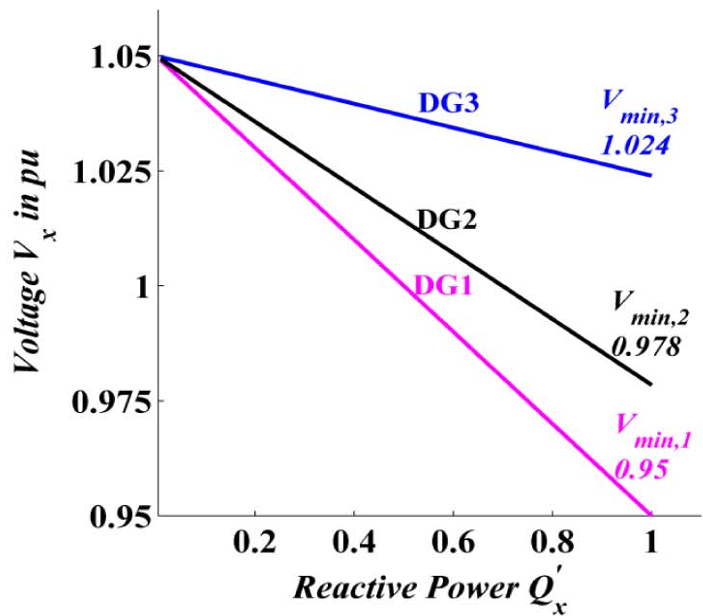 Figure 2: Maximum cost-based droop lines. Note the different gradients that prioritize cheaper DGs.
Experiments & Results: Real-World Gains
The researchers built a laboratory-scale microgrid with three 1kW inverters emulating diesel units, fuel cells, and turbines.
Key Findings:
- Cost Savings: The scheme achieved a 15.8% (Maximum Cost-based) and 16.6% (Mean Cost-based) reduction in total costs under mid-load conditions.
- Superiority over SOTA: These results beat previous non-linear methods which only managed 9%–13% savings.
- Renewable Integration: When a solar DG was added, the system successfully compensated for the intermittent sun while still keeping the dispatchable DGs in their most economic operating zones, yielding a steady 17% average saving.
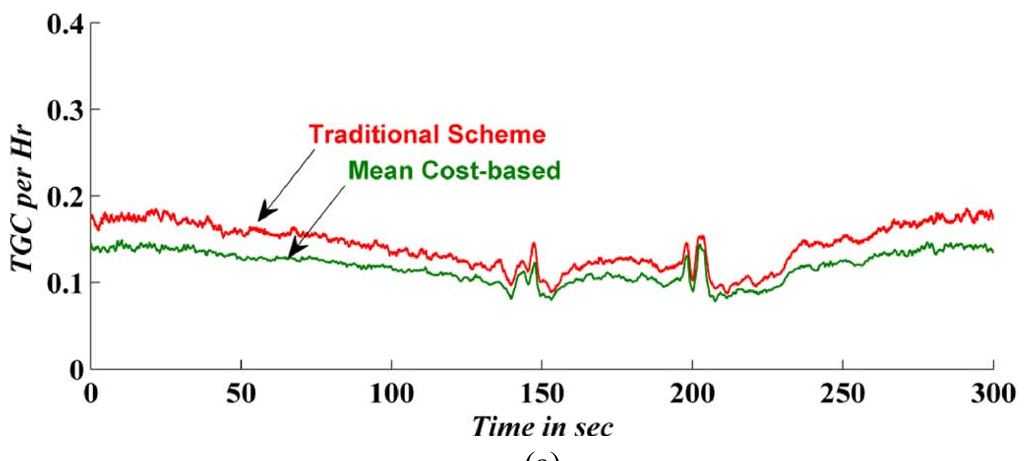 Figure 3: Power sharing comparison. The proposed scheme (right) clearly shows the cheaper DG3 (blue) taking the majority of the load compared to traditional sharing (left).
Critical Analysis & Conclusion
This paper is a masterclass in "Less is More." By moving away from complex non-linear polynomials back to linear slopes, the authors solved the stability issues of previous "economic" droops while actually improving cost performance.
Limitations:
- Parameter Sensitivity: The "Max Cost" of the system () must be known by all agents. If a new, much more expensive DG joins the grid, all other DGs need an update to their slope calculations.
- Binary Costing: It treats mean costs as constants. In reality, fuel prices fluctuate.
Final Takeaway:
Industrial microgrid designers should favor this linear approach. It offers a "plug-and-play" economic upgrade to existing droop-controlled inverters, requiring only a software update to the primary control layer rather than a total overhaul of the communication infrastructure.