
Beyond Single Layers: Decoding Innovation Diffusion in Multiplex Social Networks
On the linear threshold model for diffusion of innovations in multiplex social networks
This paper introduces an extension of the Linear Threshold Model (LTM) to multiplex networks, specifically focusing on duplex (two-layer) systems. It proposes two decision protocols, "OR" and "AND," and introduces a novel "Live-Edge Tree" framework to compute cascade centrality in these complex structures.
TL;DR
Information doesn't just spread on one "social network"; it moves across overlapping layers of professional, personal, and digital connections. This paper extends the classic Linear Threshold Model (LTM) to Duplex Networks, introducing "AND" and "OR" protocols to model how we reconcile signals from different sources. By inventing the Live-Edge Tree, the authors provide a rigorous way to calculate "Cascade Centrality"—the influential reach of a single node—across multiple layers.
Problem & Motivation: The Monoplex Fallacy
In classical network theory, we often collapse all interactions into a single graph (a monoplex). But humans are more nuanced. You might adopt a new technology because your friends use it (Layer 1) or because your colleagues recommend it (Layer 2).
The core challenge is: How does an agent decide when signals from different layers conflict? Existing LTM frameworks were not equipped to handle the logic of "I need both groups to adopt it" (Conservative) versus "I'll adopt it if either group does" (Sensitive).
Methodology: Protocols and the Live-Edge Tree
The authors propose two fundamental protocols for a duplex (two-layer) network:
- Protocol OR (Sensitive): An agent activates if the threshold is met in either layer.
- Protocol AND (Conservative): An agent activates only if thresholds are met in both layers simultaneously.
To solve the steady-state probability of activation without running thousands of time-step simulations, they generalized the Live-Edge Model (LEM).
The Live-Edge Tree
The "Live-Edge Tree" is the paper's most significant technical contribution. For any node, you can trace its potential influence path backwards through both layers, forming a branching tree.
- Reachability OR: If the tree has at least one finite branch ending in a "seed" (an early adopter).
- Reachability AND: If all branches of the tree are finite and end in seeds.
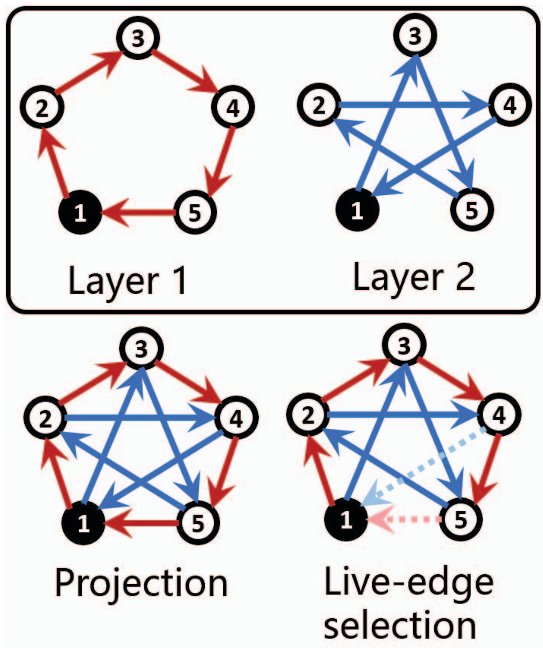 Fig 1: A duplex network showing different connection patterns in Layer 1 and Layer 2.
 Fig 2: The Live-Edge Tree for node 5. Note how branches represent different layers.
Experiments: The Cost of Conservatism
By proving the equivalence of the LTM and their new LEM, the authors developed Algorithm 1 to compute Cascade Centrality. Their results reveal a strict ordering of social influence:
In their experimental example (Figure 3), they compared a duplex network against its individual layers and its "projection" (all layers merged together).
| Network Type | Cascade Centrality of Node 1 |
|---|---|
| Duplex (OR) | 4.75 |
| Projection (Merged) | 3.11 |
| Layer 1 Solo | 3.00 |
| Layer 2 Solo | 2.00 |
| Duplex (AND) | 1.00 |
The "OR" protocol shows a "synergistic" effect where the reach is greater than the sum of its parts, whereas the "AND" protocol effectively kills the cascade if the seed isn't perfectly positioned in both layers.
 Fig 3: The undirected duplex network used for benchmarking.
Critical Insight & Conclusion
The takeaway for researchers is clear: Network topology is not enough. To predict how an idea spreads, we must understand the "inter-layer logic" of the agents.
Limitations: The computational complexity of the Live-Edge Tree grows exponentially (). While mathematically elegant, applying this to millions of nodes in a real-world social network would require significant heuristic approximations.
Future Work: The authors suggest a "Multiplex Threshold" () that could interpolate between OR and AND logic, potentially allowing for a "K-out-of-M layers" activation rule, which would be a powerful tool for marketing and political strategy modeling.