
Beyond Static Graphs: Why Timing is Everything in Social Influence
Linear threshold model in temporal networks — Seed selection for social influence
This paper investigates the Linear Threshold Model in temporal social networks, proposing a dynamic seed selection strategy that account for the evolution of network topology over time. The study demonstrates that leveraging temporal granularity for seeding consistently outperforms traditional static network approaches across multiple real-world datasets.
TL;DR
In the world of social networks, a "friendship" is rarely permanent. This paper argues that traditional influence models, which treat social networks as frozen in time, are fundamentally flawed. By introducing Temporal Social Networks (TSN) and a forgetting mechanism, the author proves that we can trigger much larger "information cascades" by selecting seeds based on recent activity rather than lifetime aggregates.
The "Static Trap" in Influence Maximization
For over a decade, researchers have treated influence maximization as an NP-hard problem solved on a static graph. The assumption? If you emailed someone two years ago, you are still "connected."
In reality, social structures are fluid. Nodes (users) and edges (interactions) are transient. Using a static graph to pick influencers is like using a 10-year-old phone book to find a current TikTok trend-setter. The author identifies that current SOTA methods often overestimate the importance of "historically" central nodes while ignoring "currently" rising stars.
Methodology: High-Resolution Temporal Seeding
The core innovation lies in how the social network is constructed and how node importance is weighted.
1. Temporal Windowing
Instead of one big graph, the author splits time into windows . This allows the model to see the network's evolution.
2. Forgetting Mechanisms
To avoid the "static trap," the author implements a weighting system where the influence of past events decays. For example, Linear Forgetting (LF) is calculated as:
(Where is the time index, ensuring recent windows have higher multipliers than older ones.)
 Figure: The structural representation of how events aggregate into temporal windows.
Experiments: More Windows, Better Influence
The researchers tested their hypothesis using real-world human communication data (from the KONECT platform).
- Key Archetype: The Out-degree measure (how many people a user contacts) combined with Exponential Forgetting was the "Golden Strategy." It consistently picked seeds that triggered the largest cascades.
- Granularity Matters: The more time windows used (higher granularity), the more effective the seeding became. This suggests that the "timing" of contacts is just as important as the "volume" of contacts.
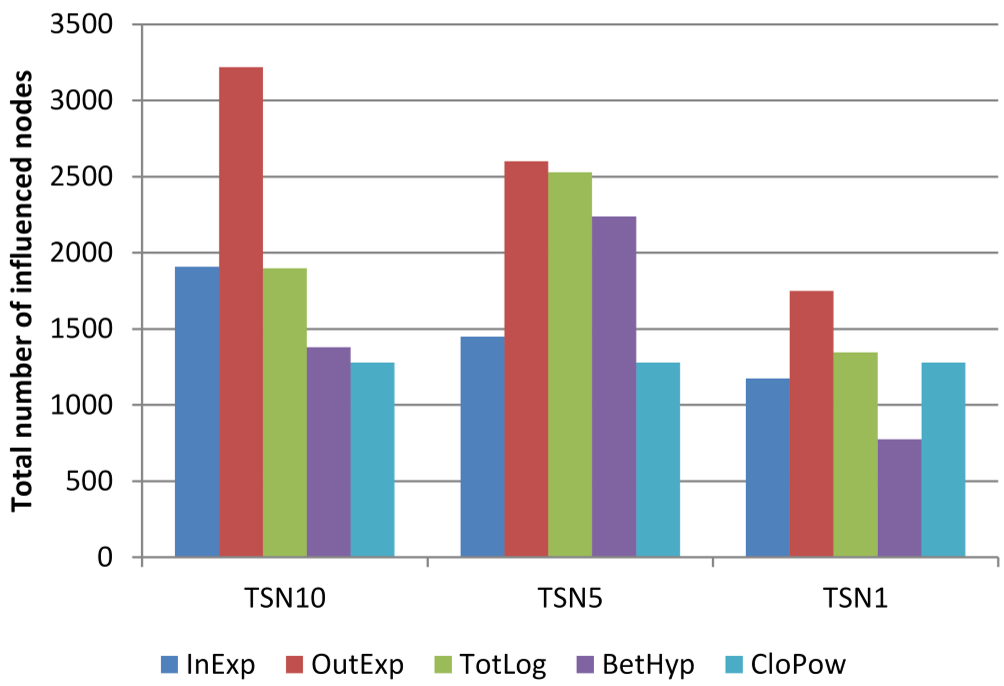 Figure: Results for the Digg dataset show that temporal strategies (colored bars) significantly outperform static baselines at high threshold levels ().
Critical Insight & Future Outlook
This work shifts the focus from who you know to when you last talked to them.
Takeaway for Practitioners: If you are running a marketing campaign or a public health awareness drive, don't look at a user's total follower count. Look at their interaction velocity over the last few weeks.
Limitations: The computational cost increases with granularity. Processing individual event logs () is storage-intensive, though the author's windowing approach offers a pragmatic middle ground. Future research could explore "Adaptive Windowing," where the time frames change based on the network's volatility.
Conclusion
The Linear Threshold Model in Temporal Networks proves that static snapshots are no longer sufficient for understanding modern social dynamics. By respecting the "arrow of time" and the decay of social ties, we can achieve far more efficient information diffusion with fewer resources.