
LineChange: Dynamically Rewiring the Crowd for Complex Problem-Solving
LineChange: An Analytic Framework for Automated Moderation of Crowdsourcing Systems
LineChange is an analytic framework designed for automated moderation and facilitation of complex crowdsourced problem-solving. It utilizes a "Wiring Protocol" to dynamically reconfigure participant networks, evolving them from isolated ideators to collaborative teams to achieve collective consensus.
TL;DR
Crowdsourcing has long been stuck in the "micro-task" era (think data labeling). LineChange is a new analytic framework that moves the needle toward complex deliberation. By treating the team structure itself as a dynamic variable—reconfiguring who talks to whom through an automated "Wiring Protocol"—it facilitates the transition from raw brainstorming to structured debate and final consensus without the need for expensive human moderators.
Background: Why Simple Crowdsourcing Fails at Complex Tasks
Current collective intelligence platforms like the Good Judgment Project work because tasks are independent and parallelizable. However, when we face "wicked problems"—those involving incendiary arguments or complex organizational changes—the lack of facilitation leads to chaos or cognitive paralysis. Expert facilitators help navigate these waters, but they are a rare resource. LineChange proposes an intelligent machine substitute that monitors participant behavior as sensory data and intervenes at "transitional moments."
Methodology: The "Wiring Protocol" and Composable Teams
The core innovation of LineChange is the Wiring Protocol. Instead of a static group chat or a rigid forum, it models the crowd as a bipartite graph where participants are linked to "Team" objects.
The Phase-Based Evolution
LineChange manages the evolution of a problem-solving cycle—brainstorming, debate, and consensus—by changing the network topology:
- Brainstorming (Isolates/Cliques): To maximize diversity of thought and prevent early bias, participants work in isolation or small, closed groups.
- Debate (Local Knowledge): Small teams are formed. Participants see their teammates' positions but remain blind to other teams to prevent premature convergence.
- Consensus (Global Knowledge): The system "rewires" the network into a complete graph, exposing the summarized results of all debate cycles to every participant for a final vote.
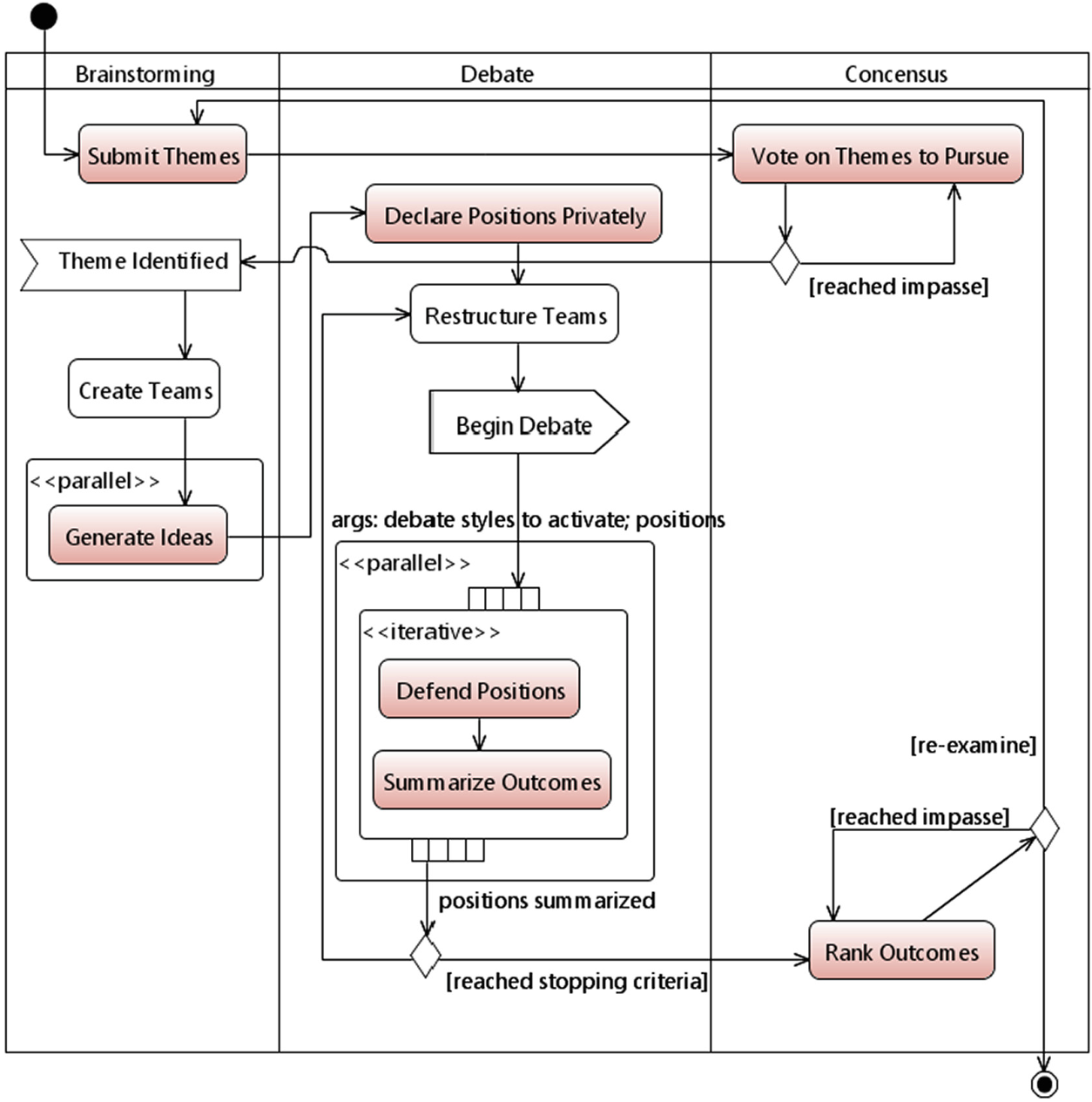 Figure 1: The cyclic process model showing how LineChange moves from individual ideation to global consensus.
Engineering Insight: Teams as Sensors
One of the most profound shifts in LineChange is treating participant interactions (clicks, posts, ratings) as sensory input.
- Scale-Free Design: Because it relies on configuration and inference (dynamic bipartite graphs) rather than hard-coded rules, the system can handle ten participants or ten thousand with the same logic.
- Cognitive Load Management: By controlling the "mixing rate" of teams during the debate phase, LineChange ensures that participants aren't overwhelmed by too many conflicting viewpoints at once, instead "drip-feeding" new perspectives as the teams merge.
Case Study: The Reorganization Challenge
The authors illustrate the framework through a "closed-category card sorting" task—reorganizing a company after a merger.
- Brainstorming: Personnel are sorted into categories by individuals.
- Debate: LineChange merges these individual sorts into team discussions, using "rewiring" to connect teams that have diverse views, forcing them to resolve conflicts locally before moving to the final stage.
- Consensus: A Borda count voting method is used to finalize the "roster," ensuring the most broadly acceptable solution wins.
 Figure 2: Overview of the automated facilitation mechanism monitoring behavior to trigger structural changes.
Critical Analysis & Conclusion
Takeaway
LineChange introduces the concept of active moderation as a background service. By automating the "Lineup" (much like a hockey coach swapping players), the system optimizes the collective output by matching the network structure to the current cognitive requirements of the task.
Limitations & Future Work
While the conceptual framework is rigorous, its real-world effectiveness against "incendiary arguments" remains to be fully tested in a live environment. The specific "inference" rules—how the machine decides exactly when to merge teams based on sentiment or dissent levels—require further empirical tuning.
In the future, we can expect LineChange-like protocols to be integrated into decentralized autonomous organizations (DAOs) and large-scale corporate decision-support systems, creating a more "enlightened" form of digital democracy.