
Decoding the Anatomy of Disinformation: A Linguistic Profile of Philippine Fake News
Computing the Linguistic-Based Cues of Fake News in the Philippines Towards its Detection
This paper presents a linguistic-based approach to detecting fake news in the Philippines by constructing the "Philippine Fake News Corpus." Using features extracted via LIWC and various readability formulas, the authors demonstrate that Logistic Regression and SVM can achieve a precision of 94% in distinguishing legitimate news from disinformation.
TL;DR
Researchers have successfully automated the detection of fake news in the Philippines with 94% precision. By analyzing the "writing style" rather than just the facts, the study reveals that fake news is often characterized by longer headlines, lower readability scores, and a heavy focus on the "present" tense compared to the "past-focused" reporting of legitimate journalism.
Background: The High Stakes of Philippine Media
The Philippines has often been called the "patient zero" of digital disinformation. From the 2016 elections to the present, fake news has been weaponized to manipulate public opinion. While humans are notoriously bad at spotting lies—hitting only 54% accuracy—machines can identify the subtle, sub-conscious "linguistic cues" that fake news authors leave behind.
The "Tell": How Fake News Betrays Itself
The core insight of this paper is that deception is visible in metadata, not just semantics. The authors constructed a corpus of over 22,000 news articles and extracted 145 different features. Their findings reveal a distinct "fingerprint" for Philipine fake news:
- The Length Paradox: Fake news headlines are significantly longer (11 words vs. 7 words for real news), but their article bodies are much shorter.
- The Complexity Gap: Legitimate news requires a higher level of education to digest. Metrics like the Flesch-Kincaid Grade show that real news is consistently more lexically dense.
- Temporal Focus: Professional journalists report on events that happened (Past focus). Fake news peddlers focus on the now (Present focus), often to spark immediate emotional reactions.
Methodology: Feature Engineering & Model Selection
The researchers didn't just dump text into a model; they performed meticulous Feature Engineering across eight categories:
- Readability Scores (e.g., SMOG, Gunning Fog)
- Linguistic Dimensions (Word counts, Syllables)
- Summative/Affective Cues (Clout, Authenticity, Anger)
- Cognitive/Informality Cues (Certainty vs. Tentative language)
Model Architecture and Comparison
The study compared Gaussian Naïve Bayes (GNB), Logistic Regression (LR), and Support Vector Machines (SVM). To prevent overfitting, they used Recursive Feature Elimination (RFE) combined with Grid Search (GS).
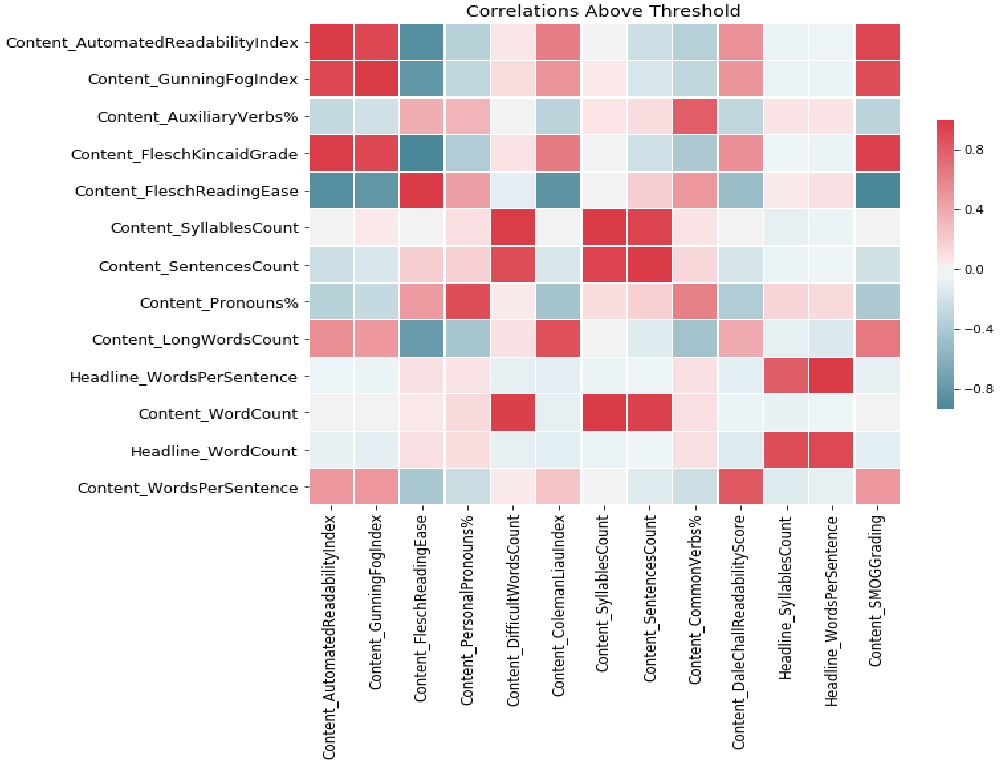 Figure 1: The top features—dominated by Syllable and Word counts—showing that "Linguistic Dimensions" are the strongest predictors.
Key Results: Precision in Action
The results were remarkably consistent. The "Both Headline + Content" feature set achieved a 94% precision. Even when tested on a completely new dataset from January 2019 (unseen during training), the model maintained 93% precision.
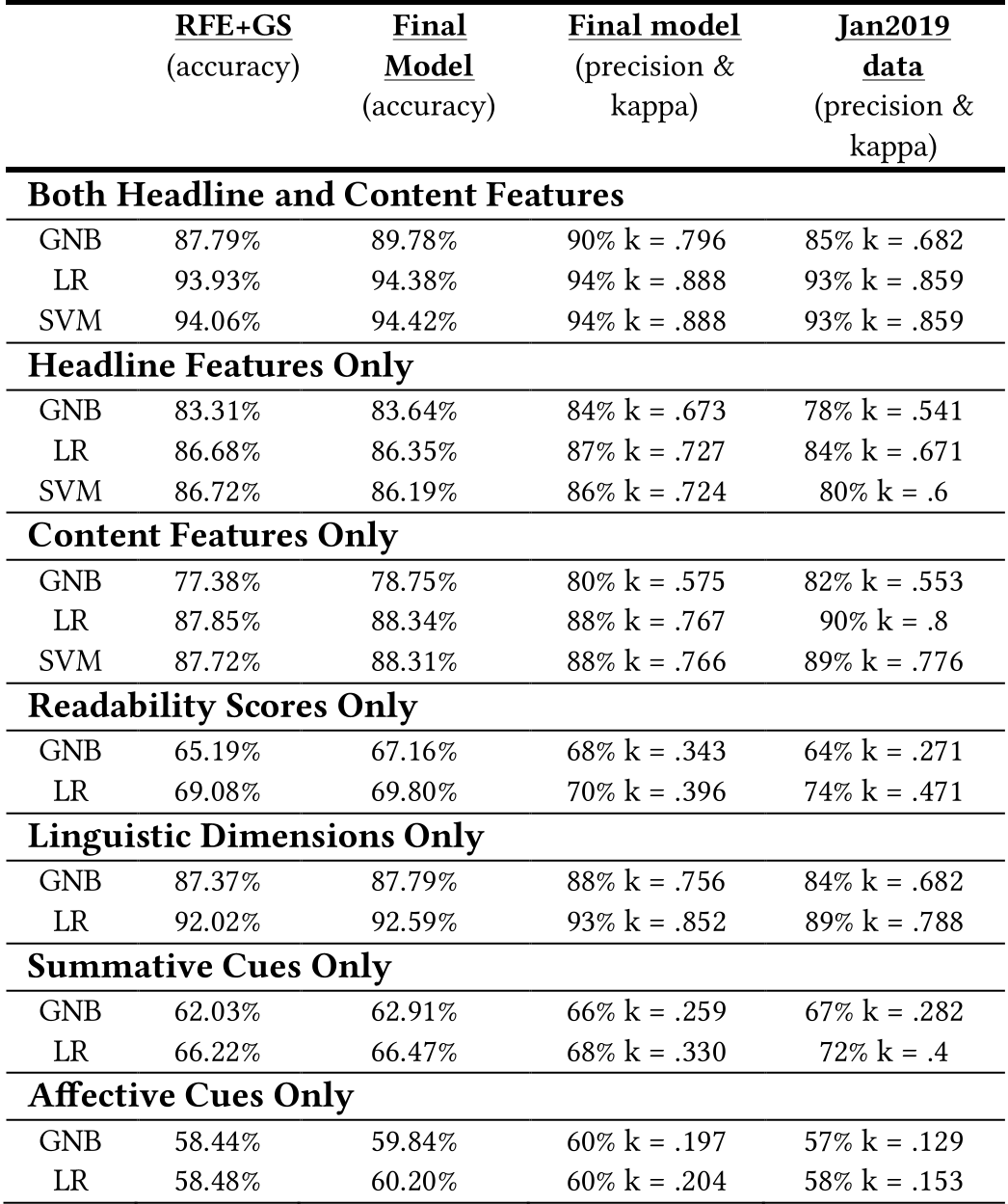 Table 1: Comparison of algorithms across different feature subsets. LR and SVM consistently outperform Naïve Bayes.
Interestingly, the study found that we can detect fake news with 87% precision using ONLY the headline. This suggests that the sensationalist "clickbait" style of fake news is its own statistical giveaway.
Critical Insight: Why Does This Work?
The success of Logistic Regression over Naïve Bayes suggests that the linguistic features of fake news are highly correlated. For instance, a decrease in "Analytical Thinking" cues often coincides with an increase in "Present Focus" and "Anger" words. Discriminative models like LR are better at capturing these collective weights than generative models that assume feature independence.
Conclusion and Limitations
This research proves that localized, linguistic-based detection is a powerful weapon against disinformation. However, it has its limits:
- English Only: The study focuses on English-language news, leaving out Tagalog and other native languages due to a lack of NLP tools like POS taggers.
- Evolving Tactics: As "troll farms" become aware of these linguistic markers, they may adapt their writing style to mimic professional journalists.
The Takeaway: For platforms and educators in the Philippines, this research provides a math-backed blueprint for "red-flagging" suspicious content before it goes viral.