
Digital Twins in Chat: Deciphering the Linguistic DNA of Personalized Agents
Linguistic Features to Consider When Applying Persona of the Real Person to the Text-based Agent
This study proposes a framework for applying the Persona of a Real Person (PRP) to text-based AI agents by identifying specific linguistic features that drive user recognition. Using a modified Wizard-of-Oz experiment and a validation survey, the researchers ranked 16 key linguistic attributes, finding that Content-related features like "Wake-up words" and "Emoji usage" are the most critical determinants of persona perception.
TL;DR
Can an AI agent truly feel like your mother, your spouse, or your best friend just through text? This paper identifies the Persona of a Real Person (PRP) framework—a set of 16 linguistic features that allow text-based agents to move beyond generic "human-likeness" toward mimicking specific individuals. By prioritizing unique "Wake-up words," emojis, and response latency, researchers have created a blueprint for highly personalized digital personas.
The Missing Piece: From "Human-Like" to "Person-Specific"
In the world of Human-Computer Interaction (HCI), we have spent decades trying to make bots feel "human." But in the age of instant messaging, we don't just talk to humans; we talk to specific people with unique quirks. The problem is that current agents lack the "linguistic DNA" that distinguishes one friend from another. Why does a bot feel "off" even when its grammar is perfect? Because it lacks the specific Content and Use patterns that define our real-world social circles.
Methodology: The User-Driven Wizard-of-Oz
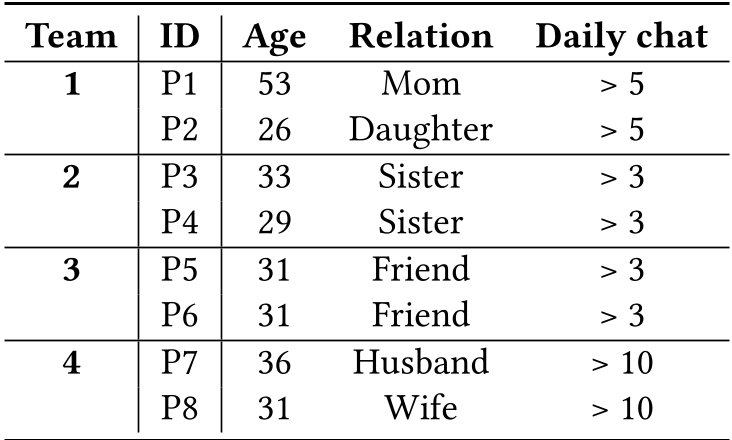
The researchers conducted a unique study involving real-world pairs (mothers, daughters, spouses) to see what triggered a sense of "recognition." They used a modified Wizard-of-Oz setup where participants were led to believe they were chatting with a system mimicking their partner.
The researchers categorized these triggers based on Bloom’s language model:
- Content (Semantics): The specific words choosing (e.g., Slang, Emojis).
- Form (Morphology/Syntax): How sentences are built (e.g., Punctuation, Sentence structure).
- Use (Pragmatics): The context and timing (e.g., Response time, Delivery).
Key Results: What Makes a Persona Stick?
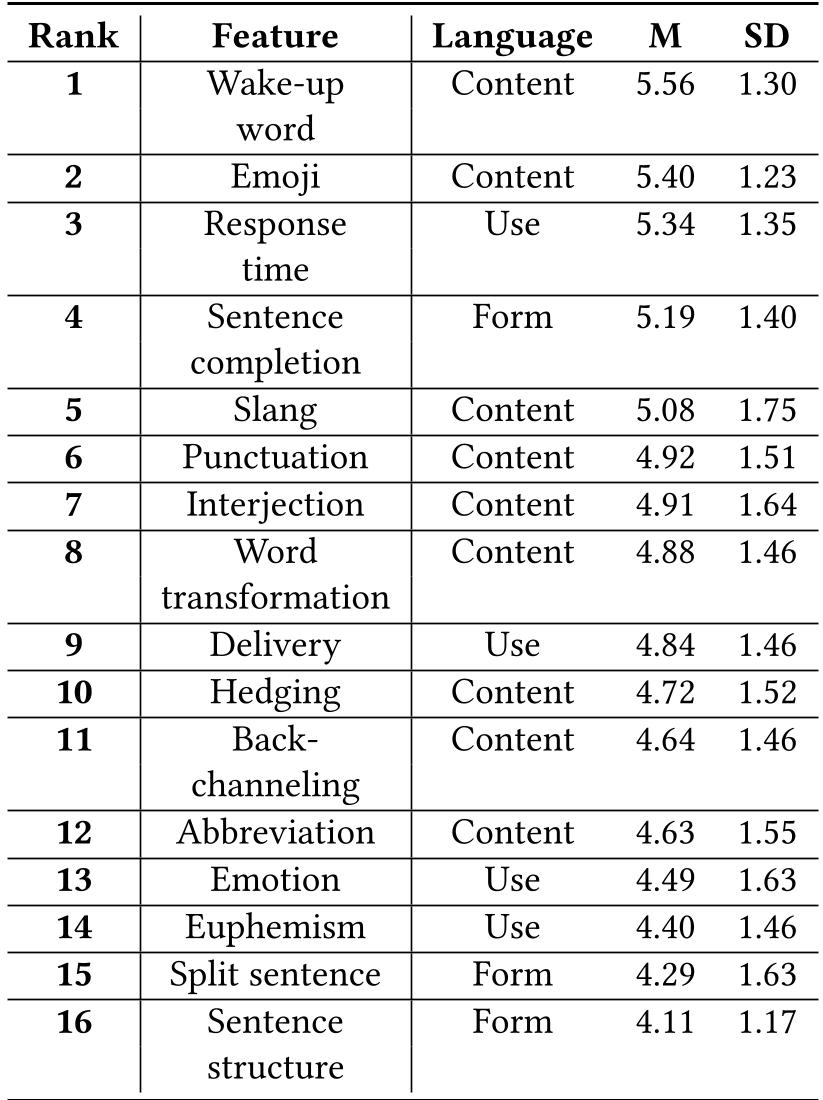
The study ranked 16 features that define a person's text-based identity. Surprisingly, "grammatically correct" features like sentence structure were the least important for recognizing a specific person.
| Rank | Feature | Category | Importance (1-7) |
|---|---|---|---|
| 1 | Wake-up words | Content | 5.56 |
| 2 | Emoji | Content | 5.40 |
| 3 | Response time | Use | 5.34 |
| 4 | Sentence completion | Form | 5.19 |
The "Content" Mastery
The analysis showed a significant statistical preference for Content over Form. This suggests that to mimic a real person, an AI doesn't need to mirror their syntax perfectly; it needs to use their "catchphrases" and their specific palette of emojis.
Deep Insight: Beyond Words
One of the most profound takeaways is the role of Response Time (Use). In real life, the speed at which someone replies is a massive part of their persona (the eager replier vs. the slow, thoughtful texter). Designers of PRP systems must move beyond LLM generation and incorporate "timing models" to truly capture a human's essence.
Critical Analysis & Future Outlook
While this study provides a vital taxonomy, it also opens the door to the Uncanny Valley of text. If a bot uses your spouse's "Wake-up words" but fails at emotional nuances, does the experience become "eerie"?
Future Directions:
- Cultural Adaptation: The study was conducted in Korean; applying these 16 features to English or other languages may reveal different priorities (e.g., the weight of sarcasims or capitalization).
- Ethical Mimicry: As we move closer to "Digital Legacies" (mimicking deceased loved ones), the weight of these 16 features becomes not just a design choice, but an emotional responsibility.
Conclusion: To build the next generation of social agents, we must stop designing for "Humanity" and start designing for "Identity."