
Beyond N-grams: Leveraging Graph Topology to Uncover Silent Drug Side Effects
Exploring Linguistic and Graph Based Features for the Automatic Classification and Extraction of Adverse Drug Effects
The paper introduces a hybrid framework for the automatic classification and extraction of Adverse Drug Effects (ADEs) from unstructured text. By combining traditional linguistic features with Word Distance (WD) and Drug Adverse Effect (DAE) graph topological features, the authors achieve SOTA accuracy (up to 94% on MEDLINE) in identifying drug-side effect relationships.
TL;DR
Adverse Drug Effects (ADEs) are a leading cause of mortality, yet they are notoriously underreported. This paper introduces a breakthrough framework that transforms unstructured text—ranging from formal MEDLINE abstracts to noisy tweets—into a bipartite graph network. By prioritizing graph topological features over traditional linguistic parsing, the authors achieved a 94% accuracy on medical text and an 88% accuracy on Twitter data, significantly outperforming deep learning baselines like CNNs.
Background: The Pharmacovigilance Gap
Pharmacovigilance depends on the early detection of side effects. However, traditional reporting is slow. Social media offers a real-time stream of patient experiences, but it is a "noisy needle in a haystack." Previous models failed because:
- Structural Complexity: They couldn't model the long-distance relationship between a drug mentioned at the start of a tweet and a symptom at the end.
- Noise Sensitivity: Standard dependency parsers break down when faced with the slang and poor grammar of Twitter.
Methodology: The Architecture of Discovery
The researchers moved beyond simple keyword matching. Their framework relies on two distinct graph structures to extract meaning where traditional NLP fails.
1. Word Distance (WD) Graphs & TextRank
Instead of viewing a sentence as a sequence, they viewed it as a network. Words are nodes, and edges are weighted by physical proximity and Pointwise Mutual Information (PMI). By applying the TextRank algorithm (derived from Google’s PageRank), the model identifies which "nodes" (words) are central to the sentence’s context, effectively filtering out noise.
2. Drug-Adverse Effect (DAE) Bipartite Network
The core innovation is representing the ADE knowledge base as a bipartite graph. This allows the system to identify "Implicit ADEs"—side effects that might not be explicitly linked in a single sentence but are statistically probable based on the "neighborhood" of the drug and symptom in the global network.
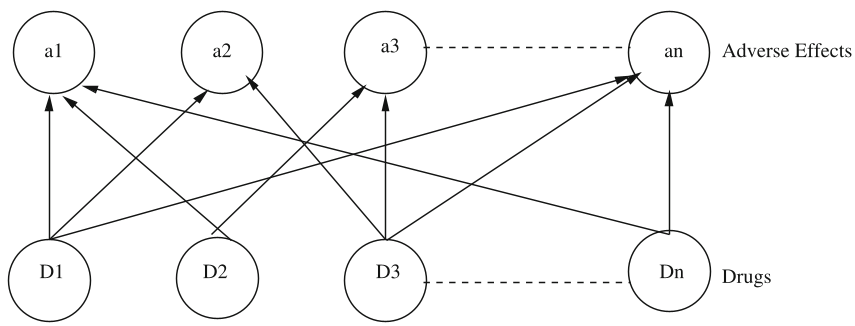 Figure 1: Bipartite graph showing the nodes of drugs (D) and their adverse effects (E).
Experimental Results: High Stakes Performance
The authors tested their approach against two datasets: the Pacific Symposium on Biocomputing (PSB) Twitter dataset and the MEDLINE ADE corpus.
- The MEDLINE Results: By combining graph features with sentiment and dependency analysis, they reached an Accuracy of 94% and a Recall of 98%.
- The Twitter Challenge: In the noise of social media, linguistic features failed. However, the Graph-only features achieved an F1-score of 0.78, crushing the CNN baseline (F1: 0.51) and the TF-IDF approach (F1: 0.45).
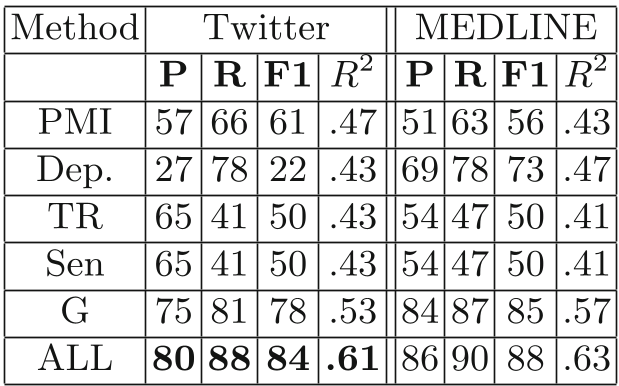 Table 1: The synergy of Graph (G) features consistently leads to higher F1 and R2 scores across both datasets.
Deep Insights: Clustering and Knowledge Discovery
The paper doesn't just classify; it categorizes. Using K-Means clustering on the extracted ADEs, the authors grouped drugs by their side-effect profiles. For instance, Losartan and Enalapril were clustered based on shared effects like "dizziness" and "tired feeling."
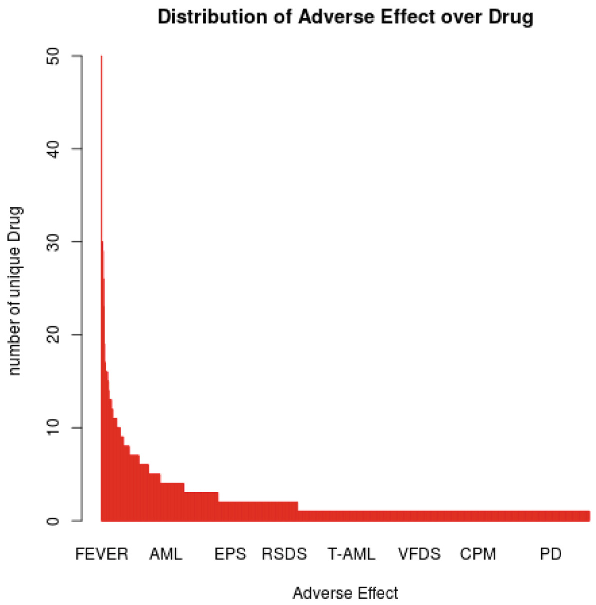 Figure 2: Statistical distribution of drugs and their relative density of adverse effects.
Conclusion & Future Directions
The primary takeaway is clear: Network topology is a more robust indicator of semantic intent than grammatical structure in informal settings. While dependency parsers struggle with tweets, a graph can still find the "signal" through the proximity and relevance of terms.
Limitations: The system still struggles with non-English drug descriptions and highly fragmented sentences. Future work should look into integrating Multi-relational Knowledge Graphs to further refine the discovery of "hidden" drug-drug interactions that are currently invisible to single-sentence extraction methods.