
LHFLC: Revolutionizing Fuzzy Control with Linguistic Hedges and Current-Mode Circuits
16104_Circuit implementation of linguistic-hedge fuzzy logic controller in current-mode approach.
This paper presents a novel Linguistic-Hedge Fuzzy Logic Controller (LHFLC) implemented using a mixed-signal current-mode CMOS approach. By integrating linguistic-hedge modules, the system achieves SOTA control performance using only three membership functions per variable and a minimal set of nine inference rules.
TL;DR
This research introduces the Linguistic-Hedge Fuzzy Logic Controller (LHFLC), a mixed-signal chip that uses "linguistic hedges" (modifiers like very or more or less) to dramatically reduce the complexity of fuzzy control. By using just 9 rules instead of 49+, it achieves superior performance in non-linear tasks while maintaining a tiny hardware footprint.
Problem & Motivation
Fuzzy Logic is the backbone of "human-like" machine decision-making. However, the Rule Explosion problem is its Achilles' heel. To control a complex system precisely, engineers traditionally increase the number of membership functions (MFs). Because rules grow exponentially (), hardware implementations quickly become bloated, slow, and power-hungry.
The authors' insight was to stop adding rules and start "stretching" the ones they already had. By applying Zadeh's theory of Linguistic Hedges, the controller can modify the shape of its membership functions on the fly, effectively providing the granularity of a 49-rule system with the hardware of a 9-rule system.
Methodology: The Core Mechanism
The LHFLC architecture is divided into a current-mode signal processor and a digital programming unit.
1. Dynamic Shape Modification
Instead of static triangles, the system uses concentration () and dilation () operators. These are implemented as Linguistic Hedge Modules inserted after the fuzzification stage.
2. Current-Mode Circuitry
Why current-mode? In the analog domain, addition is literally just joining two wires (KCL). The authors use "Translinear" principles to execute complex power functions () using simple MOS transistors in saturation.
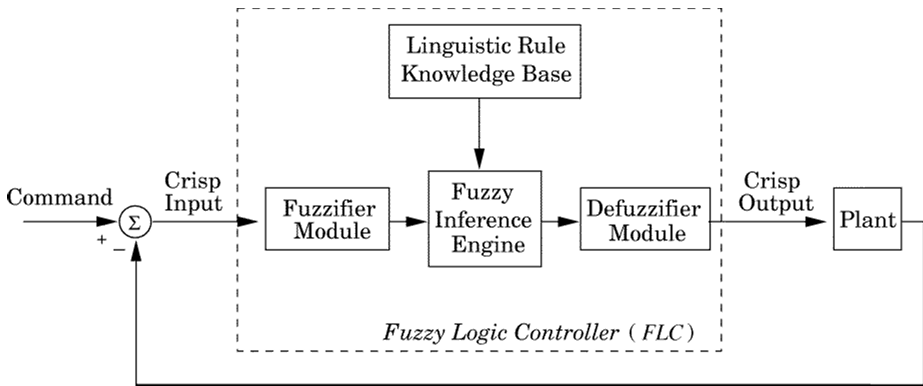 Figure 1: The architecture features a dedicated Linguistic-Hedge module between the fuzzifier and the inference engine.
3. Programmability
While the math is analog, the strategy is digital. A SIPO (Serial-In Parallel-Out) shift register stores the optimal hedge combinations and rule table, allowing the chip to be repurposed for different plants (e.g., a cart-pole vs. a truck).
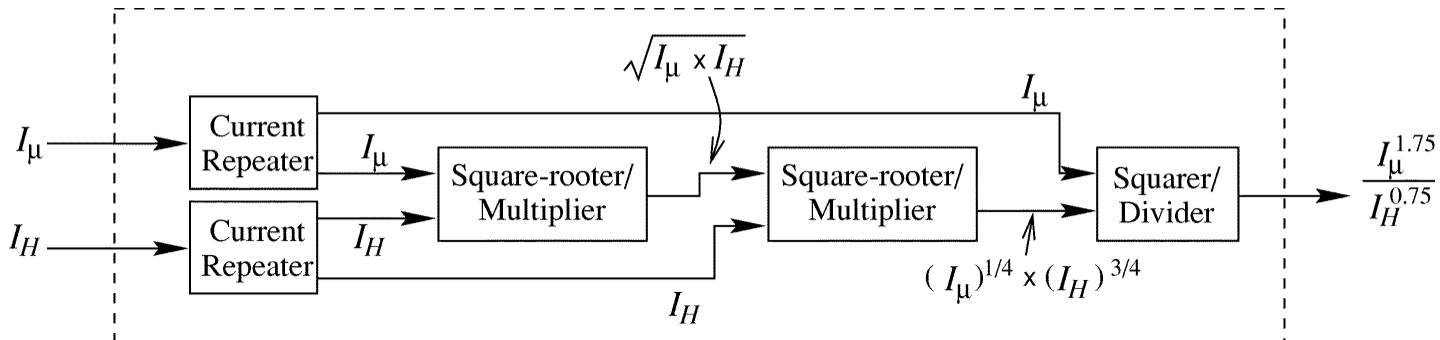 Figure 2: Implementation of Concentration ("Absolutely") and Dilation ("Minus") hedges using Current-Mode Squarer/Divider and Square-rooter/Multiplier circuits.
Experiments & Results
The chip was put to the test against three classic non-linear challenges:
- Non-linear Plant Tracking: The LHFLC achieved a 0.3s settling time, crushing the conventional 7x7 rule FLC (1.1s) and the 3x3 rule FLC (2.7s).
- Truck Backer-Upper: It managed near-perfect docking (Error: 0.0029) with fewer iterations than high-rule baselines.
- Cart-Pole Balance: The hardware, running at 0.5M FLIPS, showed remarkably stable control in a physical environment using only its 9-rule logic.
 Figure 3: Performance comparison showing LHFLC outperforming conventional FLCs across all metrics with fewer membership functions.
Critical Analysis & Conclusion
Takeaway
The LHFLC proves that mathematical elegance can simplify hardware. By leveraging the "semantic" power of linguistic hedges, the researchers shifted the burden from rule-storage (which is costly) to mathematical modification (which is efficient in current-mode analog).
Limitations
- Search Complexity: While the chip is efficient, finding the optimal hedge combination still requires an off-chip Genetic Algorithm (MSGA), which might be slow for real-time adaptation in rapidly changing environments.
- Analog Sensitivity: While precautions like guard rings and cascoded structures were used, analog current-mode circuits are inherently more sensitive to process variations and noise compared to purely digital counterparts.
Future Outlook
This work paves the way for "edge-AI" fuzzy controllers. Integrating on-chip A/D and D/A converters could result in a single-chip solution for autonomous micro-robotics where power and space are the primary constraints.