
Is Linguistic Information the Key to Legal Text Classification?
4300_Is linguistic information relevant for the text legal classification problem
This paper investigates the impact of linguistic preprocessing on the classification of European Portuguese legal texts using Support Vector Machines (SVM). By evaluating lemmatization, Part-of-Speech (POS) tagging, and feature selection, the authors achieve a significantly optimized classifier for the Portuguese Attorney General’s Office Decisions (PAGOD) dataset.
TL;DR
Automating the classification of legal documents is notoriously difficult due to complex terminology and unstructured formats. This study demonstrates that by moving beyond simple "Bag-of-Words" and utilizing linguistic information—specifically Nouns and Proper Nouns—we can reduce feature complexity by over 98% while significantly boosting classification accuracy (F1-score jump from 0.68 to 0.82).
Background: The Legal Data Challenge
Legal documents, such as the Portuguese Attorney General’s Office Decisions (PAGOD), represent a goldmine of information but are difficult to navigate. In this study, 8,151 documents were analyzed, covering a taxonomy of nearly 7,000 legal concepts. The sheer volume of unique words (over 68,000) creates a "curse of dimensionality" for machine learning models. The authors ask: Can we ignore certain words based on their linguistic function to make models faster and smarter?
Problem & Motivation
Standard Information Retrieval (IR) methods often treat all words as equal tokens. However, in the legal domain, a "verb" might carry less conceptual weight for classification than a "noun" representing a specific legal entity or doctrine. Previous SOTA methods for Portuguese often ignored these linguistic nuances. The authors hypothesized that lemmatization (reducing words to their dictionary form) and Part-of-Speech (POS) tagging could act as a superior filter for selecting features that actually matter.
Methodology: Refining the Input
The researchers employed a multi-stage pipeline:
- Parsing: Used the PALAVRAS parser to assign POS tags (Noun, Verb, Adjective, etc.) to every word in the document.
- Linguistic Filtering: Created subsets of the data based on tags. For instance, testing a model using only nouns vs. only verbs.
- SVM Classification: Used Support Vector Machines with Sequential Minimal Optimization (SMO). SVMs are particularly adept at handling high-dimensional text data because they seek the "maximum margin" between categories.
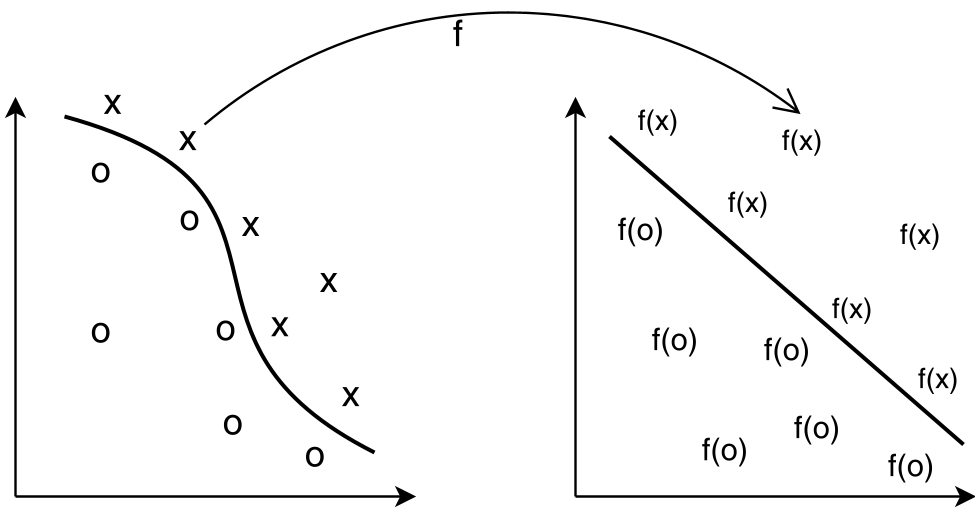 Figure 1: The Kernel function transforms non-linear data patterns into a linear feature space for easier classification.
Key Innovation: POS-Based Selection
Instead of using statistical filters like "Gain Ratio" alone, the authors found that filtering by Nouns (N) and Proper Nouns (PRP) provided the best signal-to-noise ratio. This essentially acts as a domain-specific dimensionality reduction technique.
Experiments & Results
The experiments compared 288 different combinations of preprocessing.
- Feature Reduction: Lemmatization (rdt3) showed a significant reduction in unique features (from ~68k down to ~42k) without losing predictive power.
- The "Winning" Combo: The best performance was achieved using Nouns + Proper Nouns, filtered by Term Frequency, and using a threshold to remove rare words (appearing < 400 times).
| Experiment | Micro-Precision | Micro-Recall | Micro-F1 |
|---|---|---|---|
| Baseline (All words) | 0.810 | 0.709 | 0.756 |
| Nouns + Proper Nouns | 0.879 | 0.770 | 0.821 |
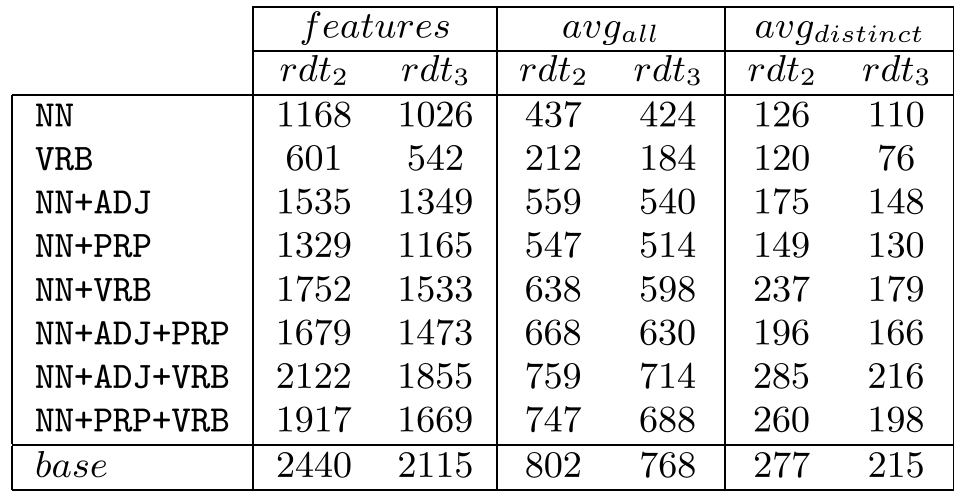 Table: Comparison of feature counts across different POS tagging strategies.
The results show that while some categories like "Army Injured" (c2) are easy to classify (F1 > 0.97), abstract concepts like "Public Officer" (c7) remain challenging, likely due to their higher level of conceptual abstraction.
Critical Analysis & Conclusion
Takeaway: Linguistic preprocessing is not just a "nice-to-have"; it is a powerful tool for computational efficiency. By focusing on Nouns and Proper Nouns, the researchers stripped away the "fluff" of the language, allowing the SVM to focus on the core legal entities and concepts.
Limitations:
- Abstraction Gap: The model still struggles with high-level abstract concepts.
- Static Representation: The "Bag-of-Words" approach still ignores word order, which could be vital in complex legal clauses.
Future Work: The authors suggest moving towards String Kernels or more complex semantic representations to capture the sequence and context of legal phrasing, a precursor to the transformer-based logic used in today's AI.