
Linguistic Object-Oriented Web Mining: Bridging Human Language and Web Logs
Linguistic object-oriented web-usage mining q
This paper introduces a Fuzzy Object-Oriented Web Mining (FOOWM) algorithm designed to extract linguistic association rules and browsing patterns from quantitative web logs. By treating web pages as classes and visits as instances, it successfully integrates fuzzy set theory with object-oriented data structures to handle the inherent ambiguity in user behavior.
TL;DR
The paper proposes a novel framework that treats web pages as Objects and user metrics as Fuzzy Sets. By doing so, it moves beyond simple "User A visited Page B" analytics to discover complex, linguistic patterns like: "If a user spends a 'High' amount of time on the DIY page, they are likely to browse 'Middle' range components next."
Background: The Gap in Web Analytics
In the mid-2000s, web mining was primarily focused on crisp transactional data. However, human behavior isn't binary. Using a standard database approach, a user browsing for 59 seconds and another for 61 seconds might be categorized differently. The authors argue that Fuzzy Logic is the natural solution for this ambiguity, while Object-Oriented (OO) structures provide the necessary container for the multiple attributes (price, time, quantity) associated with a single URL.
Methodology: The Two-Phase Extraction
The proposed algorithm, FOOWM, operates through a sophisticated pipeline that transforms raw server logs into semantic knowledge.
1. Linguistic Intra-page Mining
Instead of treating a web page as a flat string, the authors define it as a Class. Every time a client visits, it creates an Instance.
- Step: Quantitative values (like purchase amounts) are mapped to fuzzy regions: Low, Middle, High.
- Goal: Find relationships within the page. For example, does buying a 'High' quantity of Item A relate to a 'Low' price threshold on the same page?
2. Linguistic Inter-page Mining
The large itemsets from Phase 1 are compressed into Composite Items. The algorithm then performs a sequential pattern analysis to see how users move between these semantically enriched objects.
 Conceptual overview of how web log data is restructured into object-oriented sequences.
The Mathematical Intuition
The core of the fuzzy transition lies in the Scalar Cardinality. Unlike traditional support counting where an item is either 0 or 1, FOOWM sums the membership grades () across all transactions:
This allows the algorithm to represent "partial truths"—if a user's behavior is 80% 'High' and 20% 'Middle', both regions benefit from the count, leading to much more robust association rules that aren't sensitive to arbitrary thresholds.
Experimental Insights
The authors tested the algorithm on 100 object-oriented web pages. The results highlighted a critical performance trade-off:
- Scalability: The number of rules identified remains stable as the customer base grows, proving the model's reliability for large-scale deployments.
- Performance Bottleneck: Phase 2 (Inter-page) is significantly more time-consuming than Phase 1. This is because the number of possible browsing permutations between pages is exponentially larger than the number of attributes within a single page.
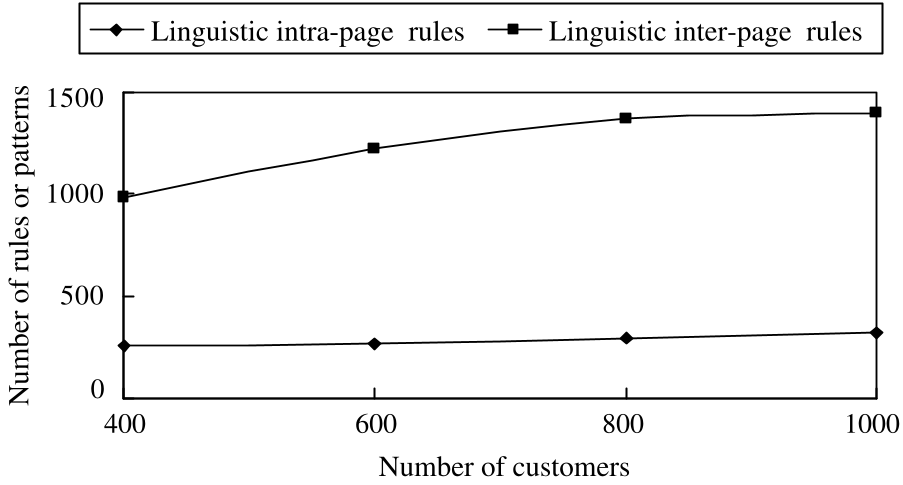 Comparison of rule generation vs. customer count.
Critical Analysis & Conclusion
Takeaway
The FOOWM algorithm successfully turns cold, numerical web logs into "Linguistic Knowledge." By using an Apriori-like structure, it ensures that only the most significant patterns survive, providing web administrators with actionable insights written in natural-language-like terms.
Limitations
As noted in the experiments, the sequential mining of inter-page patterns suffers from high computational costs. In the modern era of "Big Data," the dependency on an Apriori-style pass (which requires multiple scans of the database) might be replaced by more efficient FP-Growth or neural embedding techniques.
Future Outlook
This work laid the groundwork for Semantic Web Usage Mining. Future iterations could integrate ontology-based attributes, allowing the algorithm to understand not just that a page is "pc_diy.htm," but that it belongs to the broader "Electronics" category, enabling cross-domain fuzzy analysis.