
From Bags of Tags to Semantic Webs: Solving Complex Queries in Image Retrieval
14738_Linguistic Patterns and Cross Modality-based Image Retrieval for Complex Queries.
The paper introduces a multi-modal framework for image retrieval targeting complex semantic queries. It utilizes a novel Linguistic Pattern Extractor (LPE) to bridge the semantic gap, achieving state-of-the-art performance on large-scale datasets (WCQ148K) by integrating textual, visual, and cross-modality models.
TL;DR
Modern image search fails when queries get specific (e.g., "a boy walking with a dog in a park at sunset"). This paper introduces a Linguistic Pattern-based framework that moves beyond simple keyword matching. By decomposing queries into structured relationships (Linguistic Patterns) and validating them through a Tri-model architecture (Textual, Visual, and Cross-Modality), the authors significantly outperform traditional search engines and SOTA re-ranking methods on large-scale datasets.
The "Bag of Concepts" Problem
Most image retrieval systems treat a query as a collection of isolated terms. If you search for "a boy hitting a ball," a standard system looks for "boy" and "ball." It might return a boy holding a ball or a ball lying next to a boy. The semantic gap exists because the interaction (the action of "hitting") is lost.
Current SOTA methods attempt to alleviate this by using co-occurrence statistics, but they struggle with:
- Rare Concepts: Infrequent combinations of objects.
- Spatial/Action Relationships: The specific "how" and "where" of the entities.
- Void of Information (VoI): Images with missing or noisy metadata.
Methodology: The Power of Linguistic Patterns
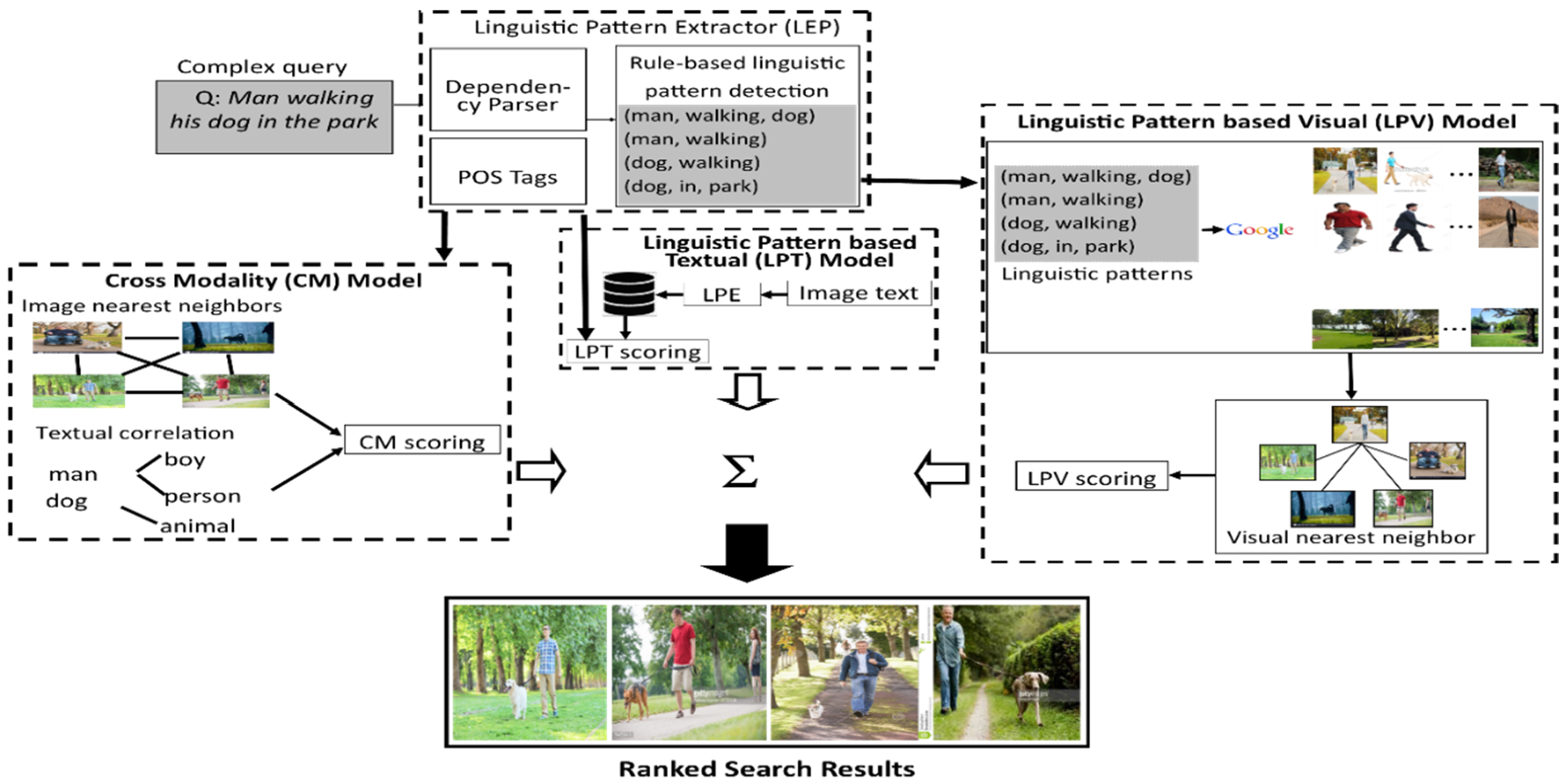
The core innovation is the LPE (Linguistic Pattern Extractor). Instead of raw text, the system converts queries and image descriptions into binary and ternary relations.
1. The Rule-Based Semantic Parser
Using the Stanford Dependency Tree (SDT) as a foundation, the authors developed rules to extract meaningful triplets. For example, from the query "baby lying in bed", it extracts:
- (baby, lying) - [Entity, Action]
- (lying, bed) - [Action, Entity]
- (baby, lying, bed) - [Entity, Action, Entity]
2. The Tri-Model Integration
The system doesn't just look at text; it fuses three distinct perspectives:
- LPT (Textual Model): Calculates a weighted score where ternary patterns (triplets) carry more weight than binary ones.
- LPV (Visual Model): Fires patterns as "sub-queries" to a search engine to find visual anchors, then uses k-Nearest Neighbors (k-NN) to find similar images in the local dataset.
- CM (Cross-Modality Model): This is the "fail-safe." If an image has no text (VoI), it looks at its visual neighbors. If the neighbors are labeled with the query concepts, the image receives a "boosted" relevance score.
Experimental Proof: Beyond Google
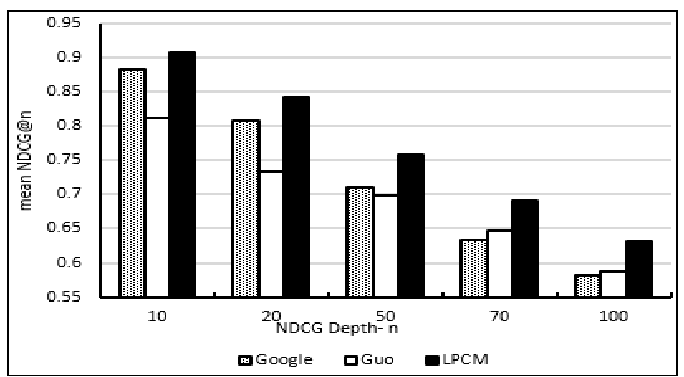
The researchers tested their approach on WCQ148K, a massive dataset combining MSCOCO, Flickr8k, and Google Search results.
Performance Gains
The results using NDCG@n (Normalized Discounted Cumulative Gain) show that as the search depth increases, the proposed method (LPCM) maintains high relevance while competitors drop off.
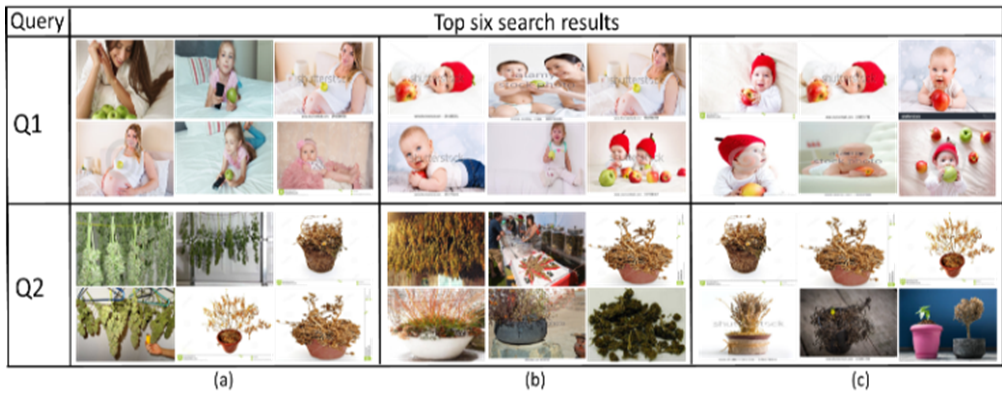
In a direct head-to-head comparison for the query "a baby with an apple lying in the bed":
- Google: Returned mixtures of women with girls; failed to find the specific "lying in bed" context consistently.
- LPCM: Successfully identified images where the specific baby-apple-bed relationship was present, thanks to its ternary pattern matching.
Critical Insight: Why it Works
The brilliance of this paper lies in the Cross-Modality (CM) Model’s handling of VoI. In social media, many images have no captions. By using Neighbor Voting—where visual neighbors "vote" on what concepts should be present—the system can rank an unlabeled image correctly just by looking at what it "looks like" compared to labeled counterparts.
Conclusion & Future Look
While this 2018 work relies on rule-based parsing and VGGNet features, its philosophy is a precursor to modern Multi-modal Large Language Models. It proves that structured relationships are the DNA of complex retrieval.
Limitations: The current model still struggles with abstract queries (e.g., "romance") and strict spatial constraints (e.g., "the boy is to the left of the man"). Future iterations utilizing Scene Graphs could potentially bridge these remaining gaps.