
Beyond Words: Boosting Newspaper Sentiment Analysis with Linguistic Context
Linguistic Sentiment Features for Newspaper Opinion Mining
The paper introduces a sentiment analysis framework specifically designed for German newspaper articles, moving beyond word-based methods. It combines traditional word weighting (PMI, Chi-square, Entropy) with complex linguistic features—such as negations, conjunctions, and modal verbs—modeled through a Support Vector Machine (SVM) to achieve SOTA performance on German media datasets.
TL;DR
Analyzing sentiment in news is significantly harder than in movie reviews due to the subtle and objective tone of journalism. This paper moves past simple "bag-of-words" models by introducing specific features for negation, conjunctions, hedging, and entity-specific scopes. By feeding these linguistic insights into an SVM, the authors achieved up to a 75% accuracy rate on German news—a substantial leap over traditional dictionary methods.
Context: Why News Sentiment is a "Hard Nut to Crack"
In a typical Media Response Analysis (MRA), human analysts spend hours reading articles to determine a company's image. Automating this is difficult because:
- Subtlety: News isn't as emotive as an Amazon review.
- Contextual Reversal: A word like "profitable" is positive, but "was hardly profitable" or "profitable but risky" changes the game entirely.
- Scope: Sentiment often attaches to specific entities (persons or organizations), not the whole sentence.
Methodology: The "Linguistic Feature" Layer
The authors don't just look at word scores (). They introduce two deeper feature sets:
- Linguistic Effect Features (): Boolean or ratio-based indicators (e.g., "Is there a negation here?").
- Influenced Sentiment Features (): The cumulative sentiment score within the scope of a linguistic event.
The Engine of Perception: Scope and Delimiters
To handle context, the model identifies "scopes." For instance, a conjunction like "however" acts as a delimiter. It marks the boundary where the sentiment of following words might be inverted or modified.
 Table 1: Conjunction values () showing how words like "but" (-1.0) invert sentiment, while "and" (1.0) reinforces it.
The study also tracks Hedging (modal verbs like could, might, would). These verbs often weaken the strength of an opinion, a nuanced detail that pure lexical models miss.
Experiments and SOTA Comparison
The researchers tested their approach against various baselines including PMI (Pointwise Mutual Information), Chi-square, and the SentiWS dictionary.
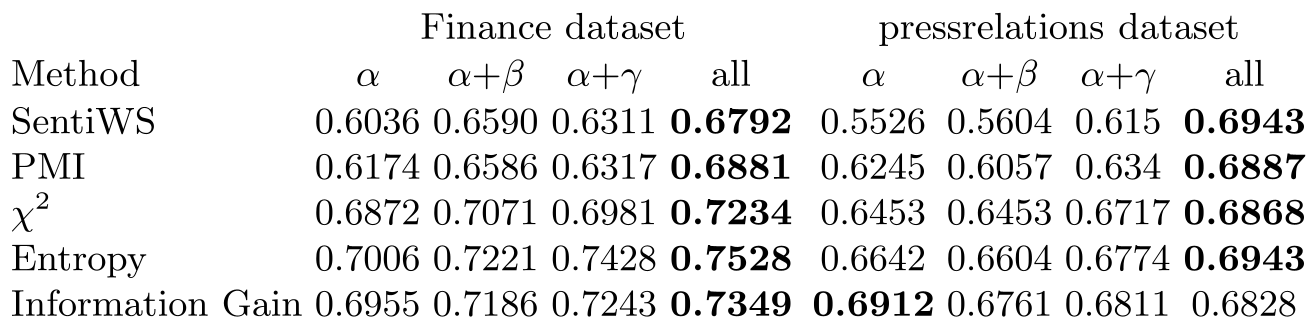 Table 2: Accuracy comparison. Note how the "all" column (combining ) consistently yields the highest performance across almost all methods.
Key Insights from the Results:
- The Power of Combination: For the dictionary-based SentiWS, adding linguistic features improved accuracy from ~60% to ~68% on Finance and from ~55% to ~69% on political news.
- Domain Sensitivity: In political texts, the features (weighted sentiment in scope) were more effective than simple indicators, suggesting that the complexity of political rhetoric requires a deeper analysis of "how much" sentiment is being modified.
Critical Analysis & Conclusion
This work demonstrates that Linguistic Inductive Biases—the rules of grammar and discourse—are powerful tools when data is less "obvious" (like news).
Takeaways:
- Efficiency: You don't always need a billion-parameter model to solve domain-specific sentiment; smart feature engineering with an SVM remains highly effective and interpretable.
- Limitations: The scope-finding rules are still largely heuristic. In very complex sentences with nested clauses, these delimiters might fail.
- Future Path: The next logical step is integrating these scope-based features into Neural Networks, allowing the model to "attend" specifically to linguistically modified regions of a sentence.
For media monitoring services, this research provides a viable roadmap to reduce human effort by automating the detection of nuanced media images with high reliability.