
The Sparseptron: Mastering Linguistic Structure with Structured Sparsity
14202_Linguistic structure prediction with the sparseptron.
The paper introduces the Sparseptron, an online learning algorithm for linguistic structure prediction that leverages structured sparsity to manage high-dimensional feature sets. Applied to dependency parsing through the authors' TurboParser, it achieves competitive accuracy while significantly reducing the number of active features used in the model.
TL;DR
Dependency parsing—the process of mapping sentences to their underlying grammatical structures—often involves millions of features, many of which are redundant. This paper introduces the Sparseptron, an innovative online learning algorithm that uses group-L1 regularization to automatically prune unhelpful feature groups. By maintaining a strict "budget" of active features, it achieves state-of-the-art performance with a fraction of the parameters, proving that intelligence in NLP often comes from knowing what to ignore.
Problem & Motivation: The Disambiguation Dilemma
Human language is inherently ambiguous. Consider the sentence: "The pig was saved from being slaughtered by an intelligent spider..." Does "by the spider" modify "slaughtered" (a comical reading) or "saved" (the intended meaning)?
To solve this, researchers use Dependency Parsing, treating words as vertices in a graph and searching for the Maximum Arborescence (directed spanning tree) that maximizes a score. The challenge lies in the ScoreTreeParts function. To accurately score an arc, we need millions of features—linguistic patterns, part-of-speech tags, and lexical idiosyncrasies.
Typical learners like MIRA (Margin-Infused Relaxation Algorithm) utilize all these features, which leads to two major issues:
- Overfitting: On small datasets (like Slovene), specific words act as noise rather than reliable signals.
- Complexity: Managing millions of weights is computationally expensive and hinders real-time applications.
Methodology: The Sparseptron Logic
The authors propose the Sparseptron, which evolves the classic Structured Perceptron by adding a sparsity-inducing step.
1. The Core Equation
The score for any arc is determined by: Where is a high-dimensional feature vector and is the weight vector.
2. Group Sparsity
Instead of pruning individual features, the Sparseptron operates on groups. In a morphologically rich language like Slovene, you might group all features related to specific word forms. If the group doesn't help the model generalize, the entire group is zeroed out.
3. The Algorithm
The algorithm follows a simple yet elegant loop:
- Step 1: Select a sentence and predict a tree using the current weights.
- Step 2: If the prediction is wrong, update weights using the Perceptron rule.
- Step 3: Apply a group-wise thresholding (Proximal Gradient) to keep only the top feature groups according to their norms.
 Figure: The visual complexity of all possible attachments in a sentence. TurboParser (the authors' implementation) identifies the blue "arborescence" as the optimal structure.
Experiments & Results: Less is More
The efficacy of the Sparseptron was tested across various languages and tasks. The results (Table 1) show that the model often matches or exceeds SOTA performance while drastically reducing the model's footprint.
| Language | Accuracy | Feature Reduction |
|---|---|---|
| Japanese | 93.1% (+0.2%) | 78% Pruned |
| Turkish | 75.6% (+0.3%) | 54% Pruned |
| Arabic | 78.2% (+0.1%) | 41% Pruned |
In non-parsing tasks like Named Entity Recognition (NER), the Sparseptron used only 4–11% of the features required by standard methods while maintaining higher accuracy. This "debiasing" process—learning the structure first with sparsity and then refining with a cost-aware learner—proved to be a formidable pipeline.
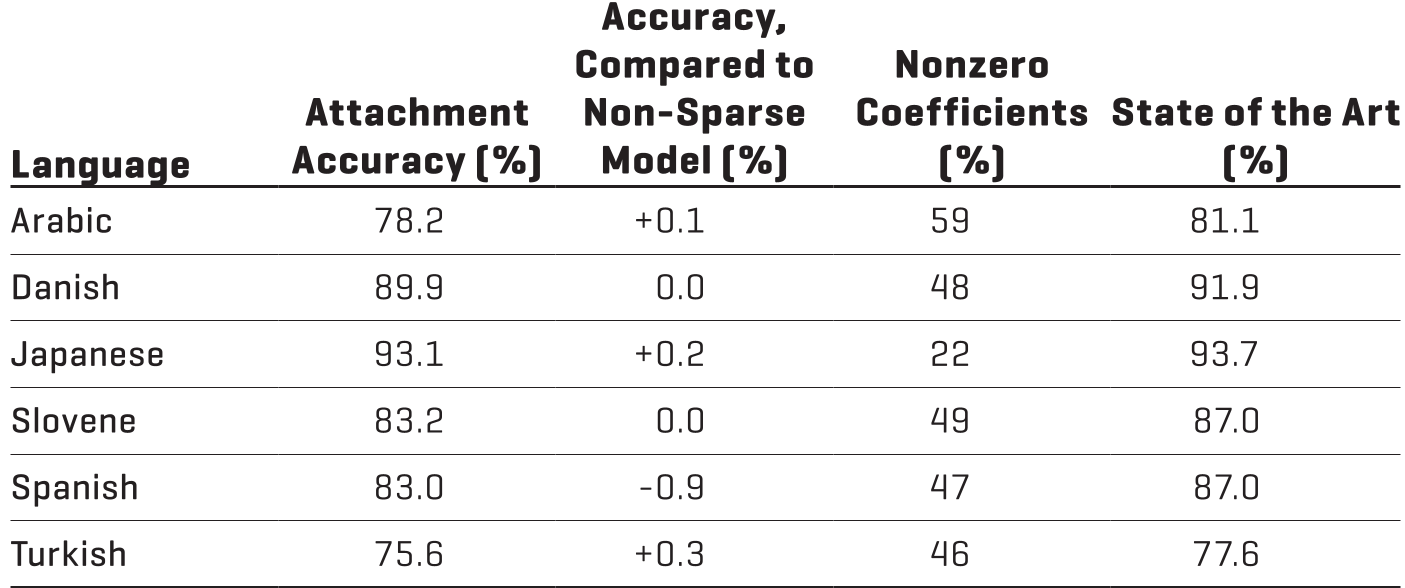 Table: Comparison of accuracy and feature density across multiple languages.
Critical Insights & Conclusion
The Sparseptron highlights a fundamental shift in NLP strategy: moving from "feature engineering" to "feature selection via optimization."
Key Takeaways:
- Inductive Bias is Key: By grouping features based on linguistic theory, the model "knows" which categories of information are likely to be useful.
- Efficiency: Reducing the weight vector leads to faster inference and smaller model sizes, crucial for mobile or edge deployments.
- Limitations: The effectiveness of the Sparseptron depends on the quality of the initial feature grouping. If the groups are poorly defined, the model may prune essential information.
In conclusion, Smith and Martins have provided a robust tool for structured prediction that respects both the complexity of language and the need for computational parsimony. As we move into an era of increasingly "heavy" models, the Sparseptron’s philosophy of structured sparsity remains more relevant than ever.