
From Data to Dialect: Mastering Linguistic Summarization with IF-THEN Rules
Linguistic summarization using IF-THEN rules
This paper introduces a Linguistic Summarization (LS) framework focused on generating human-readable IF-THEN rules from databases using Interval Type-2 (IT2) Fuzzy Sets. By defining specific quality measures like Usefulness and Outlier degrees, the method effectively extracts both representative patterns and anomalous data points, achieving superior descriptive clarity compared to traditional numerical summaries.
TL;DR
In the era of "Big Data," we are often overwhelmed by numbers but starved for knowledge. This paper proposes a methodology to transform raw database records into human-intuitive IF-THEN rules (e.g., "IF Age is Around 35, THEN Survival is Yes") using Interval Type-2 Fuzzy Sets. By introducing a two-pronged evaluation system—Usefulness for patterns and Outlier for anomalies—the authors provide a framework that bridges the gap between machine processing and human perception.
The Motivation: Why Numbers Aren't Enough
While statistical summaries like mean or median are precise, they are "terse." They fail to capture the nuances of non-numeric data or the inherent uncertainty in human language. The authors argue that Linguistic Summarization (LS) is superior for knowledge discovery because it mirrors how humans actually think and communicate.
However, prior work in LS was limited to simple descriptions (e.g., "Most people are tall"). This paper takes the leap to IF-THEN rules, which are not only descriptive but also functional—they can be integrated into knowledge bases for Perceptual Reasoning and decision-support systems.
The Core Innovation: Modeling Uncertainty with IT2 Fuzzy Sets
The paper’s most significant theoretical contribution is the advocacy for Interval Type-2 (IT2) Fuzzy Sets.
Why IT2 over Type-1?
- Intra-personal Uncertainty: A single person might have a vague definition of "Medium Age."
- Inter-personal Uncertainty: "Medium Age" means 30 to one person and 45 to another.
Type-1 Fuzzy Sets are "certain" (the membership function is fixed), creating a logical contradiction when trying to model "uncertain" words. IT2 Fuzzy Sets solve this by using a Footprint of Uncertainty (FOU)—essentially a fuzzy set of fuzzy sets—to capture the diverse meanings of words across a population.
 Fig 1: Word FOUs obtained through the Interval Approach, capturing varying linguistic interpretations.
Measuring Quality: The Five Pillars
To prevent the system from generating "trash rules," the authors defined five quality measures. The two most critical are:
- Degree of Usefulness (): The "Gold Standard" for rules. It requires both high Validity (Truth) and Generality (Sufficient Coverage).
- Intuition: A rule must be true AND apply to a significant portion of the data.
- Degree of Outlier (): The "Investigative Tool." It targets rules that are true but apply to almost no data.
- Intuition: This is how we find the "black swans" or data entry errors in a dataset.
The Haberman Survival Case Study
The authors tested their approach on the Haberman’s Survival Dataset (breast cancer cases). The experimental results demonstrate a clear hierarchy in rule quality:
- Truth alone is misleading: Some rules had 100% truth but only represented one patient, making them useless for general conclusions (Outliers).
- Usefulness is the filter: Using as the ranking criterion, the system successfully extracted the most representative trends in patient survival.
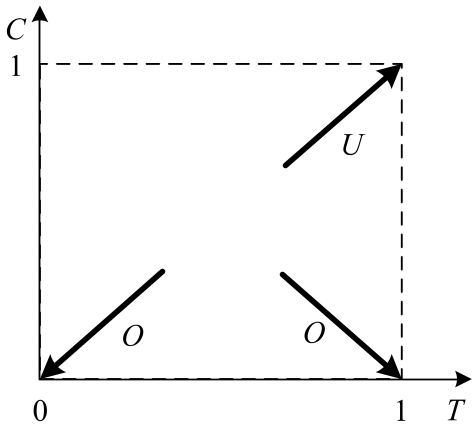 Fig 2: Differentiation between Useful rules (high T, high C) and Outlier rules (high T, low C).
LS vs. Wang-Mendel (WM) Method
A critical technical discussion in the paper is the comparison with the Wang-Mendel method. While WM is popular for building predictive models, it is prone to generating counter-intuitive rules because it selects rules based on the highest individual data point degree, regardless of how many other data points support it.
LS, by contrast, is descriptive. It prioritizes the collective evidence of the data, ensuring the summary represents the "forest" rather than just a few unique "trees."
Critical Analysis & Future Outlook
The framework's strength lies in its Human-in-the-Loop compatibility. By adjusting the S-shape function for coverage (), users can define what "sufficiently representative" means for their specific domain.
Limitations: The current approach relies on an exhaustive search of all rule combinations. As the number of attributes () and fuzzy sets grows, the computational cost will explode exponentially (the "curse of dimensionality").
Future Work: The next frontier is implementing heuristic-based pruning to handle massive datasets and applying these summarized rules to Perceptual Computing—where machines can "reason" using the same linguistically summarized knowledge bases humans use.
Conclusion
This paper provides a robust mathematical foundation for turning "dark data" into "bright insights." By using Interval Type-2 Fuzzy Sets, we are one step closer to machines that don't just compute numbers, but understand the language of uncertainty.