
LVE-Two: Improving Heart Failure Mortality Prediction via Linguistic Variable Elimination
Linguistic variable elimination for a heart failure dataset
This paper introduces a fuzzy rule discovery method based on Linguistic Variable Elimination (LVE) to predict mortality in heart failure patients. By utilizing expert-driven fuzzification and variable selection, the proposed LVE-Two model achieves a superior balance of sensitivity and specificity compared to traditional black-box classifiers.
TL;DR
Heart failure remains a leading cause of mortality globally, with a 50% four-year mortality rate. This paper presents LVE-Two, a fuzzy rule-based data mining method that predicts whether a patient might die soon based on clinical findings. By treating clinical thresholds as "fuzzy" rather than "hard" and employing a unique variable elimination strategy, it achieves higher diagnostic accuracy (Sensitivity + Specificity) than Neural Networks or Decision Trees.
The "Vagueness" Problem in Clinical Data
In medical diagnostics, "hard" boundaries are often artificial. For instance, is a patient's age "young" at 38 but suddenly "middle-aged" at 39? Such small numerical changes can drastically flip a standard Decision Tree's prediction, leading to errors.
The authors identify two types of uncertainty:
- Vagueness: Difficulty in making precise distinctions (e.g., blood pressure levels).
- Ambiguity: Situations where multiple alternatives (e.g., "Normal" vs. "Elevated" NT-proBNP) might simultaneously be true.
LVE addresses these by using Fuzzy Sets and Membership Degrees, ensuring that information is not lost during the discretization of numerical data.
Methodology: Linguistic Variable Elimination (LVE)
The core of the approach is an iterative algorithm that filters out unimportant linguistic variables.
1. Fuzzification based on Expert Insight
Rather than letting a machine decide the bins, the authors use medical literature to define membership functions. For example, normal creatinine levels are defined differently for males and females, and the transition from "low" to "normal" is handled via a gradient (membership degree).
2. The LVE Algorithm
The algorithm seeks to minimize Classification Ambiguity. It evaluates linguistic terms connected with the AND operator and measures their truthfulness () against known outcomes.
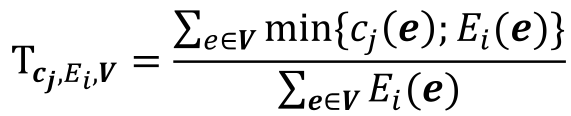
The truthfulness formula acts as the critical filter, ensuring only rules with high confidence are retained.
3. Asymmetrical Thresholding
The method's secret sauce is the use of separate thresholds for different classes ( for Alive, for Dead). This allows clinicians to prioritize Sensitivity (identifying those who might die soon to prevent life-threatening situations) or Specificity (reducing the cost of over-treating patients who are likely fine).
Experimental Battle: Fuzzy Logic vs. Modern ML
The authors tested their method against several standard Weka implementations using 10-fold cross-validation on a dataset of 2,032 patients from Hull LifeLab.
Performance Comparison
LVE-Two (the dual-threshold version) outperformed all traditional models in the "Sum" metric (Sensitivity + Specificity):
| Method | Sensitivity | Specificity | Sum |
|---|---|---|---|
| LVE-Two | 66.35 | 74.93 | 141.28 |
| C4.5 (Decision Tree) | 40.96 | 87.90 | 128.86 |
| MLP (Neural Network) | 32.12 | 93.98 | 126.10 |
| BayesNet | 24.04 | 95.37 | 119.41 |
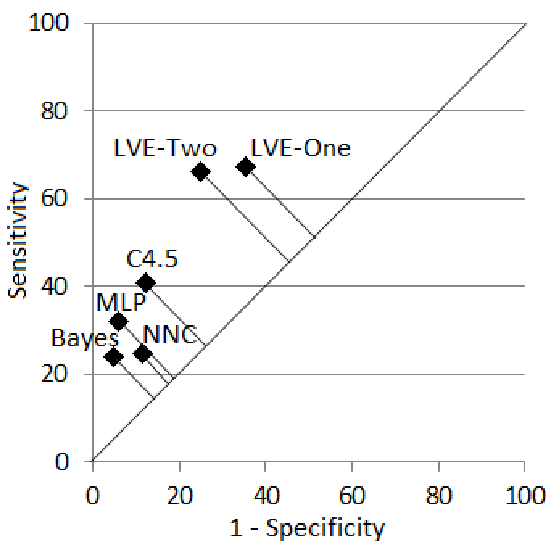 The ROC graph shows LVE-Two (top right plots) consistently further from the random guess line than its competitors.
Deep Insight: Accuracy vs. Interpretability
The study highlights a classic trade-off:
- LVE-One (Single Threshold): Results in a highly interpretable model with only 44 rules, but lower overall accuracy (131.93 sum).
- LVE-Two (Dual Threshold): Results in 627 rules, significantly boosting accuracy but making the model harder for a human to read at a glance.
Conclusion
The "Linguistic Variable Elimination" approach proves that incorporating expert knowledge via fuzzy logic isn't just a way to make models more "human-like"—it actually makes them more accurate in domains where data is messy and stakes are high. By allowing mortality and survival to be governed by different truth-thresholds, the LVE-Two model provides a flexible framework for hospital cost-risk management.
Future Outlook: The next step for this research would be applying these fuzzy linguistic rules to real-time monitoring systems where data arrives as a stream, potentially integrated with IoT-based heart rate and pulse sensors.