
Beyond Point-and-Click: Transforming VR Selection through Linguistic Deixis
Towards a linguistically motivated model for selection in virtual reality
This paper proposes a human-oriented approach to object selection in Virtual Reality (VR) based on linguistic principles of "Deixis." It introduces the DRIVE framework, which leverages insights from human-human communication—such as the "pointing cone" model and cross-modal compensation—to create more natural, "step-in" multimodal interfaces.
TL;DR
Object selection in VR is often treated as a geometry problem, but this paper argues it is actually a linguistic problem. By shifting from a tech-centric "Ray-Casting" approach to a human-centric "Deictic Reference" model, we can build VR interfaces that understand natural human gestures, gaze, and speech as a unified communicative act.
Background: The Limits of Technical Precision
Since Bolt's seminal "Put-That-There" in 1980, the dream of natural multimodal interaction in VR has persisted. However, most modern solutions focus on increasing sensor precision. Thies Pfeiffer argues that we are missing the "human" in Human-Computer Interaction. In human-human interaction, we don't need millimeter precision to understand what someone is pointing at; we use context, redundancy, and a "pointing cone" of attention.
The Linguistic Lens: What is "Deixis"?
The core contribution of this work is the classification of object selection as Place Deixis. In linguistics:
- Reference: The link between an expression and an entity.
- Referent: The actual object in the world.
- Extension: The set of potential objects a gesture might be referring to.
When we point and say "that bolt," the speech is underspecified (many bolts exists), and the gesture is fuzzy. Human addressees resolve this by intersecting these messy signals. The paper argues that VR systems should do the same.
Methodology: Coding Human Intuition into VR
The paper synthesizes several linguistic and empirical findings to refine VR interaction:
1. From Rays to Cones
While "Ray Casting" is a technical standard, human-human interaction research by Butterworth and Itakura suggests that we interpret pointing within a 10° to 15° cone.
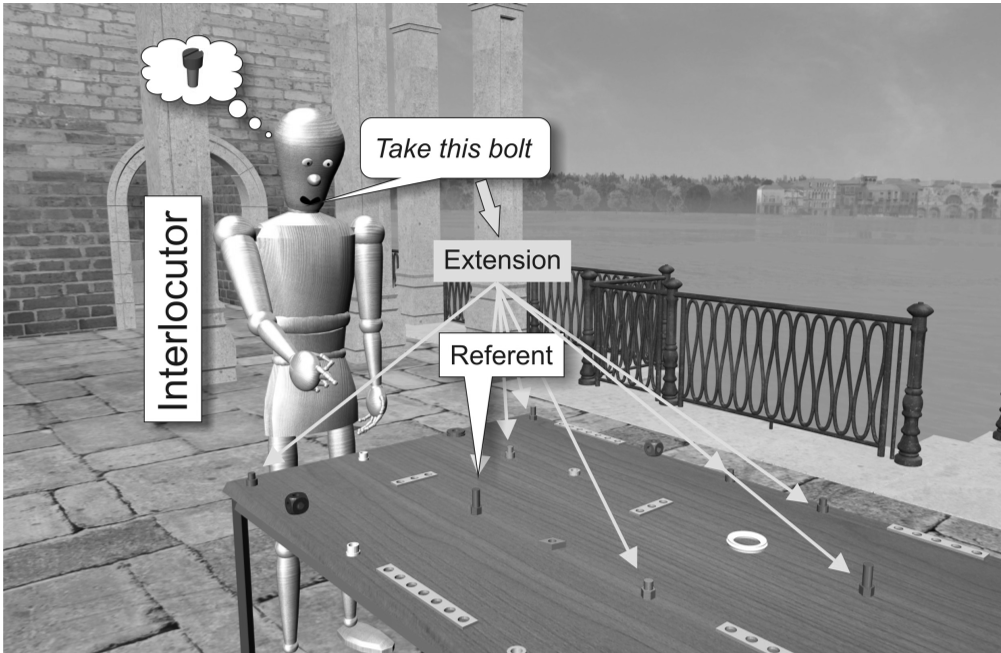 Figure 1: How multimodal signals (speech + gesture) restrict the "Potential Extension" to identify a single Referent.
2. The Geometry of Pointing
The author discovers that the most accurate way to model a human's pointing vector is not just the arm's direction, but a ray originating from the dominant eye and passing over the index finger.
3. Natural Dwell Timing
How long do you have to point at something to "select" it? Technical dwell times are often arbitrary. This research identifies a 0.43s median response time as the "natural" dwell time based on how humans confirm gestures in social settings.
Critical Insights: The "DRIVE" Framework
The culmination of this research is the DRIVE (Deictic Reference in Virtual Environments) framework. Unlike traditional selection tools, DRIVE accounts for:
- Cross-modal compensation: If the gesture is vague (e.g., distant target), the user naturally adds more verbal detail.
- Opening Angles: Use of a 14° cone for distal targets and orthogonal distances for proximal "reaching space."
Discussion & Future Outlook
While technical interfaces for experts (like 3D modeling) may still require high-precision unimodal tools, "casual" VR demands interfaces with no learning curve.
Limitations: The paper acknowledges that while hardware is getting better at measuring, we are still in the early stages of modeling the "history of interaction"—how a previous sentence influences the current selection.
Future Work: The integration of these linguistic models into ubiquitous XR headsets could finally realize the vision of "step-in" interaction, where the system understands you not because its sensors are perfect, but because it understands how humans communicate.
Takeaway for Developers
Stop building zero-width ray-casters. If your selection logic doesn't account for gaze-finger alignment and a ~14° cone of uncertainty, you aren't building for humans; you're building for robots.