
Link Encryption: Neutralizing Rogue Social Network Crawlers via Temporal Invalidation
Link Encryption to Counteract with Rouge Social Network Crawlers
2012-04-01
Summary
Problem
Method
Results
Takeaways
Abstract
This paper introduces a Link Encryption framework designed to protect Online Social Networks (OSNs) from malicious crawlers. By combining session-bound encryption with temporal constraints (TTL), the method ensures that URLs are both user-specific and time-sensitive to prevent bulk data harvesting.
## TL;DR
While Online Social Networks (OSNs) provide unprecedented connectivity, they are a goldmine for malicious crawlers seeking to build "digital dossiers" of private users. This paper proposes a robust defense mechanism: **Link Encryption**. By encrypting internal URLs with a session-specific key and a timestamp, the system ensures that links expire quickly and cannot be shared or reused by automated bots, effectively breaking the crawler's "frontier."
## The Motivation: Why CAPTCHAs and Rate Limits Fail
The traditional security perimeter is failing. Attackers now use distributed botnets to circumvent IP-based rate limiting, and "CAPTCHA farms" (human-in-the-loop services) have made traditional challenges a mere speed bump.
The core vulnerability lies in the **permanence and universality** of URLs. Once an automated script finds a profile link, that link remains valid indefinitely. Attackers can "slow-crawl" over days or weeks, bypassing hit-counters while still eventually aggregating millions of profiles.
## Methodology: The Anatomy of Link Encryption
The authors propose a four-stage framework integrated directly into the web server (implemented as an Apache module):
1. **Rate Limiter**: Tracks requests based on the session key, not just the IP address.
2. **Link Decryptor**: Validates if the requested URL was actually generated by the server for that specific user session.
3. **Content Generator**: Produces the standard HTML/PHP content.
4. **Link Encryptor**: The "magic" step. Before sending the page to the user, the server intercepts all `<a>` tags and transforms them.
### The Encryption Formula
The transformation can be visualized as:
`Encrypted_URL = Encrypt(Server_Private_Key, Original_URL + Session_Key + Timestamp)`
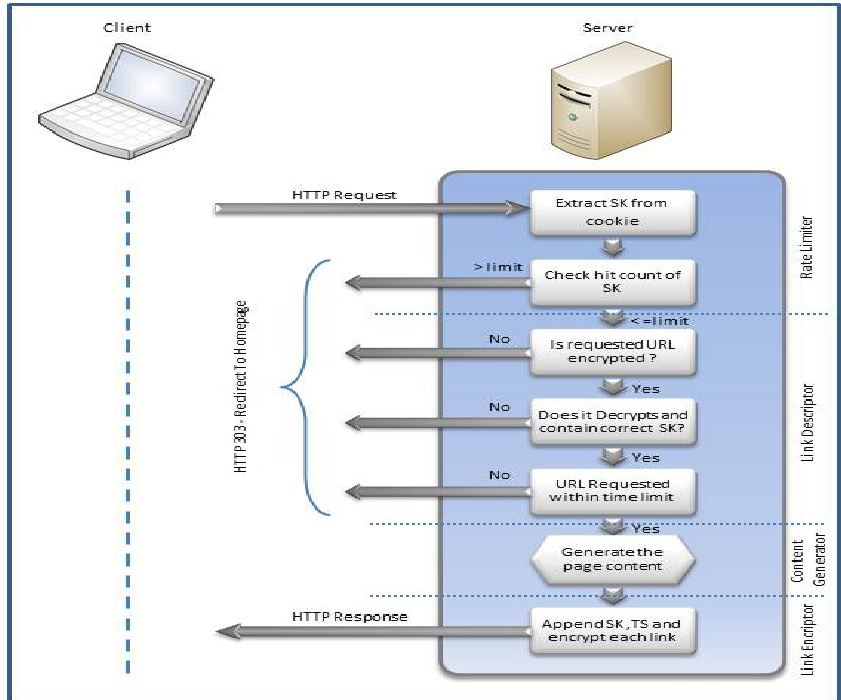
*Figure 1: The architecture of the Link Encryption framework, showing the interaction between the request handler and the encryption modules.*
## Why This Works: Physical Intuition
The brilliance of this approach is twofold:
* **Session Coupling**: If an attacker steals a list of URLs but tries to access them using a different session or bot, the `Link Decryptor` will see a mismatch between the embedded session key and the current request's cookie, rejecting the access.
* **Temporal Decay (URL Timeout)**: By embedding a timestamp, the server can enforce a "Time to Live" (TTL) for every link. If a crawler tries to save a "frontier" (a list of billions of links to visit later), those links will "rot" and become invalid before the crawler can visit them all.
## Experimental Results
The authors conducted several tests to validate the prototype:
* **Crawler Efficiency**: Confirmed that without protection, a small cluster could scrape millions of profiles in hours.
* **URL Invalidation**: Verified that links accurately timeout after the predefined period, forcing the crawler to constantly re-fetch and re-parse pages, which significantly increases the cost of the attack.
* **Session Tampering**: Proved that modifications to the session cookie immediately lead to request rejection.
## Critical Analysis & Future Outlook
While Link Encryption is a powerful deterrent, it is not a silver bullet.
1. **Computational Overhead**: Encrypting every link in a large HTML response introduces latency. High-traffic sites would need dedicated hardware acceleration (like AES-NI) to maintain performance.
2. **SEO Implications**: Since links are dynamic and session-bound, search engine crawlers (like Googlebot) may be unable to index the site properly unless exceptions are made.
3. **State Management**: The server must manage keys and timestamps effectively to ensure legitimate users don't face "broken links" during normal navigation.
**Conclusion**: This research highlights a critical shift in OSN security. By treating URLs as temporary, non-transferable tokens rather than static addresses, we can finally gain the upper hand against automated data harvesting.