
ITM: Fusing Community Structure and Node Centrality for Dynamic Link Prediction
Link prediction in dynamic social networks by integrating different types of information
This paper introduces the Integrated Time Series Model (ITM), a link prediction framework for dynamic social networks. By fusing temporal link occurrences, community structures, and eigenvector centrality scores, ITM achieves superior predictive accuracy compared to traditional static graph methods across six real-world datasets.
TL;DR
Predicting future connections in a social network is no longer just about who knows whom today. This paper introduces ITM (Integrated Time Series Model), a framework that predicts future links by merging the "recency" of interactions, the "groups" nodes belong to, and the "influence" of individual nodes. It effectively moves beyond static graphs to capture the living, breathing evolution of digital social structures.
Problem & Motivation: The Flaw of Static Thinking
Traditional link prediction often treats a network as a frozen snapshot. If you used an email network from 2020 to predict friendships in 2024, a static model would treat a message sent yesterday with the same weight as one sent four years ago.
The authors identify three missing pillars in current research:
- Temporal Decay: Old interactions are less predictive than new ones.
- Community Gravity: Nodes in the same community are "pulled" towards each other over time.
- Future Importance: Nodes that are becoming central today are likely to form the most links tomorrow.
Methodology: The Three Pillars of ITM
The core of the ITM approach is the integration of three distinct information matrices into a final prediction score ().
1. The Weighted Temporal Model
Instead of a simple binary matrix, the authors use a damping factor (). This ensures that frequent, recent interactions generate a much stronger signal than sporadic, historical ones.
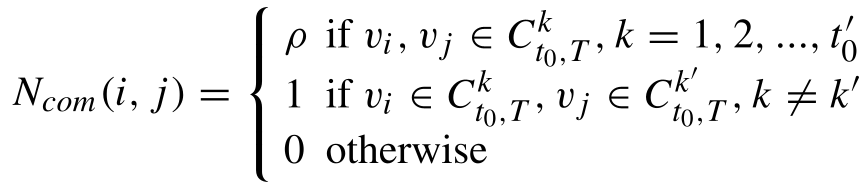
2. Community Dynamics
Social networks naturally cluster. Using the Louvain Method, the authors partition the graph into communities. They introduce a parameter to boost the similarity score between nodes within the same cluster, acknowledging that community membership is a precursor to link formation.
3. Eigenvector Centrality
Not all nodes are created equal. By calculating the Eigenvector Centrality, the model identifies nodes that are connected to other influential nodes. The assumption is that influential nodes act as "hubs" for future connections.
Experiments & Results: Proving the Integration
The authors tested ITM across six diverse datasets, ranging from manufacturing emails to face-to-face proximity data.
Comparison with Traditional Methods
The results show that ITM4 (the full integrated model) consistently beats local heuristics (Common Neighbors, Jaccard) and even challenges the Katz index, which is computationally much more expensive.
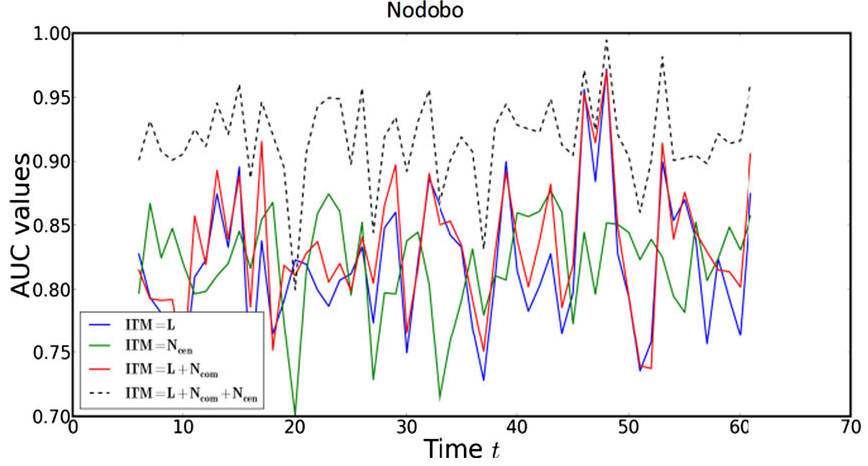 Fig 1: ITM performance vs. variants. Note the stability of the dashed line (ITM4) across different network types.
The Importance of Centrality
The "Ablation Study" (shown as ITM1 through ITM4) proves that adding node centrality () provides the sharpest increase in predictive power (AUC).
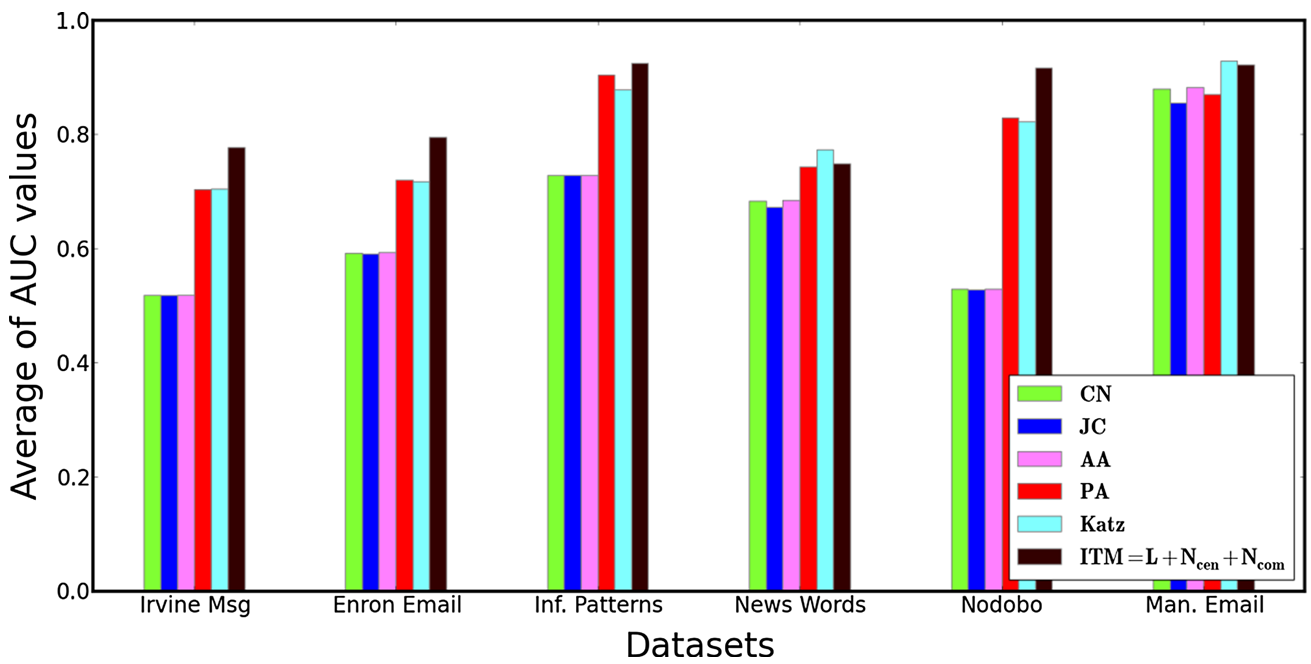 Fig 2: Average AUC values showing ITM4 significantly outperforming standard indices.
Critical Insight & Conclusion
The Integrated Time Series Model (ITM) demonstrates that link prediction is an inherently multi-dimensional problem. You cannot rely on topology alone; you must account for the time the link occurred and the hierarchical importance of the nodes involved.
Takeaway for Practitioners: When building recommendation engines or social discovery features, don't just look at "mutual friends." Look at the velocity of recent interactions and whether individuals are moving into the same influential circles.
Limitations: The model currently operates with a complexity of , which despite being leaner than many tensor-based approaches, may still require optimization (like sparse matrix handling) for billion-node social networks like Facebook or X (formerly Twitter).