
LPINT: Solving the "Latency Gap" in Dynamic Influence Maximization
Link prediction-based influence maximization in online social networks
This paper introduces LPINT (Link Prediction based Influential Node Tracking), a framework designed for Influence Maximization (IM) in dynamic social networks. By leveraging a Conditional Temporal Restricted Boltzmann Machine (ctRBM) to predict future network snapshots, the method identifies optimal seed nodes before the network evolves, achieving state-of-the-art performance in influence coverage and efficiency.
TL;DR
Influence Maximization (IM) is the art of finding a small group of "super-spreaders" to maximize information flow. But in the real world, social networks are moving targets. LPINT introduces a proactive approach: it uses Deep Learning (ctRBM) to predict who will talk to whom tomorrow and picks seeds based on that future map. The result? A massive reduction in processing time (up to 27x faster) and superior influence coverage.
Background: The Static Fallacy
Most IM research treats social networks like a frozen photograph. In reality, they are more like a high-speed video. Users follow, unfollow, message, and ignore each other in milliseconds. If you take 10 seconds to calculate the perfect "influencers" on a snapshot from 10:00 AM, by 10:01 AM, that list might already be obsolete because the network's "alleys" and "highways" have shifted.
The Intuition: Why Prediction is Better than Reaction
The authors' core insight is simple yet powerful: Predict the evolution to stay ahead of the curve. Instead of solving for the current graph , they solve for a predicted graph .
1. Forecasting with ctRBM
To predict the future, the model uses a Conditional Temporal Restricted Boltzmann Machine (ctRBM). Unlike standard RBMs, this version looks at:
- Temporal Patterns: How has the network changed over the last snapshots?
- Neighbor Influence: If my friends are likely to connect with a certain node, I might be too (Structural Bias).
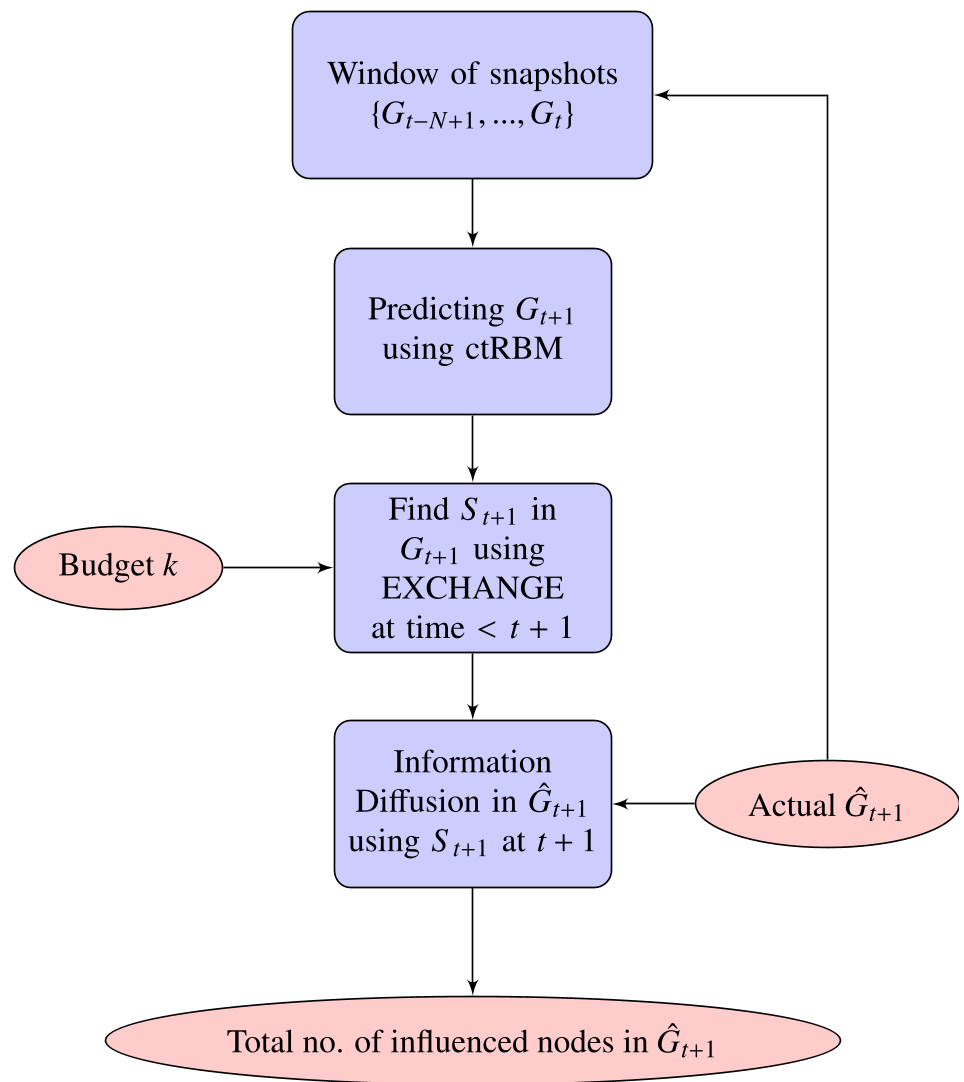 In the LPINT framework, the prediction module generates a future snapshot, allowing the IM module to work 'in advance'.
2. The EXCHANGE Algorithm
Once the future graph is predicted, the system needs to find the seeds. The authors improved the Upper Bound based Lazy Forward (UBLF) approach. Instead of starting from scratch (an empty set), they start with the seeds from the previous timestamp and "swap" low performers for high performers. This "warm-start" strategy drastically slashes computation time.
Experimental Proof: Speed and Coverage
The researchers tested LPINT against heavyweights like OIM (Online Influence Maximization) and INT (Influential Node Tracking) across diverse datasets.
Performance Highlights:
- Accuracy: Across College, Mathoverflow, and Wikitalk, LPINT consistently reached higher influence spread (the number of people reached) for the same budget of seed nodes.
- Speed: This is where LPINT truly shines. On the Wiki-talk dataset (over 1M nodes), traditional tracking took 1.6 seconds. LPINT finished in 59 milliseconds.
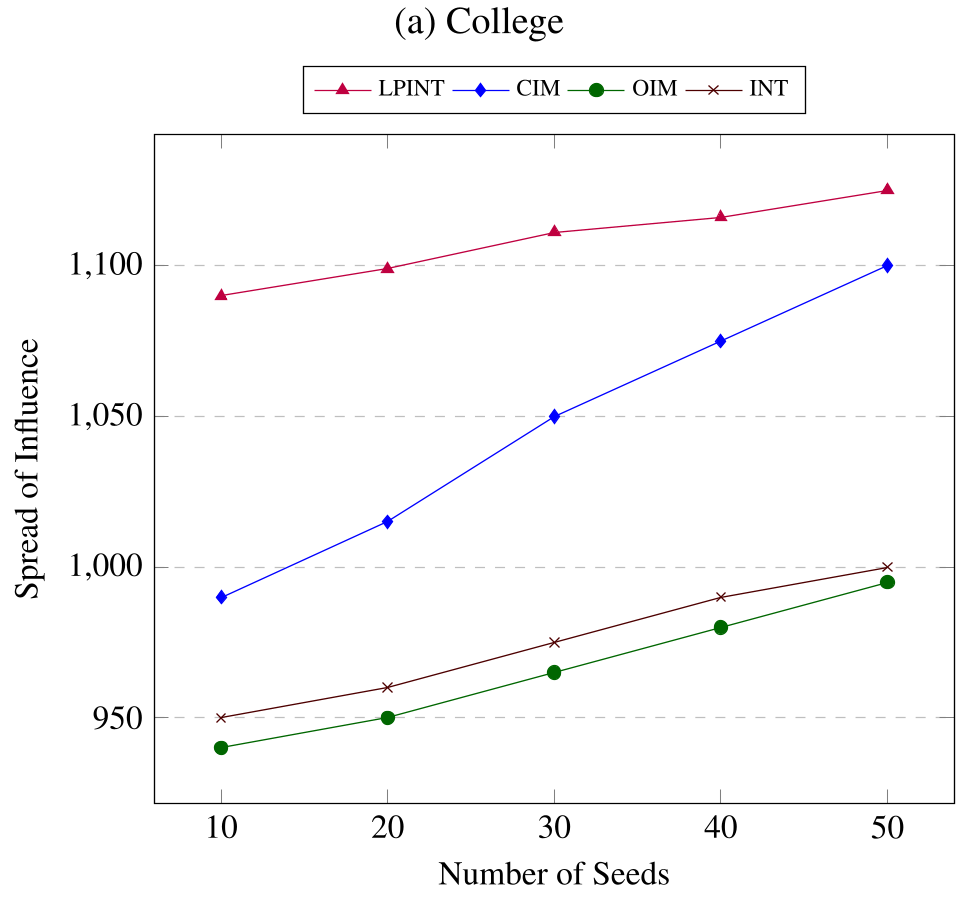 As shown above, LPINT (red line) consistently maintains the highest influence spread as the number of seeds increases.
Critical Analysis: The Cost of "Looking Ahead"
While LPINT is a breakthrough, it isn't "free." The ctRBM requires a training phase and assumes the network follows somewhat predictable evolutionary patterns. If a network undergoes a black-swan event (a sudden, random surge in activity), the prediction might fail.
However, the authors' theoretical results (Theorem 1 & 2) provide a safety net: they prove that as long as link prediction accuracy is high, the "predicted" seed set will be mathematically close to the "ideal" seed set.
Conclusion
LPINT represents a shift from Reactive IM to Predictive IM. By integrating Deep Learning for link prediction with discrete optimization for seed selection, the authors have solved one of the most frustrating problems in social network analysis: the race against time. For viral marketing and misinformation containment, this "future-focused" lens is likely the new gold standard.
Meta-Takeaway: If the network is moving, don't aim where it is; aim where it's going to be.