
Weighting the Social Fabric: Enhancing Link Prediction via Local Weighted Paths
Link Prediction in Social Networks Based on Local Weighted Paths
This paper proposes a weighted local path model for link prediction in social networks, primarily utilizing the PropFlow measure. By optimizing link strength through a Genetic Algorithm (GA) that combines factors like interaction activeness and node similarity, the authors achieve superior performance compared to traditional global measures and basic PropFlow implementations.
TL;DR
Link prediction—the task of forecasting future connections in a social network—often struggles with the computational cost of global graph analysis and the oversimplification of "link strength." This paper introduces a framework that optimizes link weights using a Genetic Algorithm and applies them to PropFlow, a localized information flow measure. By capturing the nuances of how people interact, the authors significantly boost prediction accuracy on large-scale Facebook interaction data.
The Motivation: Why Network Topology Isn't Enough
Most link prediction algorithms treat the network as a collection of binary connections (0 or 1). However, in reality, your relationship with a close friend is vastly different from that with a distant acquaintance.
- Global Measures (like Katz or PageRank) are slow and get "distracted" by noise far away in the network.
- Local Measures (like Common Neighbors) are fast but lack the "flow" of information.
- The Missing Link: Link strength. Many existing models only count the number of messages sent. This paper argues that strength is a mix of timing, intensity, and similarity.
Methodology: Mining Strength from Local Paths
The core innovation lies in treating "Link Strength" () not as a given number, but as a learned function of observed features:
1. Feature Engineering for Strength
The authors identify four "Strength Features":
- Importance Level: Based on the context of how a link first appeared.
- Activeness: A time-decayed sum of interactions (interactions now are worth more than interactions a year ago).
- Post-Connection Common Neighbors: Evaluating how much a link facilitates social convergence after it is formed.
- Similarity: Aligning node attributes like hobbies or location.
2. The Optimization Logic
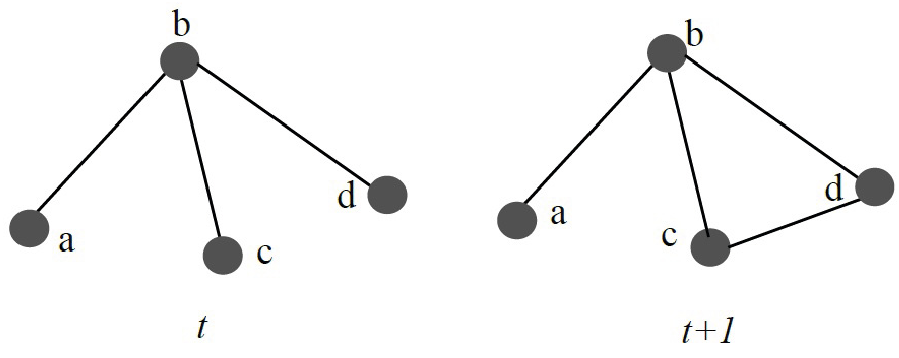
Instead of manual labeling—which is impossible for millions of Facebook links—the authors use a Genetic Algorithm (GA). They find a parameter vector that ensures that for a "future" link , the predicted flow is higher than for a non-existent link .
3. PropFlow: Localized Flow
Unlike PageRank, which walks the whole graph, PropFlow is a breadth-first search limited to height (usually 3). It simulates how "influence" spreads from a source node to its immediate neighborhood based on the learned link strengths.
Experimental Results
The researchers tested their model on the New Orleans Facebook dataset, which captures years of wall postings.
Performance Gains
The "PropFlow+" variant (which normalizes the flow score by the average flow of the source node) showed the most dramatic results. By accounting for the fact that some users are simply more "active" than others, the relative flow strength becomes a much cleaner signal for prediction.
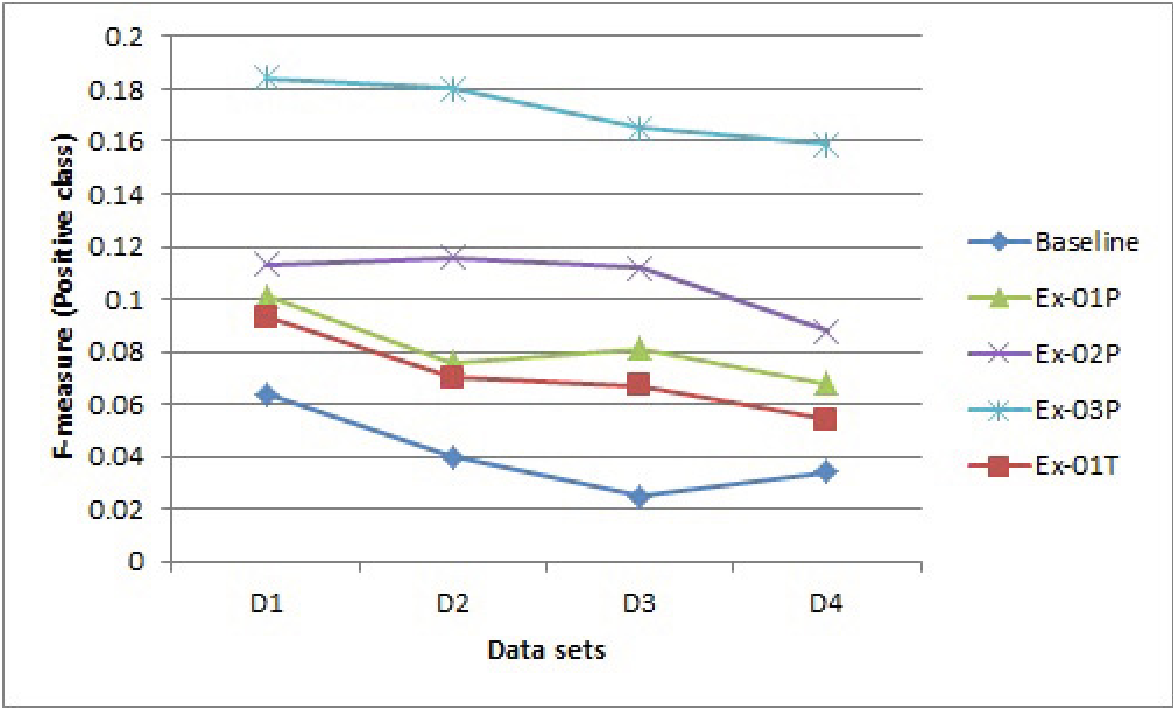
- SOTA Comparison: Compared to the "Baseline" (Common Neighbors, Jaccard, etc.), the proposed Ex-03P (PropFlow+) nearly doubled the F-measure in several test scenarios.
- Scalability: While performance generally dips as networks grow larger and sparser, the weighted local path approach remained more robust than purely topological baselines.
Critical Analysis & Takeaways
This work highlights a fundamental truth in social network analysis: Context is king. Simply knowing two people share a friend isn't enough; knowing how they interact with that friend provides the necessary weight to the prediction.
Limitations
- Imbalance: Despite the improvements, the absolute F-measure for positive class prediction remains low (). This is a common "needle in a haystack" problem in link prediction where most pairs never connect.
- Snapshot Dependency: The current GA optimization uses only two snapshots. A more dynamic, recurrent learning approach could better capture evolving trends.
Summary
By moving away from "global" graph metrics and focusing on a high-fidelity, learned "link strength" within a 3-step radius, this paper provides a scalable and accurate blueprint for predicting human connections in modern, massive social datasets.