
Enhancing Link Prediction: Why Interaction Frequency Matters in Social Networks
Link Prediction based on Structural Properties of Online Social Networks
This paper introduces Weighted Graph Proximity Measures for link prediction in Question-Answering Bulletin Boards (QABB), specifically tested on Yahoo! Chiebukuro. The core method integrates edge weights (interaction frequency) into traditional structural measures like Common Neighbors and Adamic/Adar, achieving superior accuracy in predicting future user connections compared to unweighted baselines.
Executive Summary
TL;DR: Researchers from the Tokyo Institute of Technology have demonstrated that "how often" people interact is just as important as "who" they know when predicting future social connections. By transforming static graph proximity measures into weighted ones—using Yahoo! Chiebukuro data—they achieved a significant boost in link prediction accuracy, particularly in dense online communities.
Academic Positioning: This work builds upon the classic structural proximity research (Adamic/Adar, 2003) and positions itself as a refinement of topology-based link mining for "open" and dynamic online environments where user metadata is scarce or unreliable.
Problem & Motivation: The Limits of Binary Thinking
In the world of link mining, most algorithms treat social networks as binary graphs: a connection either exists or it doesn't. However, this ignores the intensity of the bond. In a Question-Answering Bulletin Board (QABB), two users might interact once by chance, or they might regularly answer each other's queries.
Existing methods like Common Neighbors or Adamic/Adar count shared friends but ignore how strong those friendships are. Furthermore, many prior SOTA models rely on node attributes (age, location, etc.), which are often faked or hidden in online communities. The authors' insight is simple: Use the encounter frequency as a weight to refine structural proximity without needing any personal user data.
Methodology: The Weighted Evolution
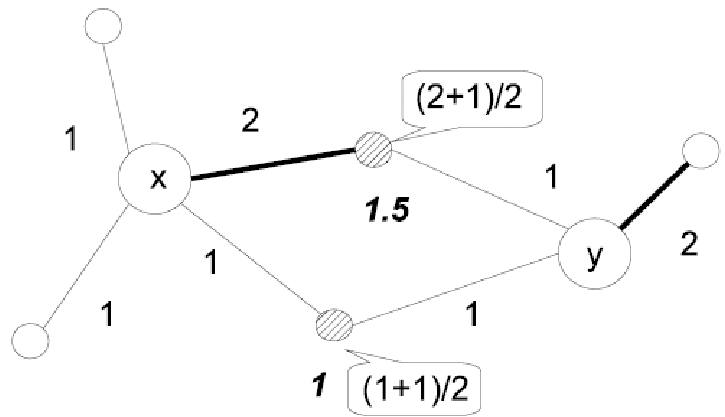
The authors reformulated three classic measures to include edge weights (), where represents the number of times user and met on the platform.
1. Weighted Common Neighbors (CNw)
Instead of just counting the number of nodes in , it sums the average weights of the links connecting the pair to those common neighbors.
2. Weighted Adamic/Adar (AAw)
The original Adamic/Adar penalizes "celebrity" nodes (nodes with huge degrees) by utilizing the log of the degree. The weighted version takes this further by considering the sum of all edge weights incident to the intermediate node :
Experiments & Results: Density is Key
The model was evaluated using a massive dataset from Yahoo! Chiebukuro, segmented into categories like News, Health, and Science.
Key Findings
- The Winner: Weighted Adamic/Adar (AAw) is the most robust predictor.
- Density Correlation: The methods perform significantly better in "dense" categories (like Manner or Business) where high-degree nodes provide richer structural signals.
- The "Rich Get Richer" Caveat: Weighted Preferential Attachment (PAw) performed poorly, suggesting that in open QABB systems, the sheer number of current links isn't a perfect predictor of future growth compared to shared contexts.
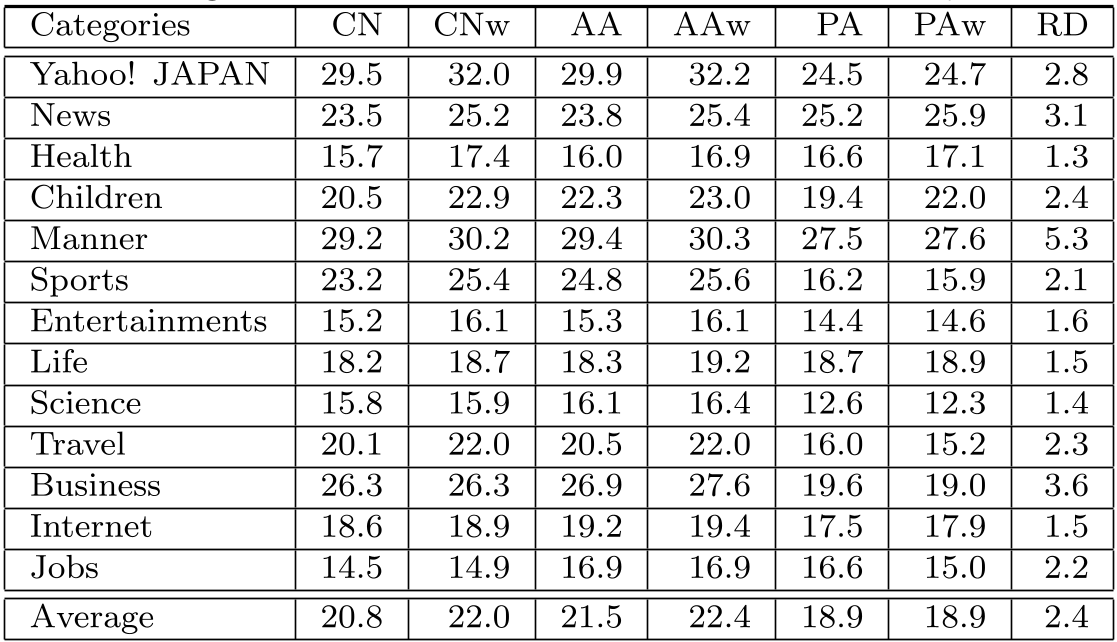 Table: Comparison of CN, CNw, AA, AAw, PA, and PAw across various categories.
Critical Analysis & Conclusion
Takeaway
The research successfully proves that interaction weights provide a superior heuristic for network evolution than simple topology. By focusing solely on structural weights, the method remains privacy-compliant and resilient to the "identity noise" common in online forums.
Limitations
- The Sparsity Problem: In very sparse categories (e.g., Internet or Jobs), the improvement from weighting is marginal because the lack of common neighbors limits the proximity calculation.
- Temporal Blindness: The current weight is a cumulative sum. It does not distinguish between an encounter that happened 2 years ago and one that happened yesterday.
Future Outlook
The next logical step is Temporal Weighting. By applying a time-decay function to link weights, researchers could prioritize recent interactions, likely leading to even higher precision in predicting "imminent" social connections.