
MVVA: Decoding the "Pillars" of Social Networks through Link Stability Analysis
On Link Stability Detection for Online Social Networks
This paper introduces Multi-Variate Vector Autoregression (MVVA) analysis for detecting link stability in Online Social Networks (OSNs). By shifting the focus from simply predicting new links to assessing the structural endurance of existing ones, the authors utilize a multi-feature regression framework and enhance its scalability via a Hamiltonian Monte Carlo (HMC) estimator to handle dynamic social interactions.
TL;DR
While most research focuses on predicting who will connect next, this paper asks a more fundamental question: Which connections will actually last? By introducing Multi-Variate Vector Autoregression (MVVA) and a Hamiltonian Monte Carlo estimator, the authors provide a framework to identify "stable links"—the structural pillars of a community—with an accuracy improvement of over 78% compared to traditional node-similarity baselines.
Contextual Positioning
In the landscape of Social Network Analysis (SNA), link stability has long been the "neglected middle child" of link prediction. Most SOTA methods focus on edge existence, but they often ignore the emotional flux and transactional dynamics that define relationship health. This work moves the field from static topology to dynamic structural integrity assessment.
The Problem: The Flaw of Univariate Simplicity
Why is link stability so hard to pin down?
- Static Bias: Current methods often look at a snapshot of a network (e.g., Common Neighbors), ignoring how relationships evolve over time.
- Feature Poverty: A link isn't just a line; it's a pipe through which sentiment, trust, and frequency flow. Univariate models are blind to these nuances.
- Scalability vs. Fidelity: Complex regression models often suffer from overfitting or multi-collinearity as the network grows.
Methodology: MVVA & Hamiltonian Dynamics
The authors solve this by treating link stability as a time-series forecasting problem.
1. The MVVA Framework
Instead of a single metric, they use a vector of six endogenous variables:
- Sentiment & Trust: How do people feel about each other?
- Frequencies & Transactions: How often do they interact?
- Betweenness & Similarity: Where do they sit in the social hierarchy?
The structural autoregressive model follows the formula: Where represents "social shocks"—disruptive world events that test link resilience.
2. Scaling with Hamiltonian Monte Carlo (HMC)
To prevent the complexity (where is features and is sample size) from exploding, the authors use HMC. Unlike standard Random Walk MCMC, HMC uses Hamiltonian dynamics (potential and kinetic energy) to navigate the probability space more efficiently, reducing autocorrelation and avoiding the "drunkard's walk" behavior of simpler samplers.
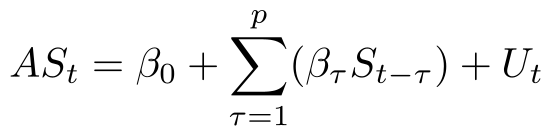 Figure: The core structural equation bridging temporality and stability.
Experiments & Results
The model was validated using a real-world Facebook dataset over a 30-day observation window.
- Efficacy: The Multivariate Link Stability Index achieved an AUC of 0.87, nearly doubling the 0.46 AUC of the Common Neighbor method.
- Prediction Accuracy: The Mean Absolute Scaled Error (MASE) was reduced by 8.3x, showing that the model "learns" the stability distribution rather than just fluctuating with noise.
- Convergence: Even with missing data, the HMC Monte Carlo estimates converged toward the ground truth stability distribution after approximately 80-100 cycles.
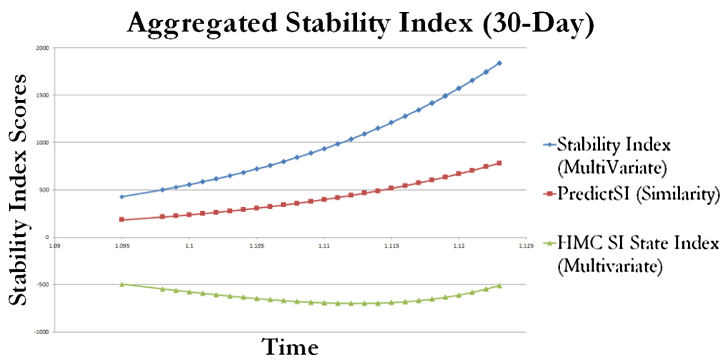 Figure: HMC iterations showing the convergence of the predicted distribution toward the actual stability dataset.
Critical Insight: The Value of "Social Shocks"
One of the most interesting aspects of the MVVA model is its inclusion of the disruption vector. By modeling link stability as a response to external shocks, the authors provide a tool not just for marketing recommendations, but for digital epidemiology and cyber-security. Identifying links that survive disruptions allows administrators to protect the "structural pillars" of a community during information warfare or crisis.
Conclusion & Future Work
The paper successfully demonstrates that link stability is a multivariate, dynamic phenomenon. While tested on relatively small cliques (20-100 nodes for detailed study), the future for this technology lies in Deep Knowledge Discovery—combining HMC with Deep Neural Networks (DNNs) to handle the sparse, high-dimensional "hyper-graphs" of the modern web.
Key Takeaway: Don't just look at who is talking; look at the sentiment and frequency of the silence between the words. Stability is found in the rhythm, not just the connection.