
With a Little Help from My Friends: Leveraging Influence Propagation for Social Recommendations
With a Little Help from My Friends (and Their Friends): Influence Neighborhoods for Social Recommendations
The paper "With a Little Help from My Friends (and Their Friends)" proposes a social recommendation framework that leverages a Threshold-Bounded Influence Propagation (TB-IP) algorithm. It integrates social graph structure into Matrix Factorization (MF) through influence-based neighborhood pre-processing and a novel social regularization factor (SocSim).
TL;DR
Social recommendations have long relied on the "friends-of-friends" intuition, but most algorithms stop at the direct neighbor level. This paper introduces a framework that uses influence propagation to build deeper neighborhoods. By combining a Threshold-Bounded Influence Propagation (TB-IP) algorithm with a Socially Regularized Matrix Factorization, the authors achieve up to an 8.6% improvement in RMSE on the Yelp dataset while simultaneously speeding up convergence.
Problem & Motivation: Beyond the Direct Neighbor
The central premise of social recommendation is Social Correlation: users are influenced by those they trust. However, the authors identify two major gaps in prior art (e.g., SoReg, Trust-MF):
- The "Hop" Limitation: Most models only look at immediate neighbors. In reality, influence propagates through networks (the "strength of weak ties" theory).
- Structural Blindness: Existing methods often treat social links as binary (friend vs. non-friend) or rely on explicit trust scores, ignoring the inherent structural influence of a user within the graph topology.
The authors' insight is that influence neighborhoods provide a more robust signal than raw social links, filtering out "noisy" connections that don't actually impact user preference.
Methodology: The TB-IP Framework
The proposed architecture integrates social signals in two distinct stages:
1. Neighborhood Formation (TB-IP)
Instead of taking the whole graph, the authors use the Threshold-Bounded Influence Propagation (TB-IP) algorithm.
- Ranking: Nodes are ranked (e.g., via PageRank or Out-degree).
- Propagation: Influence spreads to neighbors if the edge weight exceeds a threshold.
- Decay & Hops: As influence moves to or degree connections, a decay factor is applied, ensuring that distant acquaintances have less weight than close friends.
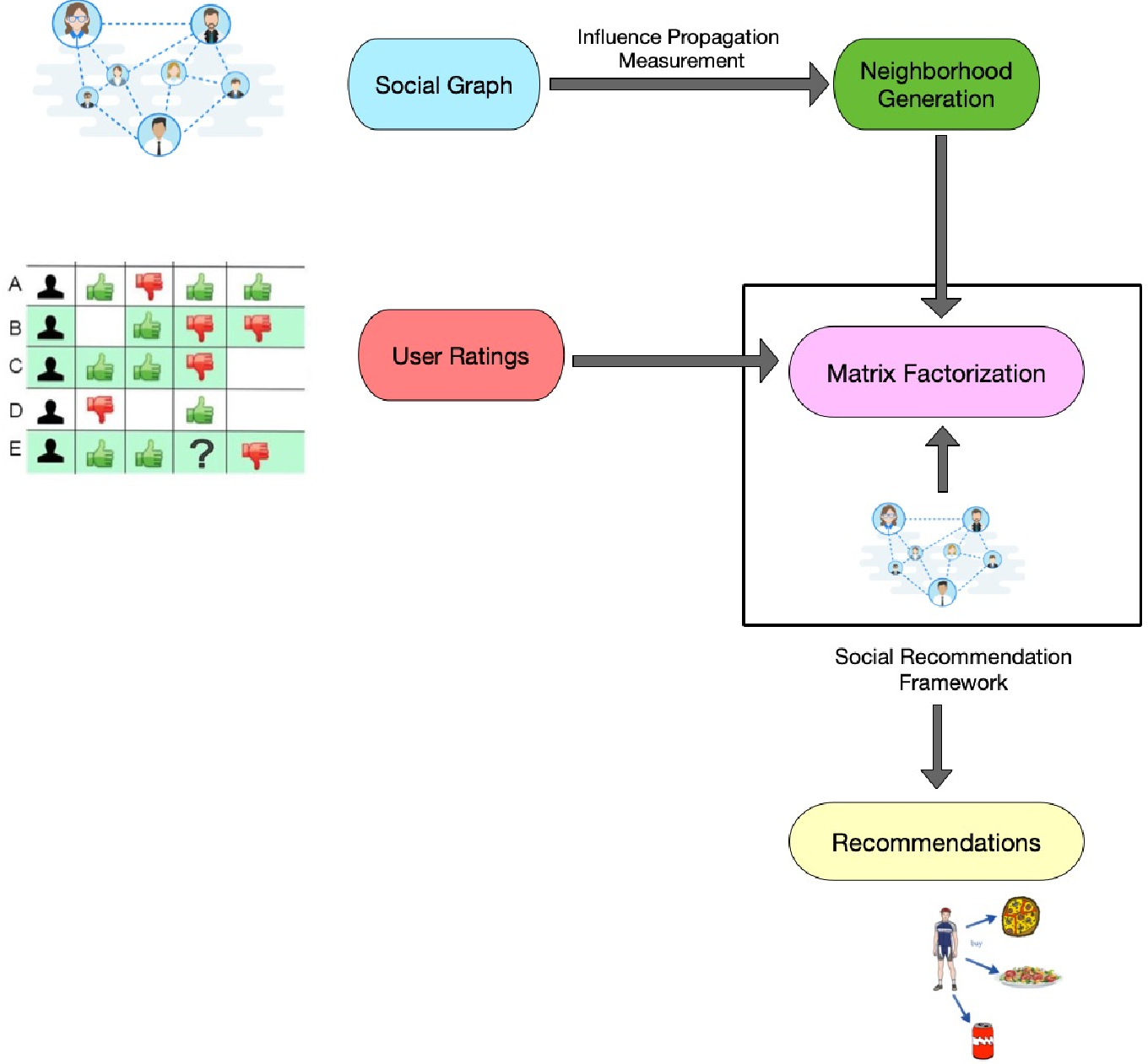 Figure 1: The high-level methodology showing the flow from TB-IP pre-processing to Social Regularization in MF.
2. Social Regularization with SocSim
The core of the Matrix Factorization advancement lies in the objective function. The authors add a social regularization term:
The SocSim metric is a hybrid: This ensures that the model respects both Homophily (similar ratings) and Social Influence (graph-derived weight).
Experiments & Results
The authors tested their approach on Yelp (Las Vegas) and Epinions.
Key Findings:
- Accuracy Boost: The
SocSim TB-IP SoRegvariant consistently outperformedSimpleMF. On Yelp, the RMSE dropped from 1.252 to 1.145. - Efficiency: Despite the pre-processing overhead, the recommendation phase became faster. For the Yelp dataset, the "SocSim" variant took only 7 seconds compared to 28 seconds for the baseline "Simple SoReg" because the influence weights provided a better starting point for the optimization process, leading to fewer iterations.
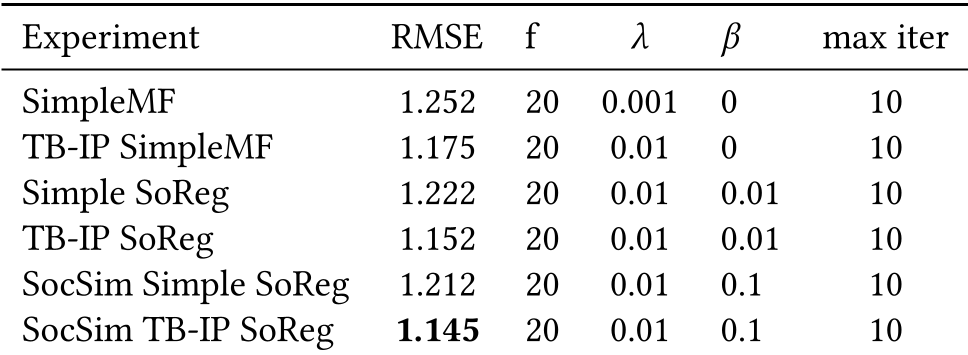 Table 1: Comparing RMSE across different experimental setups on the Yelp dataset.
Critical Analysis & Conclusion
The "Friendship" vs "Trust" Distinction
An interesting observation by the authors is that the method performed significantly better on Yelp than on Epinions. They hypothesize this is because Yelp represents real-life social friendships, whereas Epinions represents a more transactional "trust" network. This highlights a critical lesson for researchers: the semantics of the graph matter as much as the topology.
Limitations & Future Work
While effective, the TB-IP algorithm requires manual tuning of thresholds and decay factors. The authors suggest that future iterations could use Deep Learning (specifically GNNs or Autoencoders) to learn these latent features and influence propagation parameters automatically.
Summary
This paper bridges the gap between sociology and collaborative filtering. By acknowledging that we are influenced not just by our friends, but by "their friends" through a mathematically bounded propagation model, it provides a more accurate and efficient path for modern recommender systems.