
The Creative Echo Chamber: Why GPT-4 is a "Homogenization Machine" Despite Its Brilliance
Homogenizing effect of large language models (LLMs) on creative diversity: An empirical comparison of human and ChatGPT writing
This study quantifies the "homogenizing effect" of Large Language Models (LLMs) like GPT-4 on creative writing using a novel "diversity growth rate" metric. Analyzed across 2,200 college admissions essays, the research finds that while GPT-4 can produce high-quality individual outputs, it contributes significantly fewer unique ideas to a collective pool compared to human writers.
TL;DR
A new study from Georgetown University reveals a startling paradox: Large Language Models (LLMs) can help you write a more "creative" individual essay, but if everyone uses them, the world’s collective pool of ideas will rapidly shrink. Using a novel metric called the Diversity Growth Rate, researchers proved that human groups produce a much wider range of unique ideas than AI groups—even when the AI is prompted to be "as creative as possible."
The Hidden Cost of Algorithmic Monoculture
We’ve all seen the headlines: "GPT-4 passes the Torrance Test of Creative Thinking" or "AI outperforms humans in divergent thinking tasks." However, these benchmarks are static. They measure how creative a single output is in isolation.
The real-world danger isn't about one essay; it’s about one million. If thousands of college applicants or job seekers use the same underlying model (e.g., GPT-4), we face an Algorithmic Monoculture. Because LLMs are probabilistic engines trained to predict the "most likely" next token, they naturally gravitate toward the center of a distribution. They favor the conventional over the truly "weird" or "path-breaking."
Methodology: Measuring the Growth of Ideas
The researchers analyzed 2,200 college admissions essays. To go beyond simple quality scores, they developed the Diversity Growth Rate (DGR).
Imagine you are collecting seashells. If every new shell you find looks different from the last, your "diversity growth" is high. If after the fifth shell, every subsequent one looks nearly identical to the first five, your growth has saturated.
The study used Divergent Semantic Integration (DSI)—a technique leveraging BERT embeddings—to measure the "semantic distance" between words. The further apart the concepts (e.g., linking "robotics" to "neural connectomes of worms" vs. just "programming"), the higher the creativity.
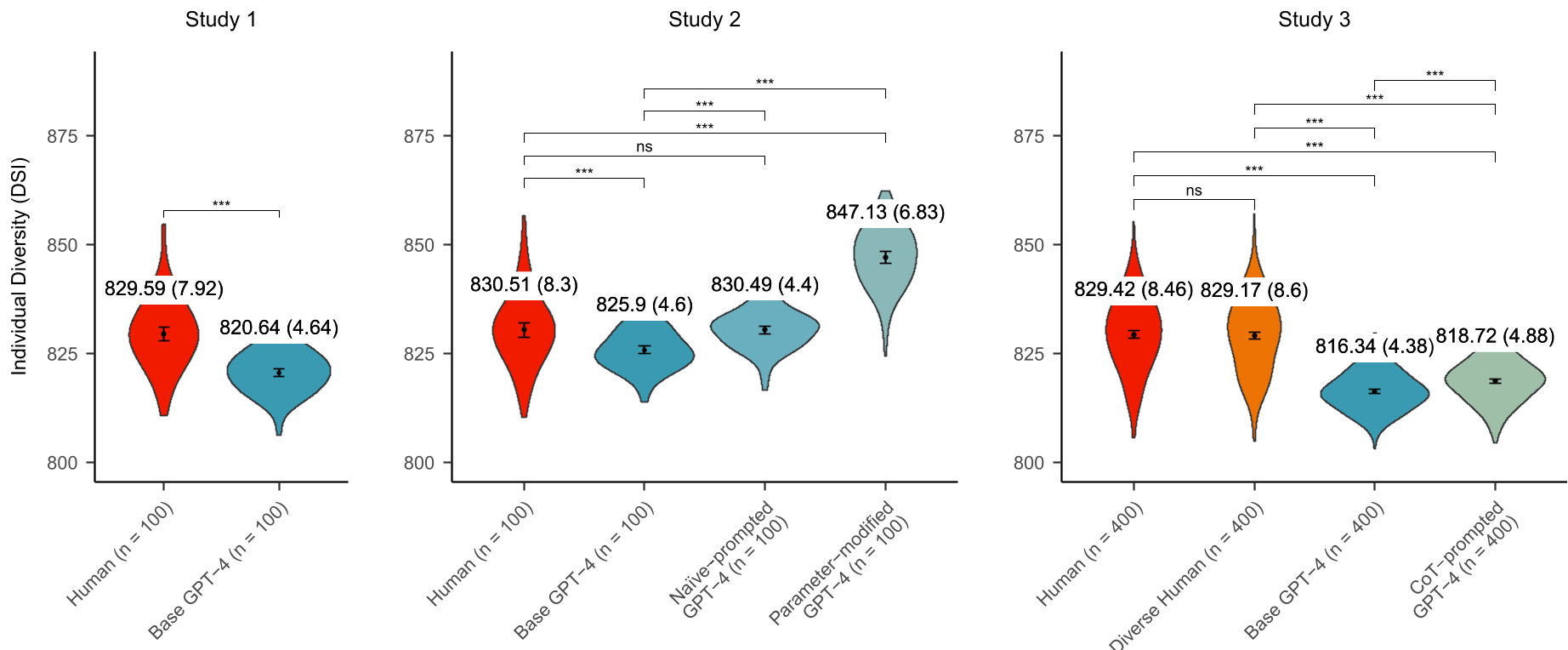 Fig 1: While AI (especially with parameter mods) can achieve high individual diversity, it struggles to maintain that variety across a group.
The "Paradox" of AI Creativity
The most fascinating finding came in Study 2 and 3. The researchers tried to "fix" the AI by:
- Naïve Prompting: Telling it to "be as creative as possible."
- Parameter Modification: Maxing out
presence_penaltyandfrequency_penaltyto force the model to use new words. - Chain-of-Thought (CoT): Forcing the model to reason through the applicant’s background step-by-step.
The Result? While parameter modifications made individual AI essays wildly diverse (sometimes even nonsensical), the group of AI essays still became repetitive much faster than the group of humans.
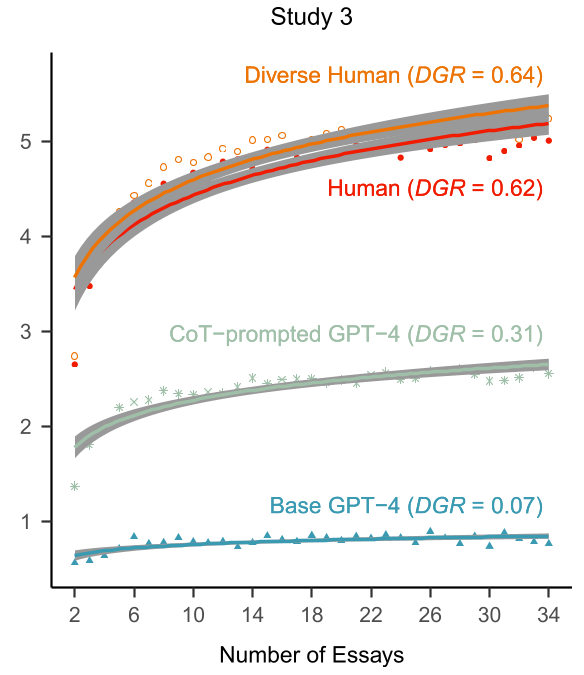 Fig 2: The steep slope of the human line (Blue) shows that every new human essay adds significant new ideas. The flat AI lines (Red/Purple) show that ChatGPT quickly runs out of "new" things to say.
Why Does This Happen?
The study points to two systemic limiters:
- Autoregressive Optimization: LLMs are built to find the "probable." Novelty is, by definition, "unlikely."
- RLHF (Reinforcement Learning from Human Feedback): To make AI "safe," we train it to align with common human preferences. This "sanding down the edges" inevitably kills the outliers that define true creative diversity.
Critical Insight: The Future of Innovation
If we replace human ideation with AI assistance, we aren't just making things easier; we are narrowing the sieve of human thought. The diversity growth of human writing was 2 to 8 times higher than baseline GPT-4.
The Takeaway: For industries that rely on "thinking outside the box"—such as R&D, higher education, and screenwriting—AI should be viewed as a productivity tool, but never as a source of collective variety. To preserve the "Diversity Growth Rate" of our culture, we must ensure that the "human-in-the-loop" isn't just a reviewer, but the primary source of the "unlikely" ideas that AI, by its very architecture, is designed to ignore.
Limitations & Future Work
The study focused on college essays (a naturally somewhat homogeneous genre). Future research should apply the DGR metric to academic abstracts or news media to see if our global information diet is becoming a "gray soup" of probabilistic text.