
Lo-Fi Matchmaking: Why Social Logic Trumps High-Tech Interfaces
Lo-Fi Matchmaking: A Study of Social Pairing for Backpackers
The paper "Lo-Fi Matchmaking" investigates requirements for mobile social software (MoSoSo) through low-fidelity role prototyping with backpackers in Australia. It identifies three distinct social pairing types—Past-Past, Past-Future, and Future-Future—finding that Past-Future pairings are highly valued for travel information exchange while automated Future-Future pairings are often redundant or ineffective.
TL;DR
This research challenges the "tech-first" approach to mobile social software by using paper cards and role-playing to study backpackers. It reveals that the value of a social connection isn't just about proximity, but the asymmetry of information: pairing someone who has been somewhere with someone who wants to go there is the "sweet spot" of social utility.
Contextualizing the Nomad
Backpackers represent the ultimate "Extremely Mobile" demographic. They are constantly moving, rely on "travel gossip," and form transient social networks that dissolve as quickly as they form. While developers often rush to build apps for such groups, Axup et al. stepped back to ask: Why would they even use a pairing system?
The study moves away from traditional HCI (Human-Computer Interaction) by using Lo-Fi Role Prototyping. By stripping away the screen, the researchers forced participants to engage with the concept of being paired by an algorithm, rather than complaining about a menu's font size.
The Social Topology of Travel
The researchers identified three types of "Ties" that define travel interactions. This taxonomy is vital for anyone designing social discovery apps today:
- [Past-Past]: Reliving memories. Entertaining and good for bonding, but low utility for future planning.
- [Past-Future]: The "Expert-Novice" dynamic. This had the highest utility (Rating: 3.75/5). It is the engine of travel information exchange.
- [Future-Future]: People going to the same place. Surprisingly, this failed (Rating: 1.3/5). Users felt they had nothing to talk about yet—they were both equally "clueless."
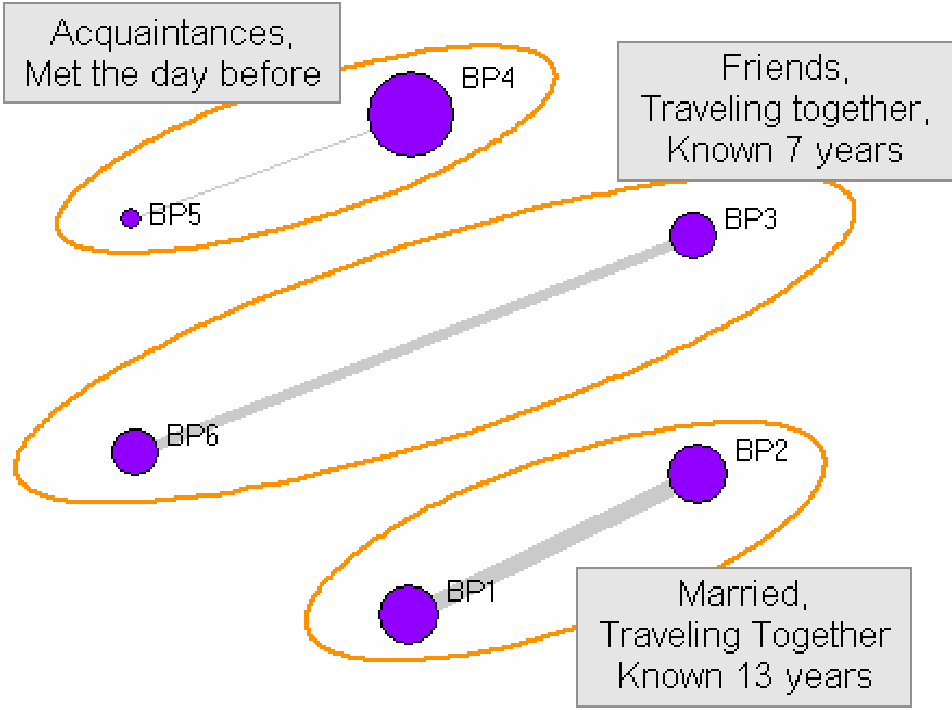 Figure: Initial social network mapping in Study 1, identifying the flow of information between participants.
Methodology: Simulating the Algorithm
The "algorithm" was actually a human researcher manually matching backpackers' index cards during a boat trip to a Koala Sanctuary.
The "Spout" vs. The "Pool"
A fascinating outcome of the social network analysis was the identification of specific user roles:
- Information-Spouts: Experienced travelers (moving in the opposite direction) who push out huge amounts of data.
- Information-Pools: Novices who absorb data but have little to contribute yet.
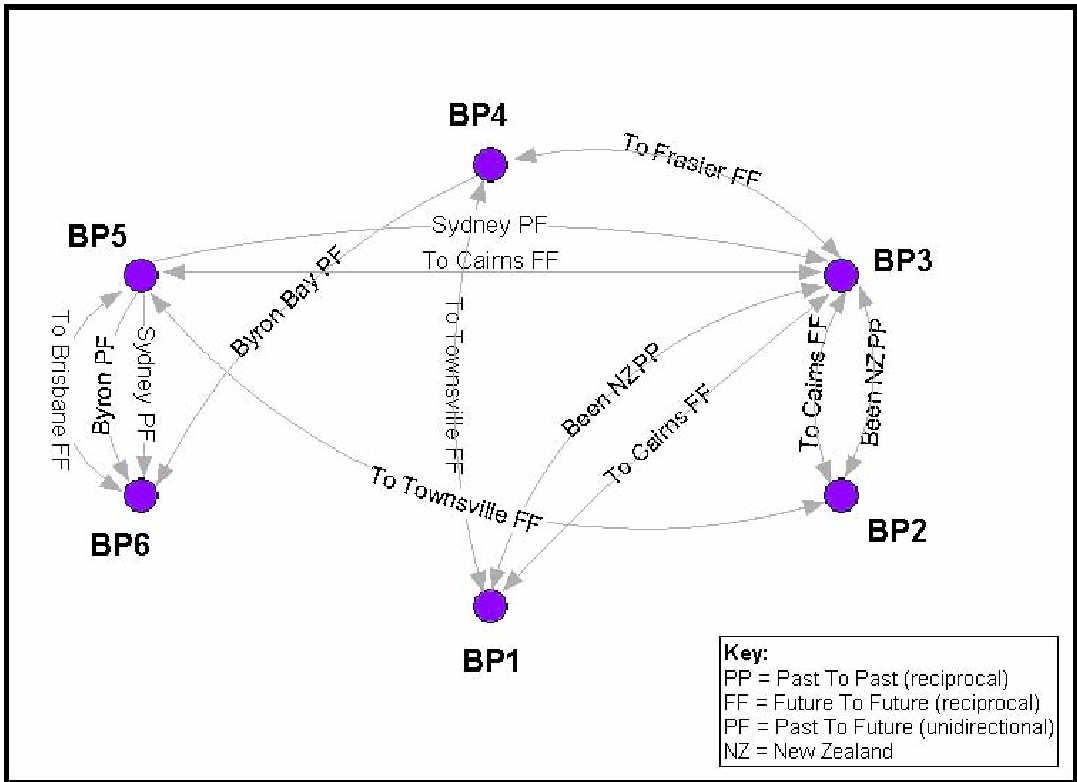 Figure: Visualization of information flow, highlighting hubs (spouts) and consumers (pools).
Critical Insight: The Reputation Gap
One of the deepest takeaways of the paper is the "Social Responsibility" dilemma. Because backpacker networks are so transient, there is little incentive for an "Information-Spout" to keep giving if they never see the recipients again.
The authors argue that for MoSoSo (Mobile Social Software) to be sustainable, we must bake in reputation systems. If a system can track that you were helpful in Brisbane, that "social capital" should follow you to Cairns, ensuring that others are more likely to help you in return.
Conclusion & Future Value
This paper is a masterclass in needs-led design. It proves that:
- Reciprocity is Key: Automated pairing should focus on "I have what you want, and vice versa."
- Context matters: Direction of travel (North vs. South) is a better predictor of pairing success than simple proximity.
- Interface Invisibility: Lo-fi methods reveal social frictions (like a pairing feeling "too formal") that high-fi prototypes often mask.
For modern product managers in the "Social Discovery" space, the lesson is clear: Stop optimizing the "Like" button and start optimizing the information asymmetry between your users.
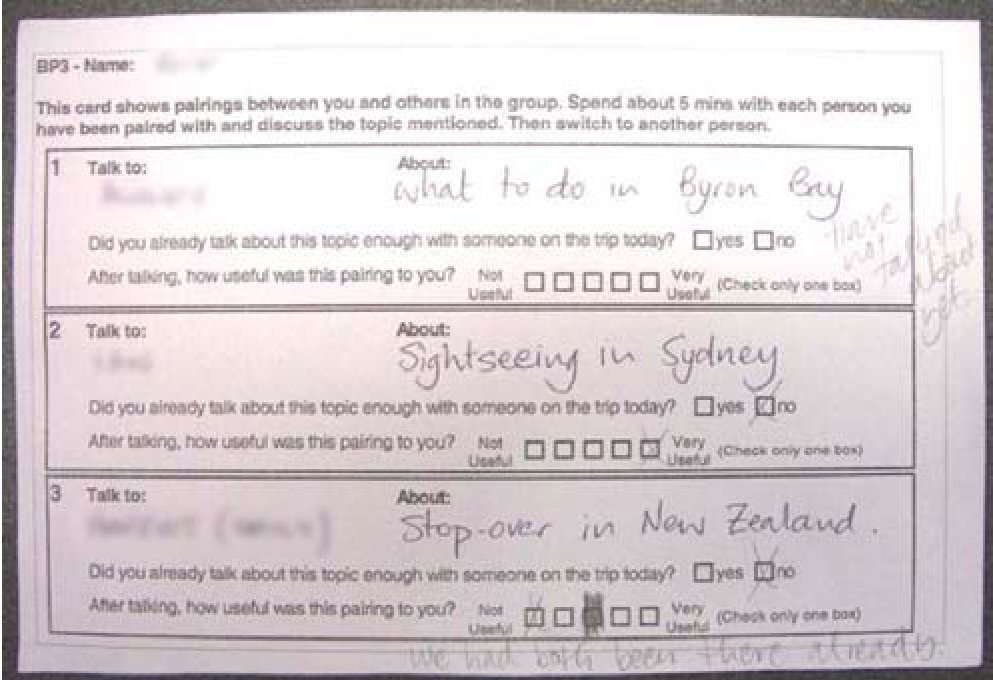 Figure: The Lo-Fi "Role Prototype" index card used to collect utility data without a digital interface.