
Local Matching Dynamics: Why Your Social Network Strategy Might Take Exponential Time
Local matching dynamics in social networks
This paper investigates the Stable Marriage and Roommates problems within social networks subject to locality constraints. It introduces the concept of "locally stable matchings" where agents only find partners through their 2-hop neighborhood (triadic closure) and proves that while polynomial convergence exists, oblivious dynamics often suffer from exponential delays.
TL;DR
In a world of decentralized social networks, we don't match with strangers; we match with "friends of friends" (triadic closure). This paper explores the Local Stable Matching problem, proving that while a path to stability always exists, simple decentralized strategies (like "better-response") often fall into exponential "traps" unless agents have a bit of memory of who they've met before.
Background & Positioning
Matching theory (Gale-Shapley) usually assumes every "Man" can see every "Woman." Martin Hoefer’s work shifts this into the realm of Network Topology. It sits at the intersection of Game Theory and Distributed Computing, specifically addressing how local information constraints change the convergence properties of stable systems. It moves beyond the "Job Market" models of Arcaute and Vassilvitskii (2009) by generalize preference structures and lookahead distances.
The Problem: The Locality Trap
In a social network, your "accessible" partners are your direct neighbors and those you can reach through a common link (2-hop neighbors). When you match with a 2-hop neighbor, you effectively "short-circuit" the network, potentially discovering new neighbors.
The problem is obliviousness. Without global coordination, agents might repeatedly break and form matches in a cycle that mimics a binary counter, leading to an exponential number of steps before the system reaches a "Locally Stable Matching"—a state where no pair of accessible players wants to deviate.
Methodology: The Edge Movement Graph
The paper’s most elegant tool is the Edge Movement Graph ().
- Nodes: Represent potential matching edges.
- Movement Edges: Represent how a player might switch from one partner to a better one discovered via triadic closure.
- Domination Edges: Represent how one strong match prevents several weaker ones.
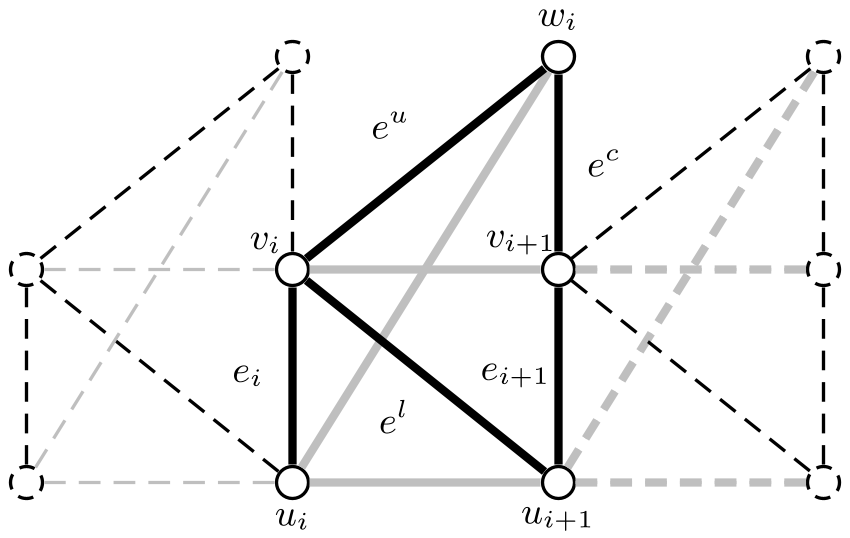 Figure 1: The "Edge Trap" structure used to prove exponential convergence for oblivious dynamics.
By analyzing paths in , Hoefer reveals that while a central coordinator could find a short path to stability, independent agents acting on "best-response" are easily "trapped" by structures where high-value edges are hidden behind several layers of lower-value "facilitator" matches.
High-Level Results
- The Good News: For (one-to-one matching) and (triadic closure), there always exists a polynomial-length sequence () to a stable state.
- The Bad News: For oblivious dynamics (random/concurrent), this time can be , effectively making stability unreachable in large networks.
- The Solution: Memory. If players have a "Random Memory" of past partners, they can occasionally jump across the network to re-engage with old contacts. This simple modification forces the system to converge in polynomial time .
Deep Insight: Memory as a Shortcut
The most profound takeaway is that Memory acts as a dynamic edge in the social graph. By remembering a past match, you aren't just remembering a person; you are maintaining a "wormhole" in the network topology that prevents the system from forgetting progress.
However, not all memory is equal. The paper shows that standard cache eviction policies like FIFO (First-In-First-Out) or LRU (Least Recently Used) can still result in exponential convergence because they might discard the very "anchor" edges needed to prevent the system from cycling.
Conclusion & Future Outlook
Hoefer’s work suggests that for decentralized matching platforms (like Tinder or LinkedIn), the efficiency of the "market" depends less on the search algorithm and more on how the user's searchable history is maintained.
- Limitation: The model focuses on "Correlated Preferences." If preferences are totally random/arbitrary, stability might not even exist in the roommates' case.
- Future Work: Applying these dynamics to multi-modal networks (e.g., matching users to both content and other users) could reveal how "echo chambers" are essentially locally stable matchings with high global regret.