
Decoding the Social Fingerprint: Motif Analysis in Large-Scale Email Networks
Local Topology of Social Network Based on Motif Analysis
The paper presents a local topology analysis of large email-based social networks using "network motifs" (3-node subgraphs). By identifying specific Triad Significance Profiles (TSPs), the authors establish a topological "fingerprint" that characterizes human communication patterns and differentiates them from biological or technical networks.
TL;DR
Is it possible to understand the global essence of a massive social network by looking at only three people at a time? This paper proves that "network motifs"—recurring patterns of interconnection—serve as a topological fingerprint. By analyzing email logs from a technical university, the researchers found that social networks belong to a unique "superfamily" characterized by heavy clustering and reciprocity, traits that become even more pronounced as the strength of the relationship increases.
Background: Why Local Discovery Matters
In the world of Graph Theory and Social Network Analysis (SNA), we often focus on the "big picture": who is the most central person? Where are the largest cliques? However, for networks with tens of thousands of nodes, these calculations become computationally prohibited.
The authors pivot from global to local, suggesting that local topology reflects global properties. Much like DNA defines an organism, specific multi-node patterns called "motifs" define the nature of a network, whether it is biological (gene transcription), technical (the WWW), or social.
The "Broken" Reality of Prior Work
Most prior motif studies focused on small networks (<100 nodes) or unweighted graphs. They ignored a crucial human element: Communication Intensity. Sending one email to a stranger is not the same as a daily exchange with a close colleague. The authors address this by introducing a weighted relationship strength (RS) formula that accounts for both the frequency of messages and the number of recipients per email (filtering out "spammy" broadcast behavior).
Methodology: The Anatomy of a Triad
The core of the study involves Directed Triads—every possible way three people can be connected by directional arrows (emails). There are exactly 13 such configurations.

The researchers used the Z-score to determine "significance." A motif is significant not just if it is frequent, but if it appears way more often than it would in a random network of the same size. If , the network "favors" that pattern; if , it "repels" it.
Key Insights from the Data
1. The Strength of Mutuality
As the strength of the tie increases (Class 1 to Class 5), the percentage of mutual edges jumps from 1.2% to a staggering 16.2%. This confirms the sociological intuition that strong human bonds are built on reciprocity.
2. Broadcasters vs. Clusters
In the total network, Motif 1 (a single outgoing arrow) has a high Z-score, indicating many "broadcasters" (administrative emails, newsletters). However, as we look at stronger ties (Class 5), the Z-score for M1 plummets, and Motif 13 (a fully connected clique) skyrockets.
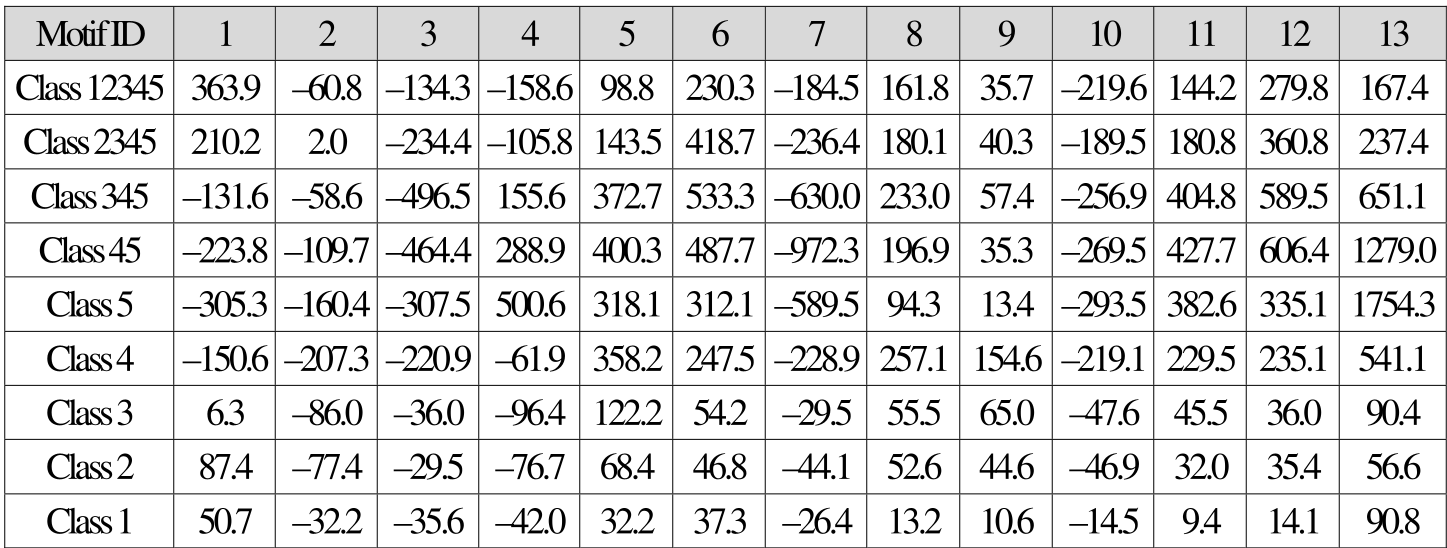
3. The Social Fingerprint (TSP)
The "Triad Significance Profile" (TSP) acts as a visual signature. Despite varying communication intensities, the shape of the curve remains remarkably consistent across classes. This proves that the social "superfamily" identity is robust.
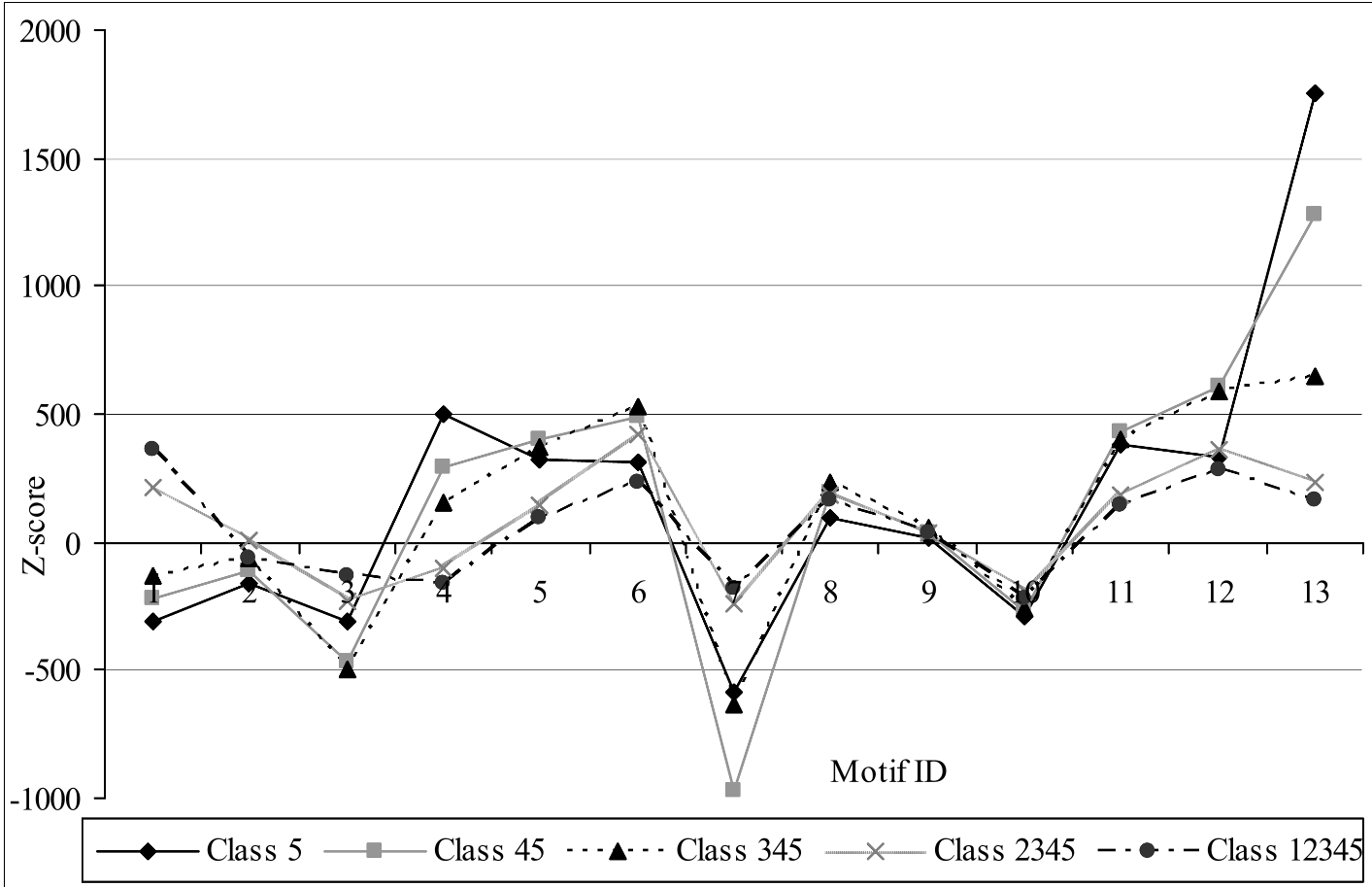
Deep Insight: The "Strong Tie" Paradox
The most profound takeaway is that if you want to understand a network's true character, you should look at its strongest ties. The researchers found that while Class 5 ties represented only 11% of the total edges, they provided the most "distinctive" version of the network's fingerprint. In essence: The essence of a social network is concentrated in its most intense interactions.
Conclusion & Future Work
The paper successfully demonstrates that motif analysis is a fast, efficient "compression" technique for network profiling. By observing how motifs change over time, future researchers could potentially track how social groups evolve or even identify the "executives" of a network (nodes that receive many reports while being deeply embedded in clusters).
Limitations: The study is limited to a single university domain. To truly validate these "superfamilies," we need to see if the same Triad Significance Profile holds for modern Slack channels or encrypted messaging apps.