
Locating Identities in Time: How LBSNs Turn Your Past Into a Tool for Self-Reinvention
Locating Identities in Time: An Examination of the Formation and Impact of Temporality on Presentations of the Self through Location-Based Social Networks
This paper introduces "GeoMoments," a custom-built Location-Based Social Network (LBSN), to investigate how users' self-identity and temporal perceptions evolve over a six-week deployment. By analyzing 2,458 data points and qualitative interviews, the study provides a longitudinal understanding of how digital locational traces reshape human behavior and "spatial self" narratives.
TL;DR
Is your digital check-in history a simple diary, or a sophisticated "front stage" for an ongoing performance? This study introduces GeoMoments, a custom LBSN, to prove that our "Spatial Self" is not static. Over six weeks, users transitioned from mimicking others to aggressively curating their digital footprints, even deleting "uncool" parts of their past to safeguard their future social status.
Background: The Ghost in the Map
In the world of Location-Based Social Networks (LBSNs) like Foursquare or Swarm, we often focus on the where. But this research argues that the when—the temporality of our locational traces—is what truly defines our digital identity. The authors position LBSNs as "durational objects," acting as digital data banks that allow our past selves to bleed into our present actions.
Problem & Motivation: Beyond the One-Off Check-in
Existing HCI research often views identity through Erving Goffman’s "front stage" lens—essentially, how we wear "masks" in social situations. However, these studies usually offer a snapshot in time. The authors realized that we lack an understanding of how the accumulation of these moments over time becomes a project of "self-documentation." They wanted to see how a user's relationship with their own locational history changes their physical movement and social hierarchy.
Methodology: The GeoMoments Experiment
The researchers built GeoMoments from scratch to avoid the biases of established commercial apps and to navigate mapping restrictions in China.
Architecture of a Probe
The app featured "Moments" (geotagged photos/text), a notification system, and—most crucially—a private archive of the user's own GPS traces and history.
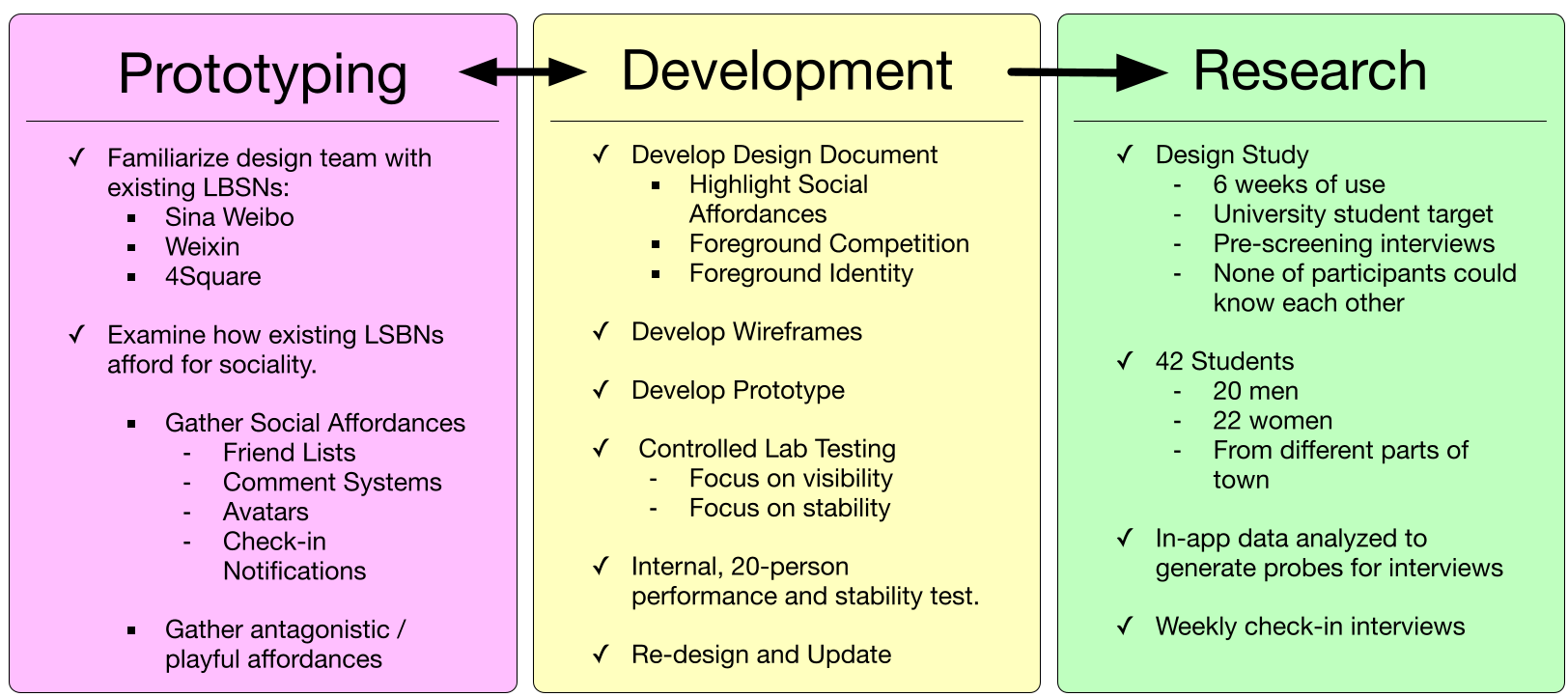 The design focused on "amplifying" social affordances to observe performativity "in the wild."
The 6-Week Evolution of the Self
Phase 1: Mimicry and Perceptual Shifts (Weeks 1-2)
Initially, users were hesitant. They only posted where others had posted, leading to "social synchrony." Interestingly, seeing others' moments in specific areas actually changed users' perceptions of the city—turning "dangerous" highways into "renovated" usable routes.
Phase 2: Playful Antagonism and Territory (Weeks 3-5)
As the "blank canvas" filled up, the behavior turned competitive. Users began "claiming" areas (like malls or neighborhoods) by flooding them with posts.
- Territorial Warfare: Using terms like "stealing my area," users defended their "local" status.
- Identity Safeguarding: Users became hyper-aware of "surveillance," refusing to post at "uncool" places like libraries or cheap noodle shops to maintain their persona.
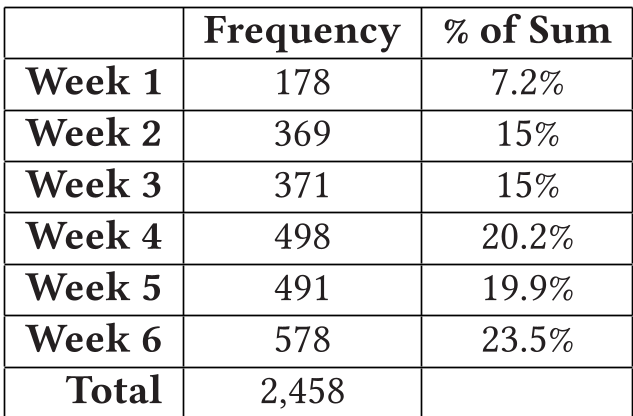 Usage frequency grew steadily as social stakes increased throughout the study.
Phase 3: The Temporal Nudge (Week 6)
By the final week, the archive became a tool for reflection. One user noted they had 30 moments of drinking but only 3 at the gym, prompting a lifestyle change. This is the "Temporal Nudge"—where the past self structures the future.
Depth Insight: The Recursive Self
The most striking finding was that users deleted their past to fix their present. When a user's past posts did not align with their "new, cool" identity, they treated the LBSN as a "nebulous memory container," pruning their history to ensure their "Spatial Self" looked consistent to potential (even if invisible) audiences.
Critical Analysis & Conclusion
Takeaway
The study successfully adds a Temporal Dimension to locative media theory. It proves that identity on LBSNs is not just about where you are, but how your history at that location constructs a narrative of authenticity and power (territoriality).
Limitations & Future Work
The study was limited to a small group (42 students) in a specific urban park. The researchers suggest that future work should investigate if these "temporal components" can be intentionally designed to facilitate positive behavioral changes, rather than just social competition.
Final Thought: Our digital footprints are not just memories; they are the architectural blueprints of who we are becoming.