
Beyond Centrality: Hunting Key Actors via Bayesian Entropy
Locating Key Actors in Social Networks Using Bayes’ Posterior Probability Framework
The paper proposes a novel framework for Social Network Analysis (SNA) that combines Bayes' Theorem with Shannon's Entropy to identify key actors. By calculating posterior probabilities and measuring "entropy change" upon node removal, it successfully pinpoints critical leaders in both hierarchical and complex random networks.
TL;DR
Locating the "brains" of a terrorist cell or a criminal enterprise is rarely as simple as counting their friends. This paper introduces a robust mathematical framework using Bayes' Posterior Probability and Shannon's Entropy to identify key actors. By measuring how much "balance" or "uncertainty" a node provides to the system, the authors can pinpoint leaders that traditional graph metrics might miss.
Background: The Fog of Social Graphs
After 9/11, Social Network Analysis (SNA) became a frontline tool for national security. However, covert networks are designed to be resilient and deceptive. Traditional measures like Degree Centrality (who has the most links) or Betweenness (who is the bridge) assume the data is complete. In reality, links are often hidden, and a "leader" might maintain a low profile. The core insight of this paper is that an actor's importance is best measured by how the total network uncertainty changes if they disappear.
Methodology: The Bayesian-Entropy Hybrid
The authors break away from static graph counts and move toward a probabilistic view of network influence.
1. The Bayesian Layer
They define the probability of a node being a "Key Actor" using Bayes' Theorem:
- Prior : The initial guess based on network size.
- Evidence : Computed based on the links incident to the node.
- Posterior : The refined belief that a node is a central player after considering its connectivity.
2. The Entropy Layer (The "Vulnerability Test")
Once posterior probabilities are established for all nodes, the system calculates the network's Shannon Entropy (). Entropy here represents the level of uncertainty or "disorder" in the network structure.
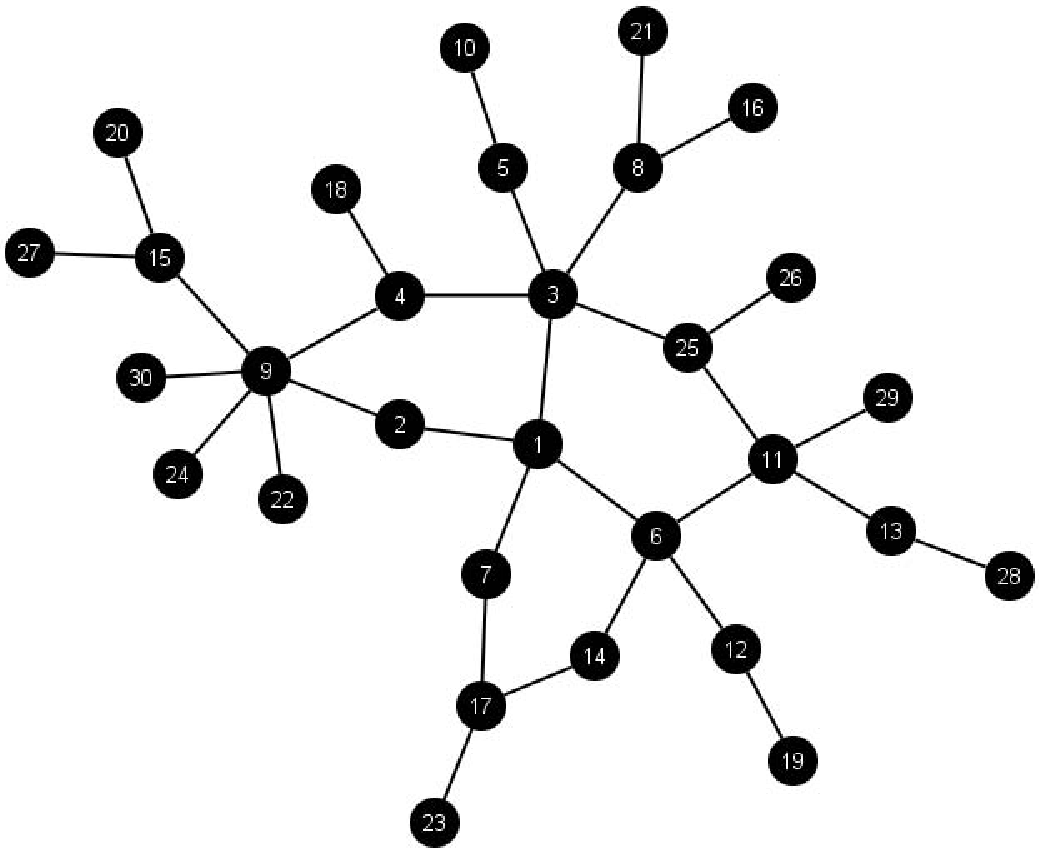 Figure 1: A hierarchical 30-node network used to test the Bayesian-Entropy framework.
The "Stress Test" involves:
- Calculating total entropy .
- Successively removing one node at a time.
- Measuring the new entropy .
- The nodes causing the maximum entropy change are flagged as the true Key Actors.
Experimental Insights: Seeing the Unseen
The researchers tested their model on two distinct types of networks: a hierarchical organization (30 nodes) and a complex random graph (60 nodes).
Detecting the Real Power
In the complex 60-node network, several nodes had the same "Degree Centrality" (6 links). Traditional tools would treat them as equally important. However, the Entropy method revealed that Node 58 was significantly less important than Node 20 or 28.
Why? Because Node 58's removal didn't fundamentally shift the network's structural uncertainty as much. It was a "well-connected placeholder" rather than a strategic bridge.
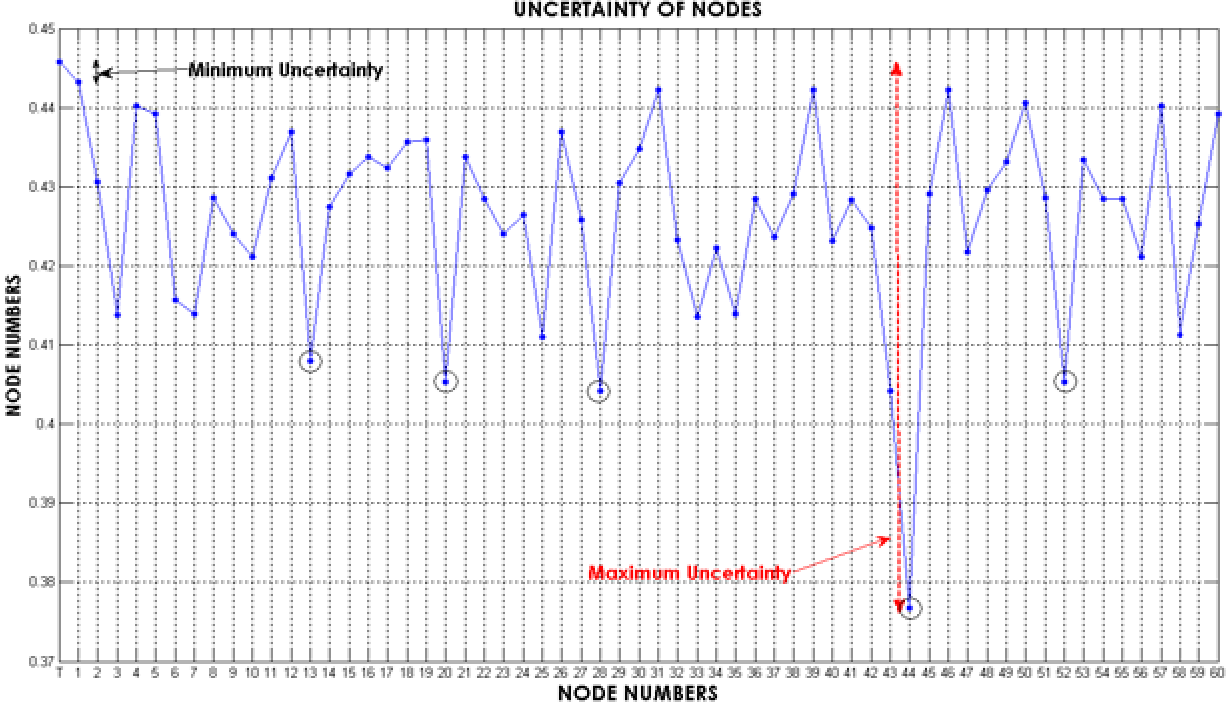 Figure 2: Plot of Node Uncertainty. The peaks and valleys clearly distinguish key actors from secondary followers.
Critical Analysis & Future Outlook
Takeaway: This work proves that "Importance" is a global property, not a local one. A node’s value isn't just about its connections, but about the information stability it provides to the whole group.
Limitations:
- The model currently assumes the "prior probability" is a simple function of network size.
- It treats all links as equal, ignoring the content of the messages (e.g., a link carrying a command is more important than a link carrying small talk).
Future Directions: The authors suggest incorporating Natural Language Processing (NLP) to analyze "message content" as a weight for the prior probability. This would allow the system to distinguish between a leader giving orders and a social butterfly chatting with everyone.
Conclusion
By treating a social network like an information system, we can quantify the "Uncertainty" of its survival. This Bayesian-Entropy approach provides a surgical tool for authorities to identify and isolate the core pillars of hostile organizations.