
The Geography of News: Understanding Contributor Preferences in Location-Based Crowdsourcing
Location-based crowdsourcing of hyperlocal news: dimensions of participation preferences
This paper explores mobile users' preferences and privacy concerns regarding Location-Based Assignments (LBA) and geotagging in hyperlocal news crowdsourcing. Using a framework of seven participation dimensions, the researchers demonstrate that users are generally willing to share location data with newsrooms when the perceived benefits of collaboration outweigh the privacy risks.
TL;DR
Journalism is evolving from a one-way broadcast to a collaborative "pro-sumer" model. This paper investigates how newsrooms can use Location-Based Assignments (LBA) and geotagging to mobilize "reader reporters." By analyzing user psychology and field experiments, the researchers developed a framework that shows readers are surprisingly willing to share their location—provided they have control over the when, where, and how.
Context: The Hyperlocal Motivation
Hyperlocal news thrives on proximity. For a newsroom, knowing exactly where a "breaking" event occurs is vital, but having a volunteer already on the scene is transformative. However, the "creepiness factor" of being tracked by a news organization is a major barrier. The researchers sought to find the "sweet spot" where the utility of a news assignment outweighs the privacy cost to the individual.
Methodology: Testing the "Reader Reporter"
The study utilized a quasi-experiment where participants received simulated SMS assignments based on their real-time location. The researchers tracked a variety of "Participation Dimensions" to see which variables moved the needle on user acceptance.
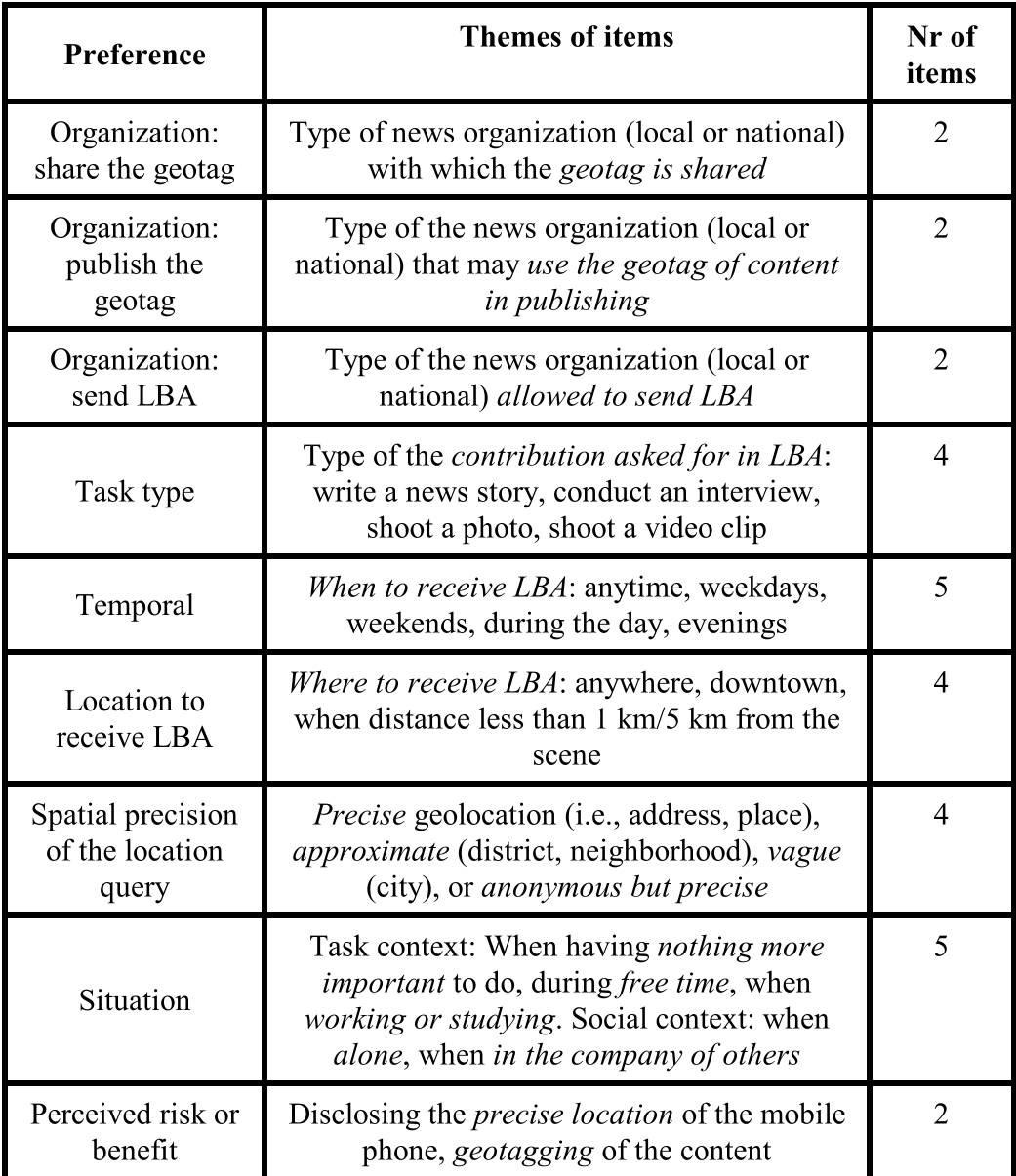
The Seven Key Dimensions
Through their analysis, the authors identified seven pillars that dictate whether a user will accept a location-based task:
- Organization: Does the user trust the local vs. national news outlet?
- Task Type: Is it a simple photo (high preference) or a complex interview (low preference)?
- Temporal Context: Is it a workday or a weekend?
- Spatial Proximity: How far is the user from the event?
- Precision: Do they want to be tracked to the exact address or just the neighborhood?
- Situation: Are they alone, with family, or busy at work?
- Incentives: Is there a monetary reward or "fame" (byline)?
Key Insights: Privacy is Context-Dependent
One of the most profound findings is that General Privacy Concern does not equal Contextual Privacy Concern. Participants who scored high on general internet privacy worries were often still willing to geotag their news photos.
The "Power of the Neighborhood"
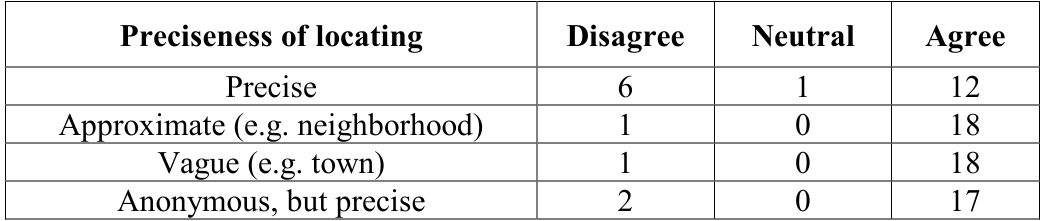
Users strongly preferred location obfuscation. While they were hesitant to share their exact GPS coordinates, they were almost universally comfortable sharing their location at a "neighborhood" or "district" level. This granularity is often "good enough" for a newsroom to decide whether to send a task.
Proximity is the Catalyst
The willingness to participate spikes dramatically when the user is within 1 km of the reporting scene. The "cost" of participation (travel time) is the primary friction point. If the task is literally "across the street," the user feels a sense of civic duty and ease of completion.
Critical Analysis: From Volunteering to "Gig Work"
The study hints at a shift in the "social contract." When newsrooms start pushing assignments based on location, readers start viewing themselves less as "engaged citizens" and more as "contracted freelancers." Many participants mentioned that if they are being tracked for "work," they expect monetary compensation. This poses a challenge for traditional crowdsourcing models that rely on altruism.
Conclusion and Future Outlook
This work provides a roadmap for the next generation of news apps. To minimize the "feeling of being watched," developers should:
- Prioritize "Pull" over "Push": Let users find tasks on a map rather than tracking them in the background.
- Anonymize by Default: Allow geotagging of content while keeping the user's home location private.
- Focus on Visual Media: Readers are far more comfortable as "eyes on the ground" (photo/video) than as "citizen journalists" (interviewers).
As location-based technology becomes ubiquitous, the "wisdom of the crowd" will likely become a "map of the crowd," turning every smartphone-wielding citizen into a potential hyperlocal sensor.