
HRV: Mastering Connectivity in the Dynamic Chaos of Urban Hybrid VANETs
Location-Based Crowdsourcing for Vehicular Communication in Hybrid Networks
This paper introduces HRV (Hybrid Routing in VANETs), a comprehensive framework for vehicular communication that integrates location-based crowdsourcing of Roadside Units (RSUs) with adaptive routing protocols. It combines a probabilistic RSU localization algorithm (HRVretrieval) with network coding-based multicast for dense networks and opportunistic routing for sparse environments.
TL;DR
The paper presents HRV (Hybrid Routing in VANETs), a holistic system designed to bridge the gap between ad-hoc vehicular movement and fixed infrastructure. By using a novel probabilistic RSU retrieval method and MDS-based network coding, HRV optimizes data dissemination across both dense and sparse vehicular grids, achieving high delivery ratios even when GPS is unreliable.
Problem & Motivation: The Connectivity Gap
Vehicular Ad Hoc Networks (VANETs) are notoriously difficult to manage. Unlike static networks, nodes (cars) move at high speeds, and urban obstacles constantly disrupt signals.
- Prior Limitation: Traditional protocols like DSR rely on stable routes that simply don't exist in intermittent vehicular traffic.
- The Infrastructure Blind Spot: Vehicles often don't know where the nearest Roadside Unit (RSU) is because databases become obsolete or GPS signals fail in tunnels and "urban canyons."
- Coding Overhead: Existing network coding solutions like CarTorrent use large finite fields that introduce unnecessary computational lag.
The authors' Insight: If we treat every vehicle as a sensor (Crowdsourcing) to map the infrastructure and use adaptive coding based on local density, we can create a "self-healing" communication fabric.
Methodology: The Core of HRV
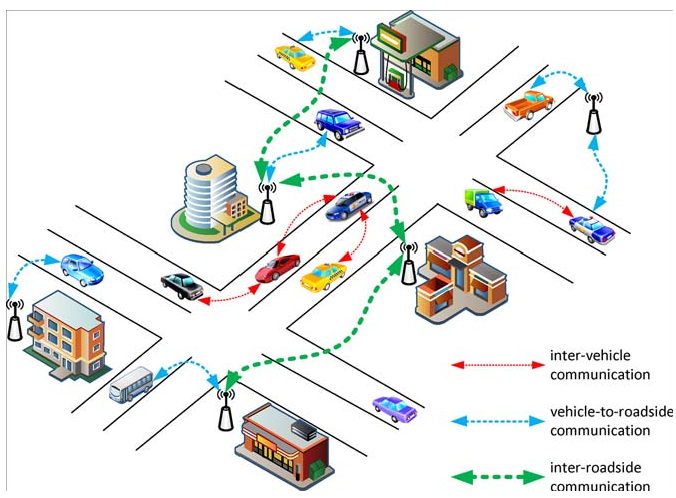
HRV operates on a three-tier logic: RSU Retrieval, Multicast Routing, and Opportunistic Switching.
1. HRVretrieval: Crowdsourcing the Infrastructure
The system doesn't rely on a map. Instead, it uses Received Signal Strength (RSS). It models signal sources as a Gaussian Mixture Model (GMM) and employs an Expectation-Maximization (EM) algorithm to "guess" where the RSUs are.
- Grid Search: Coarse estimation on a coordinate plane.
- EM Refinement: Fine-tuning the coordinates.
- Credit System: Filtering out noise and spurious signals by rewarding "voted" locations.
2. HRVmulticast: The Power of MDS Coding
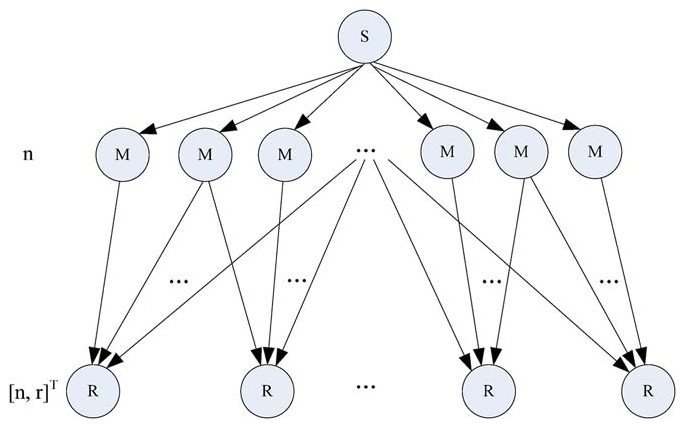
In dense traffic, HRV switches to multicast. To avoid the "global knowledge" requirement of standard linear coding, the authors use Maximum Distance Separation (MDS) codes.
- Goal: Achieve the Max-Flow Min-Cut bound.
- Optimization: It calculates the minimum finite field size required for decoding. This reduces the math overhead for the vehicle's onboard processor while ensuring that if one path fails, the data can still be reconstructed from other streams.
Experiments & Results
The authors validated HRV using both the NCTUns simulator (Manhattan grid) and a real-world testbed at UC Irvine using Open Mesh nodes.
Precise Localization
The experiment showed that as more vehicles contributed data (crowdsourcing), the RSU location error dropped significantly. With 300 data points, the error was reduced to 1.38m in simulation and 2.02m in the real testbed.
Latency and Delivery
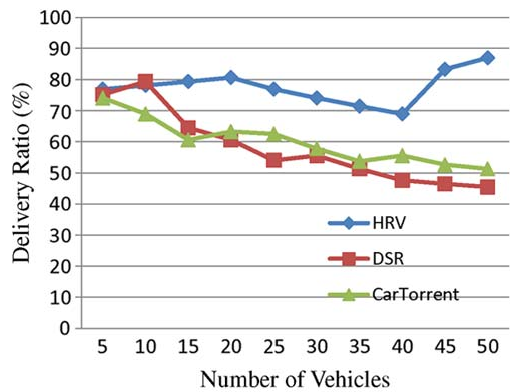
Compared to DSR and CarTorrent, HRV demonstrated:
- Lower Delay: Especially in high-density scenarios where CarTorrent’s large-field coding becomes a bottleneck.
- Higher Robustness: The delivery ratio remained stable even as the number of nodes increased, thanks to the adaptive switching to "carry-and-forward" (Opportunistic Routing) when gaps appeared in the network.
Critical Analysis & Conclusion
Takeaway
HRV succeeds because it doesn't assume a perfect world. It acknowledges that infrastructure is "invisible" and connectivity is "intermittent." By combining physical-layer signal modeling with information-theory-driven coding (MDS), it provides a mathematically sound yet practical architecture for V2X.
Limitations & Future Work
The current model assumes a relatively uniform path-loss exponent (). In reality, urban environments have highly variable shadowing. Future iterations would benefit from dynamic spectrum access (switching between Wi-Fi, LTE, and DSRC) to ensure the "Routing Switch" mechanism is truly seamless across different hardware standards.
Final Thought: HRV proves that crowdsourcing isn't just for traffic maps (like Waze); it's an essential tool for the low-level network layer of autonomous transport.