
Beyond GPS: Empowering LBS with Ontology and Collective Intelligence
Recommendation system using location-based ontology on wireless internet: An example of collective intelligence by using ‘mashup’ applications
This paper presents a Location-Based Service (LBS) recommendation platform that utilizes an ontology-driven knowledge base and "mashup" applications (OpenAPIs). By integrating user-generated content and real-time geographic data, the system provides personalized shop and movie recommendations through logic-based inference.
TL;DR
The paper introduces a scalable Location-Based Service (LBS) platform that shifts from provider-centric data to a Collective Intelligence model. By mashing up external APIs with a custom-built ontology, the system infers highly personalized recommendations—such as movie theaters that match a user's location, discount cards, and specific "free time" windows.
Academic Positioning: This work is a pioneering bridge between Semantic Web technologies and Web 2.0 mashup architectures, emphasizing the importance of user participation in maintaining up-to-date geographical knowledge bases.
The "Data Silo" Problem in Ubiquitous Computing
While GPS and mobile internet have become ubiquitous, LBS software has historically suffered from a "top-down" bottleneck. Service providers struggle to keep up with the ephemeral nature of local data (e.g., a restaurant closing or a change in discount policies). This research identifies two primary gaps:
- Static Information: Provider-driven databases lack the agility of crowdsourced data.
- Lack of Semantic Context: Most LBS focus on "nearness" but ignore complex logic like "I have 3 hours free, a student ID, and like action movies."
Methodology: The Ontology-Driven Mashup
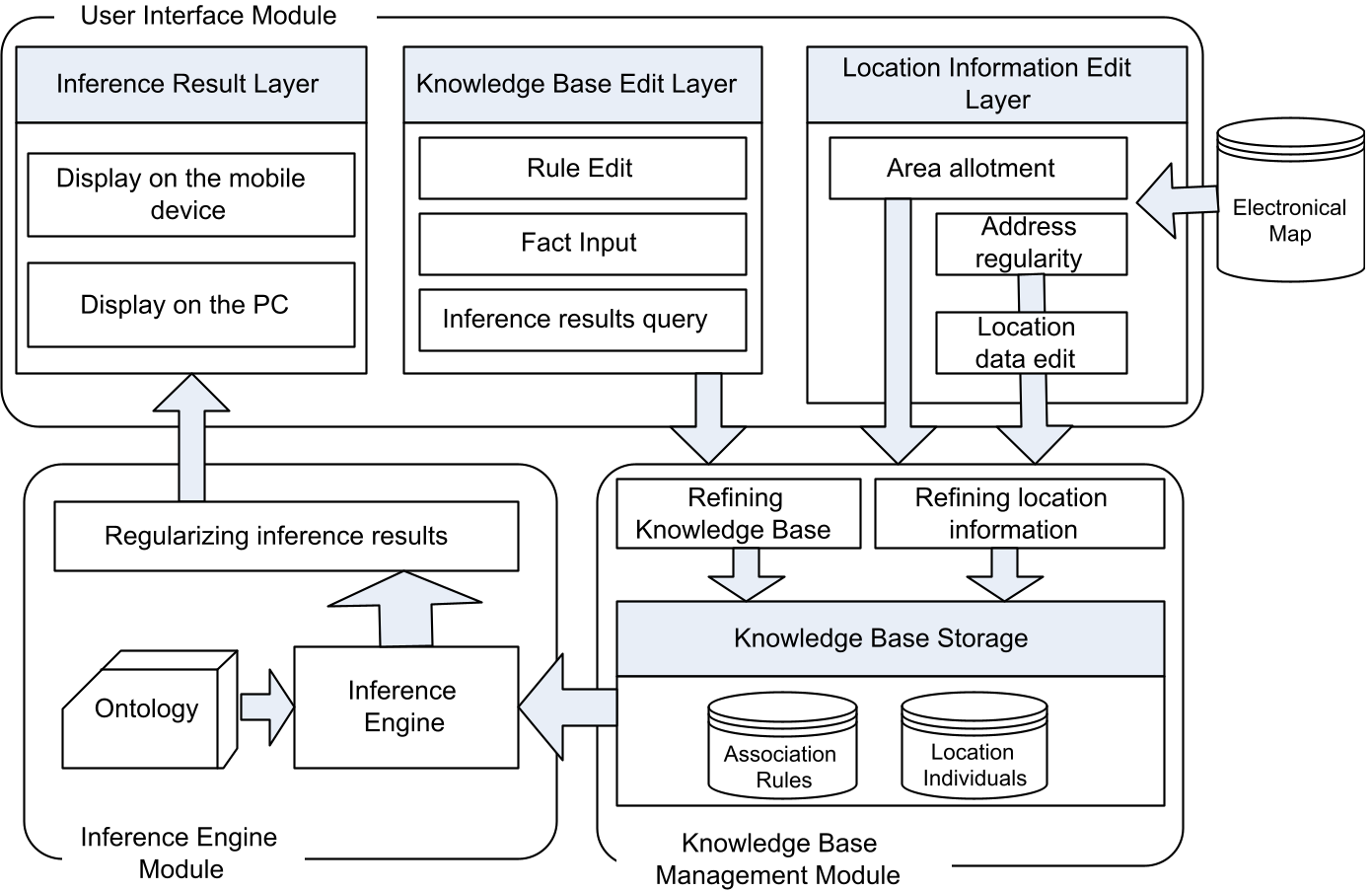
The heart of the system is a three-layer architecture: a User Interface, a Knowledge Base Manager, and an Inference Engine.
1. The Ontology Structure
The researchers built a comprehensive ontology using Protégé, categorizing entities into Shops, Time, and User Profiles. This allowed the system to understand that a "Movie Theater" is a subclass of "Shop" with specific attributes like "Ticket Price" and "Screening Schedule."
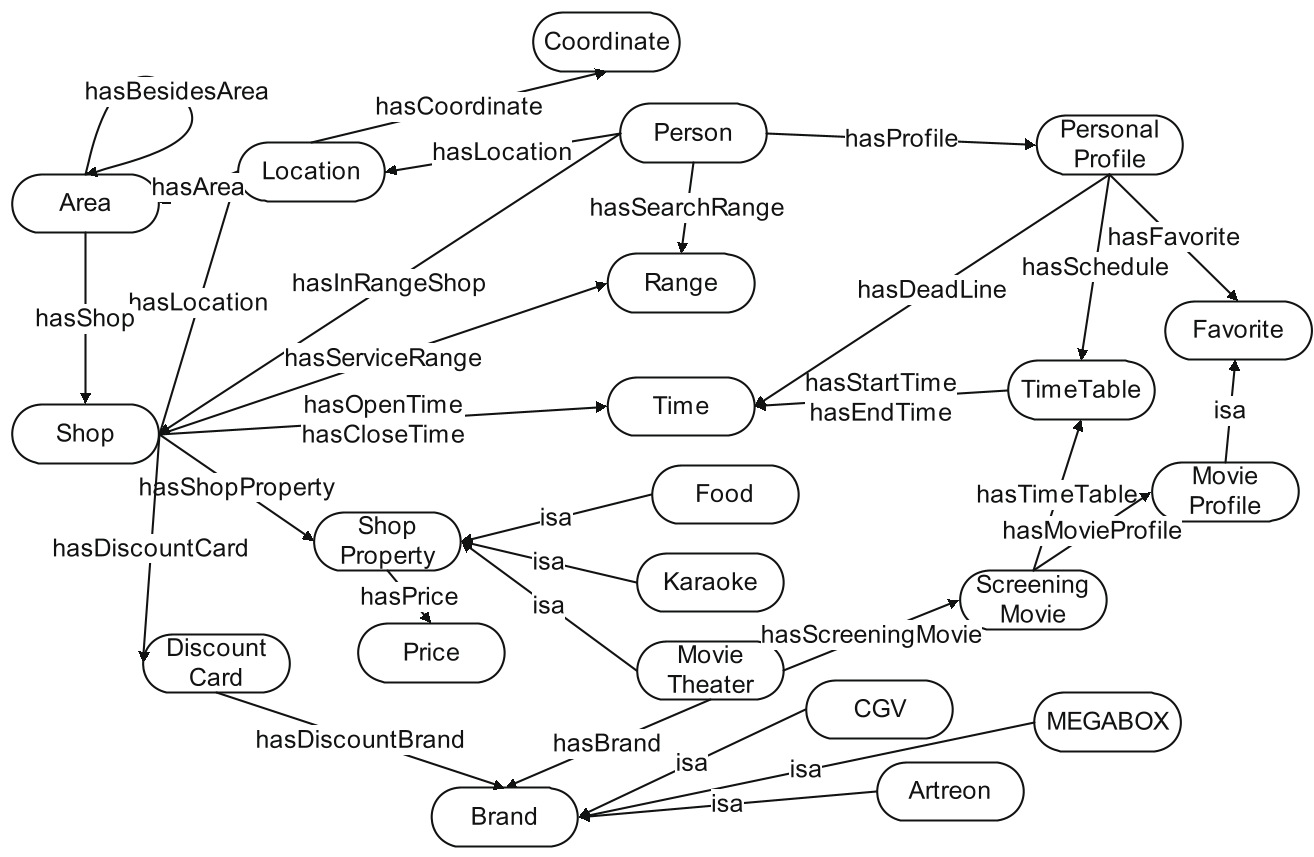
2. The Power of Mashups
Instead of building a global map and shop database from scratch, the authors used OpenAPIs:
- Daum OpenAPI: Used for search and shop identification.
- Naver Map API: Used for spatial visualization.
This integration ensures the system remains scalable while the custom ontology handles the "logic" that basic APIs lack.
3. Inference via Bossam
Using the RETE algorithm-based Bossam engine, the system executes forward-chaining inference. It matches "Static Data" (shop rules) with "Dynamic Data" (user's current GPS coordinates and current time). For instance, it provides an "Additional Discount" fact only if the user individual's "Occupation" attribute matches "College Student."
Experimental Validation
The system was tested in Sinchon, Seoul, a dense commercial district. By modeling 735 individuals and 173 association rules, the researchers proved the system could handle complex multidimensional queries.
In one scenario, a user looking for a movie was filtered not just by distance, but by:
- Time: Start times occurring after the current time but before the user's "available time" expires.
- Preference: Matching the user's favorite genre (Action) and avoiding "Uninteresting" ones.
- Cost: Incorporating specific membership card discounts (e.g., BCPlusCard).
Critical Insight & Conclusion
The true value of this work lies in its Semantic interpretation of the physical world. By treating every shop and user as a set of logical "individuals" in an ontology, the system transcends the limitations of simple proximity searches.
Limitations: While the "Collective Intelligence" aspect is robust, the paper relies on manual the knowledge base editor, which might face friction in a high-speed mobile environment. Future iterations would likely require automated NLP to extract ontology facts from user reviews.
Future Outlook: This framework sets the stage for today's "Super Apps," proving that the fusion of semantic rules and open data interfaces is the most viable path for real-time, context-aware recommendation systems.