
Q-PDT: Turning Social Networks into Urban Data Infrastructures
Using location based social networks for quality-aware participatory data transfer
This paper introduces Participatory Data Transfer (PDT), a novel framework for urban environmental monitoring that leverages Location-Based Social Networks (LBSN) to move data from sensors to aggregators. It proposes Quality-aware PDT (Q-PDT) to solve the joint optimization of sensor placement and data routing through mobile users while maintaining data quality guarantees.
TL;DR
In urban environments where Wi-Fi or cellular backhaul for sensors is too costly, humans can be the network. This paper introduces Quality-aware Participatory Data Transfer (Q-PDT), a framework that leverages Location-Based Social Networks (LBSNs) to turn pedestrians and drivers into "data mules." By linking physical proximity with digital social ties, the authors prove that optimizing this human-powered data flow is an NP-hard challenge requiring a balance between sensor coverage and social-routing efficiency.
The Core Motivation: The Infrastructure Gap
Building a "Smart City" is expensive. Traditional monitoring systems for pollution, noise, or traffic require a dense grid of sensors and a robust communication infrastructure. However, in many developing urban areas or specific environmental zones, installing dedicated wireless relays is financially unfeasible.
The authors' Research Intuition is elegant: We already have a massive, mobile infrastructure moving through every street—people with smartphones. By utilizing the "check-in" and "friendship" logic of social networks, we can create a delay-tolerant network (DTN) that costs nothing to maintain.
Methodology: High-Quality Data via Social Mules
The Q-PDT framework operates on two distinct layers:
- The Physical Layer: Sensors emit data to nearby mobile devices (via Bluetooth/Infrared).
- The Social Layer: Users exchange data packets only with designated "friends" within their LBSN. This adds a security and trust layer to data transfer.
Architecture Overview
The problem is formalized as maximizing —the quality of collected data—subject to constraints on device energy (transmission limits) and social reachability.
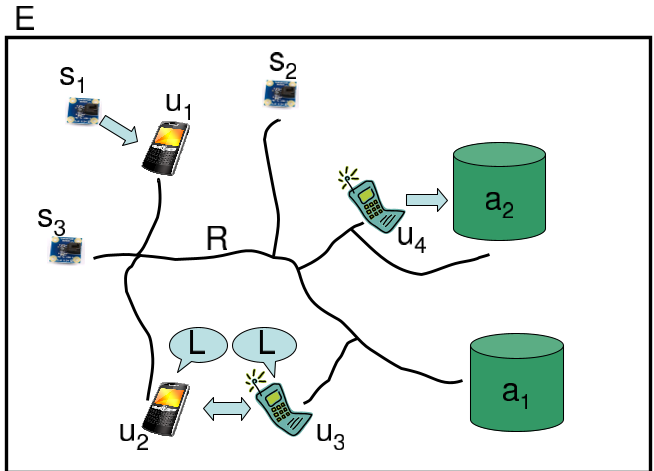
The paper defines Quality in two ways depending on the application:
- Data Collection: Measured by the reduction of Entropy () or uncertainty in predicting environmental phenomena (e.g., temperature) at unsensed locations.
- Data Propagation: Measured by the total number of distinct individuals reached (e.g., emergency alerts).
The Complexity Challenge (NP-Hardness)
The paper's most significant theoretical contribution is proving that Q-PDT is NP-hard. By reducing the "Sensor Placement" problem to a Q-PDT instance, the authors demonstrate that as the number of sensors () and city size grows, find the optimal location for sensors to meet the "mobile population" becomes computationally intractable.
The Formal Objective
The optimization focuses on: Where represents uncertainty. The challenge is that (the set of sensor points) is no longer static in its impact; its value is gated by the stochastic movement of human carriers.
Experiments and Insights
While this initial conference paper focuses on the theoretical framework and complexity analysis, it sets the stage for heuristic development.
Key Takeaways from the Variations:
- Dynamism: If sensors are mounted on buses (Mobile Sensors), the problem shifts from static placement to trajectory optimization.
- Packet Lifetime: Data such as noise levels have short "lifetimes," requiring faster human-to-human hops compared to long-term advertisements.
- Social Constraints: Friend-only transmission limits the "Epidemic Routing" potential but increases system privacy and manages energy expenditure on mobile devices.
Critical Analysis & Conclusion
Takeaway
Q-PDT shifts the focus from purely technical networking to Social-Spatial Optimization. It recognizes that data movement in a city is a byproduct of social behavior.
Limitations
- Sparsity: In low-population areas, PDT may suffer from high latency or "data death" where packets expire before reaching an aggregator.
- Incentivization: The paper assumes users will participate. In reality, users require incentives (tokens, social status) to permit data transfer on their devices.
Future Outlook
As we move toward 2026 and beyond, the integration of Edge AI and Web3 incentives could bridge the gap identified in this paper, turning the theoretical Q-PDT into a standard protocol for decentralized urban sensing.
Editor's Note: This work, originally published in ACM GIS '10, remains a cornerstone for current movements in Decentralized Physical Infrastructure Networks (DePIN).