
Vulnerability in the Physical Web: Understanding Location Privacy in Spatial Crowdsourcing
Location Privacy Challenges in Spatial Crowdsourcing
This paper provides a comprehensive taxonomic overview of spatial crowdsourcing (SC) and the inherent location privacy risks associated with its operational modes. It classifies SC into "Server-assigned" (Push) and "Worker-selected" (Pull) modes and identifies critical attack vectors that compromise participant anonymity.
TL;DR
Spatial Crowdsourcing (SC) moves digital labor into the physical world (think Uber, Waze, or PulsePoint), but this transition creates a massive privacy surface. This paper deconstructs how "Push" and "Pull" tasking modes expose workers to sophisticated location attacks—ranging from simple map matching to complex trajectory inference—even when data is supposedly "anonymized."
Background: The Price of Presence
Unlike Amazon Mechanical Turk, where tasks are location-agnostic, SC platforms like TaskRabbit or Uber require workers to be at a specific coordinate at a specific time. This creates a fundamental paradox: the system needs your precise location to function, but providing that location allows an untrusted server or malicious requester to profile your health, religion, and daily habits.
The System Architecture
The paper defines a tripartite model:
- Requesters: The entities needing data (e.g., "take a photo of this storm damage").
- Service Providers: The middleman platforms (the "Servers").
- Crowd Workers: The individuals performing physical labor.
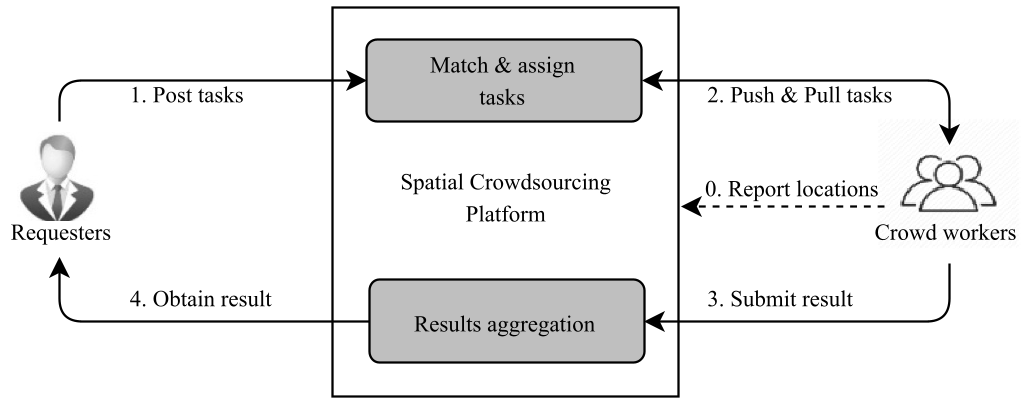
The paper emphasizes two operational modes:
- Worker-selected (Pull): You browse a map and pick a task.
- Server-assigned (Push): The server tracks you and "pushes" a task to you based on your proximity.
Anatomizing the Attacks
The core contribution of this work is the systematic categorization of how location privacy fails in these modes.
1. Pull Mode Attacks (The Snapshot Risk)
In Pull mode, the danger lies in the Task Distribution.
- Location Distribution Attack: In a sparsely populated area, even if you are "cloaked" with 3 other people (k-anonymity), if those 3 people are in a dense city center 5 miles away and you are the only one in the suburbs, the attacker can easily deduce your identity based on geography.
- Map Matching: Attackers can intersect noisy location data with physical maps to eliminate "impossible" locations (lakes, forests), narrowing down a worker's position to a specific road or building.
2. Push Mode Attacks (The Trajectory Risk)
Push mode is more dangerous because it requires continuous location updates.
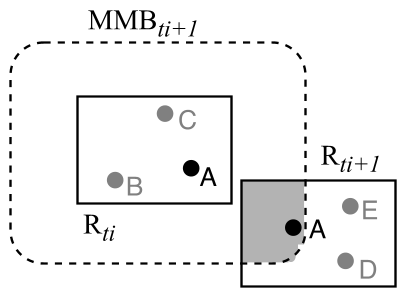
- Maximum Movement Boundary (MMB) Attack: By knowing a worker's previous cloaked region and their maximum possible travel speed, an attacker can calculate a "candidate area" for the next time step. The intersection of this area with the new cloaked region often reveals the exact location of the worker.
- Task Tracking: If a worker performs a sequence of tasks (T1 at time t1, T2 at time t2), an attacker can link the sets of anonymous users across these tasks. Often, only one individual (the worker) exists in the intersection of all these sets.
Critical Insight: The Semantic Trap
One of the most profound points made is Narrow Tasking. A malicious requester can create a task that requires a specific medical condition (e.g., "Heart rate monitoring for cardiac patients"). By accepting this task, the worker essentially "self-tags" with sensitive metadata, making even anonymized location data significantly easier to deanonymize.
Conclusion and Future Outlook
The paper concludes that existing privacy-preserving techniques (largely based on k-anonymity) are insufficient for the dynamic, multi-modal nature of spatial crowdsourcing.
Takeaway for Researchers: We must move beyond simple spatial cloaking. Future work needs to integrate Differential Privacy to add mathematical noise to trajectories and look into Local Differential Privacy (LDP) where workers perturb their own data before it ever reaches an untrusted service provider.
Takeaway for Users: Most "anonymous" crowdsourcing apps are not as private as they claim. Your movement patterns are unique fingerprints that simple "cloaking" cannot easily hide.