
Beyond the Check-in: Unmasking New Privacy Frontiers in Geo-Social Networks
Location-Related Privacy in Geo-Social Networks
The paper investigates multifaceted privacy risks in Geo-Social Networks (GeoSNs), categorizing threats into location, absence, co-location, and identity privacy. It evaluates the limitations of existing Location-Based Service (LBS) protection techniques and highlights the unique challenges posed by "user tagging" and real-time content sharing.
TL;DR
As social networks merge with real-time GPS data, a new breed of "Geo-Social Networks" (GeoSNs) has emerged. This paper argues that traditional privacy protections are failing because they ignore the social dimension. Even if you hide your exact coordinates, your friends' tags and "co-location" events can expose your secrets, your absence from home, or your hidden relationships.
Background Positioning
In the landscape of cybersecurity, this work serves as a foundational "threat model" analysis. It moves the conversation from simple Location-Based Services (LBS)—where you worry about the provider knowing where you are—to GeoSN Privacy, where the threat is your social circle and the public at large.
The Problem: The "Social" in Geo-Social is a Privacy Leak
Existing privacy methods like Spatial Cloaking (generalizing "24 West 35th St" to "Manhattan") are easily bypassed in a social context.
The authors highlight a critical insight: Correlation Attacks.
- The Scenario: Alice posts she is in "Manhattan." Five minutes later, Charlie posts a photo tagged "At a pub with Alice" at a specific GPS coordinate.
- The Result: Alice's privacy is shattered. By correlating Charlie's specific data with Alice's vague data, an adversary pinpoints her exactly.
Methodology: The Four Pillars of Geo-Social Privacy
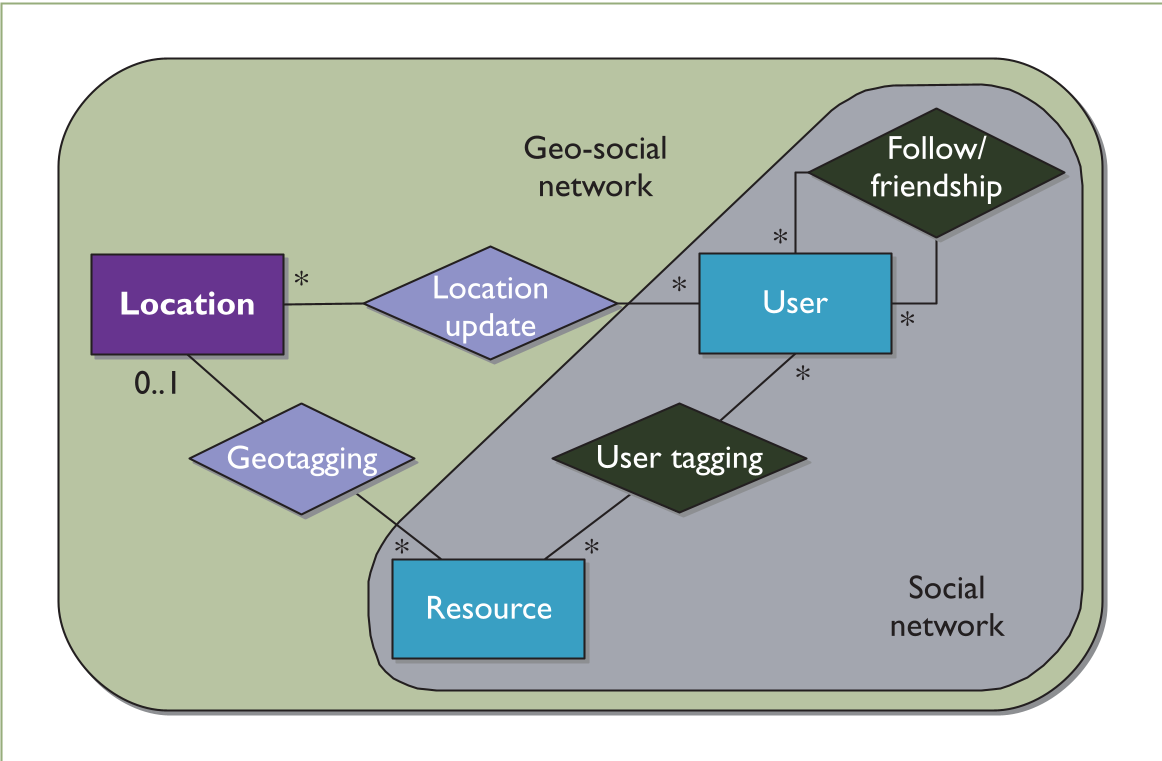
The paper breaks down the problem into a structured hierarchy of concepts, as shown in the architectural relationships of GeoSNs:
1. Location Privacy
The risk of revealing a physical location that implies sensitive information (e.g., visiting a specific medical clinic).
2. Absence Privacy
Predicting where a user is not. If you check in at a beach in California, an adversary knows your home in New York is empty—a "burglary invitation" signal.
3. Co-location Privacy
Revealing that two people are together. This is highly sensitive for professional or personal reasons (e.g., secret business meetings).
4. Identity Privacy
The risk of Re-identification. Even with a pseudonym, if you are the only person in a specific office building at 2 AM using a dating app, your identity is effectively compromised.
Comparative Analysis of Industry Giants
The authors conducted a survey of existing services to see how they handle these nuances. The results show a massive gap between service utility and privacy protection.
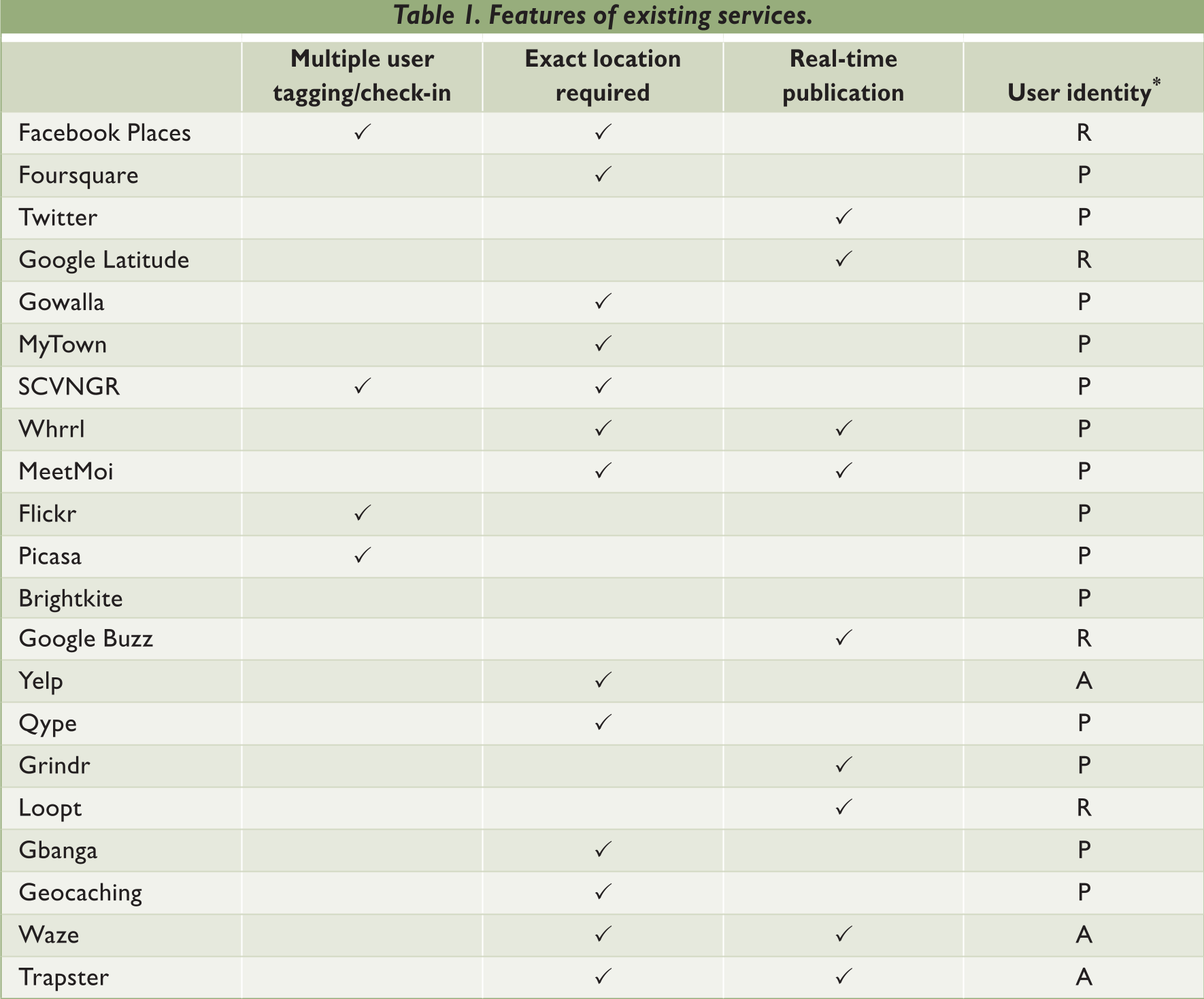
- High-Utility/High-Risk: Services like Waze and Trapster require exact coordinates and real-time updates to function, making cloaking (blurring time or space) nearly impossible.
- The Solution Path: For these "strict" services, the authors suggest shifting toward Encryption-based techniques and Private Information Retrieval (PIR), allowing the server to answer queries without ever "seeing" the raw coordinates.
Critical Insight: The Absence Privacy Region (APR)
One of the most innovative concepts discussed is the Absence Privacy Region. Instead of just hiding where you are, a system should ensure that no published data can exclude the possibility of you being in a specific safe zone (like your office during work hours).
- How? By introducing calculated publication delays (Temporal Cloaking) so that by the time a status is posted, it is physically possible you could have traveled back to your "claimed" location.
Conclusion & Future Outlook
The takeaway is clear: Privacy is no longer an individual setting. In the era of user tagging, your privacy is a collective responsibility of your social graph.
Limitations: The paper notes that current "Query Enlargement" and "Cloaking" methods often degrade the quality of service (e.g., if Google Latitude shows you are in "The United States," your friends find the info useless).
Future Work: The next frontier lies in Historical Data Management. As GeoSNs accumulate years of your movements, the ability to predict your future location or de-anonymize your past becomes a significant hurdle that current "real-time" protection methods aren't prepared to handle.