
Beyond Social Graphs: Geometric Intelligence for Location Recommendation
Locations recommendation based on check-in data from Location-Based Social Network
This paper introduces spatial recommendation methods for Location-Based Social Networks (LBSNs) using check-in data. It proposes four algorithms spanning Content-Based and Collaborative Filtering (CF) approaches, utilizing geometric constructs like Standard Deviational Ellipses and buffer analysis to recommend Points of Interest (POIs) based on geographical patterns.
TL;DR
When social relationship data is missing, can we still recommend where a user should go next? This paper from Peking University proves we can. By treating check-in data as spatial point sets rather than just database entries, the authors use Standard Deviational Ellipses and Topological Similarity to build a robust recommendation engine using nothing but GPS coordinates.
Context & Motivation
Most recommendation systems are "data-hungry," requiring timestamps, user profiles, and social links to function. However, real-world LBSN (Location-Based Social Network) data is often "thin"—containing only IDs and coordinates.
The authors identify a critical gap: How do we extract behavioral patterns from raw point sets? Their insight is rooted in geography—users exhibit spatial consistency. By modeling the "stretch" and "orientation" of a user's check-in history, one can predict future interests without ever knowing who their friends are.
Methodology: The Geometry of Interest
The paper introduces four distinct methods divided into two classical categories, redesigned for spatial data.
1. Content-Based: The SDE and Buffer Approaches
The Standard Deviational Ellipse (SDE) is the star of the methodology. It summarizes the spatial distribution of a user's check-ins by calculating the mean center, orientation, and standard distance.
- The Logic: If a user’s check-ins form a long, narrow ellipse, they likely commute along a specific axis. Recommendations are made by selecting popular POIs that fall within this personal "activity trend" ellipse.
- The Buffer Method: For a more localized approach, the system creates traditional circular buffers (e.g., 200m) around historical check-ins to recommend immediate neighbors.
2. Collaborative Filtering: Topological & Cosine Similarity
How do you find "similar" users without a social graph?
- Topological Similarity: The authors treat each user's SDE as a polygon. Similarity is calculated by the intersection-over-union (IoU) of these ellipses.
- Region-Aware Cosine Similarity: Users are mapped to a utility matrix based on four major Chinese clusters (BJ, SH, GZ, CQ). By normalizing check-in volumes across these hubs, the system finds users with similar "city-level" behavior profiles.
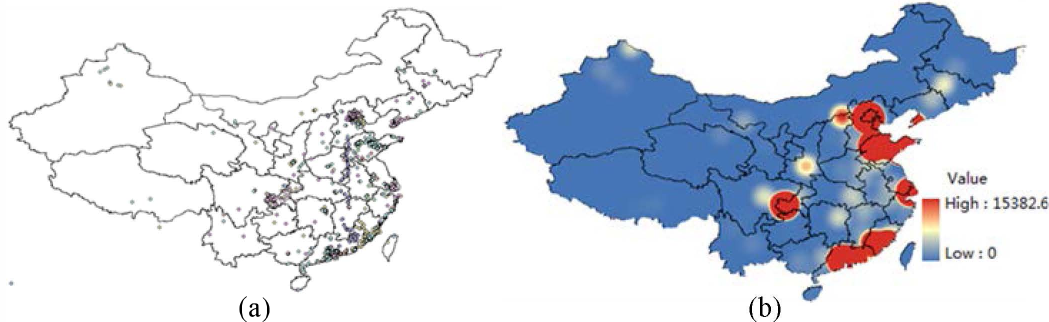 Figure: Analysis of check-in density and activity patterns using Kernel-Density Maps.
Experimental Validation
Using a dataset of over 2.7 million records from 10,049 users in China, the authors validated their priority-ranking system.
Key Findings:
- User Pairing: The system identified "User 754" as a high-match donor for "User 1" using both SDE similarity and Cosine distance, showing consistency across different mathematical models.
- Priority Ranking: Instead of a flat list, the system uses concentric rings to rank recommendations from a donor's history based on their distance to the target user's centroid.
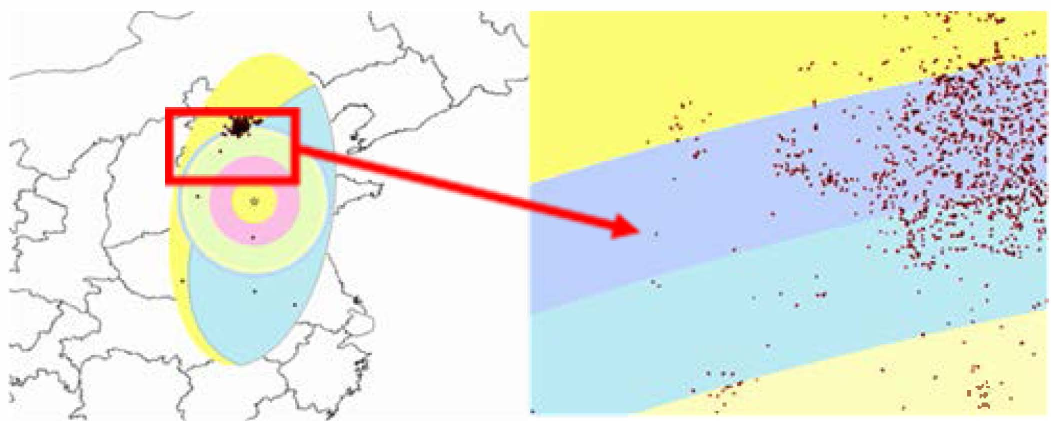 Figure: Spatial priority allocation between a target user and a high-similarity donor.
Critical Analysis & Future Outlook
Strengths: This work is highly efficient. By reducing complex behavior to geometric shapes (ellipses), it bypasses the computational cost of high-dimensional embeddings found in modern Transformers or GNNs.
Limitations:
- Temporal Neglect: The current model ignores the "when." A user at a business district at 10 AM has different needs than at 10 PM.
- Sparsity: While it handles thin data well, users with only 1 or 2 check-ins cannot form a meaningful ellipse, leading to an "elliptical cold start" problem.
Conclusion: This research reminds us that in the age of complex AI, classical spatial statistics still hold immense power for pattern recognition. For developers building lightweight, privacy-preserving, or low-metadata recommendation engines, the geometric approach is a compelling alternative.