
FCF: Harnessing Spatio-Social Ties for Efficient Location Recommendation
Location recommendation for location-based social networks
The paper introduces Friend-based Collaborative Filtering (FCF) and its geographical variant Geo-Measured FCF (GM-FCF) for location recommendation in social networks. By leveraging spatio-social ties, these methods achieve competitive accuracy while reducing computational complexity by several orders of magnitude compared to traditional Collaborative Filtering (CF) and Social CF (SCF).
TL;DR
Researchers from Penn State have developed a way to make location recommendations (like Foursquare or Yelp) drastically faster without losing accuracy. By focusing only on a user's social friends and calculating similarity based on geographical distance rather than complex history matching, their FCF and GM-FCF algorithms outperform traditional methods in efficiency by several orders of magnitude.
The Scalability Wall in LBSNs
Location-Based Social Networks (LBSNs) like Foursquare are massive. When a system tries to recommend a new restaurant to you, traditional Collaborative Filtering (CF) looks at every other user in the database to find people with similar tastes.
This creates two major problems:
- Computational Explosion: Performing matrix multiplications across millions of users and locations is too slow for real-time mobile apps.
- Noise: Most people in a global database have zero relevance to your local movements. Using them for reference introduces more noise than signal.
The Insight: Distance and Friendship
The authors conducted a "Spatio-Social Analysis" on a Foursquare dataset (58k users, 96k locations). They discovered a clear pattern:
- Friends Matter: Socially connected users are significantly more likely to share common check-ins than strangers.
- Distance is Decisive: Nearby friends share significantly more locations than long-distance friends. The "Common Location Ratio" follows a Power-Law distribution relative to distance.
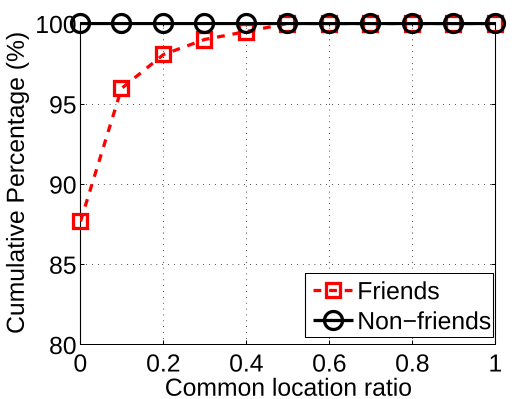 Analysis showing that friends (red) have higher location overlap than non-friends (blue), and that this overlap decays as distance increases.
Methodology: FCF and the GM-FCF Shortcut
1. Friend-based Collaborative Filtering (FCF)
Instead of calculating similarity weights against the entire user set , FCF only considers the friend set . This reduces the complexity from a global search to a local neighborhood search.
2. Geo-Measured FCF (GM-FCF)
GM-FCF takes it a step further. Instead of even looking at what your friends visited to find similarities, it uses the spatial distance between you and your friends as a proxy for similarity.
By fitting a linear model to the log-log scale of distance vs. common interests: The system can estimate how much weight to give a friend's recommendation just by knowing their coordinates. This eliminates the need to scan location history during the similarity phase.
Performance & Efficiency
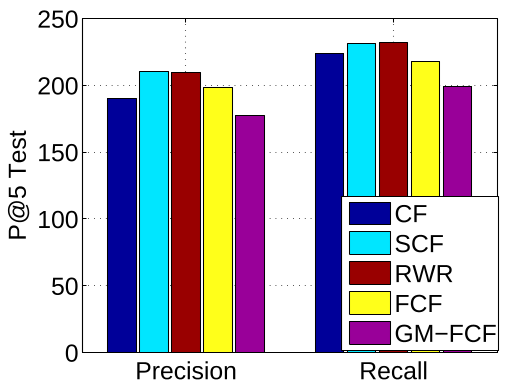
In head-to-head tests against Social Collaborative Filtering (SCF) and Random Walk with Restart (RWR), the results were striking:
- Effectiveness: FCF-based methods remained competitive in Precision@5, proving that "strangers" contribute very little to finding your next favorite local haunt.
- Efficiency: The computational cost of FCF is a fraction of standard CF. As seen in the log-scale comparison, the savings are massive, making it suitable for low-latency mobile environments.
 The computational cost comparison (log scale) shows FCF and GM-FCF significantly below traditional CF and RWR.
Critical Analysis & Conclusion
Takeaway
The core contribution of this work is the validation of the "Local Heuristic". In geographic domains, global data often dilutes the signal. By anchoring recommendations in social and spatial proximity, we gain both speed and relevance.
Limitations
- The "Cold Start" for Socially Isolated Users: If a user has no friends in the system, FCF fails. The authors acknowledge that eliminating non-friends can slightly hurt "Recall" (missing out on niche locations found by strangers).
- Static Geography: The model assumes a fixed "home" coordinate for users, which may not account for tourists or frequent travelers.
Future Outlook
This paper, published in the early days of LBSNs, laid the groundwork for modern "Geospatial Embeddings." Today’s SOTA models often use GNNs to explore these same social ties, but the fundamental physical intuition—that distance dictates desire—remains a cornerstone of geographic AI.