
Beyond the Screen: Bridging Virtual and Real-Life Socializing with Location-Sensitive Recommendations
Location Sensitive Friend Recommendation in Social Network
The paper proposes a Location-Sensitive Friend Recommendation model for social networks (specifically evaluated on Sina Weibo). It integrates Common Interests (via post content), Location Overlaps (via geo-tagging and NLP-based detection), and User Activity levels to recommend friends suitable for both virtual interaction and real-life activities.
TL;DR
While most social networks excel at finding people who "like the same things," they often fail at finding people you can actually "meet for coffee." This paper introduces a recommendation model that weights Common Interests, Spatial Overlaps, and User Activity to propose friends who are not only like-minded but also physically reachable for real-world interactions.
The "Virtual Distance" Gap
Traditional algorithms (like those on early Facebook or Twitter) often assume that if User A and User B both enjoy "Jazz" and "Machine Learning," they should be friends. However, if User A is in Beijing and User B is in New York, the friendship remains trapped in a digital bubble.
The authors argue that for a friendship to transition from a social network to the real world, it requires:
- Shared Context: Common topics of conversation.
- Physical Feasibility: The ability to meet face-to-face.
- Social Proactivity: An active presence that suggests a willingness to engage.
Methodology: The Three Pillars of Real-Life Friendship
The researchers formulated a recommendation probability based on a product of three distinct factors:
1. Interest Matching with Temporal Decay
Interests aren't static. The researchers used ICTCLAS to segment microblog content and grouped posts by month. To account for shifting hobbies, they applied an exponential decay function , ensuring that current interests carry more weight than what a user posted five years ago.
2. Location Overlap Sensing
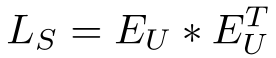
Using both GPS metadata and a specialized Chinese location library, the model constructs a User-Location Frequency Matrix. By performing a matrix multiplication (), the system calculates a similarity score based on how often two users frequent the same geographic nodes.
3. The Activity Factor
The paper assumes that "active" users (those with more posts) are more likely to respond to new friendship requests and participate in activities. This is represented by , a normalized score of a user’s total post count relative to the most active user in the network.
Experimental Insights
The study utilized a dataset of ~40 million Sina Weibo posts. The results were categorized into "Success" where the recommended user was already a "carer" (follower) of the target user.
Performance Comparison
The proposed model was compared against several baselines:
- TS (Topic Similarity): Content only.
- LO (Location Overlap): Geography only.
- AT/ALO: Active versions of the above.
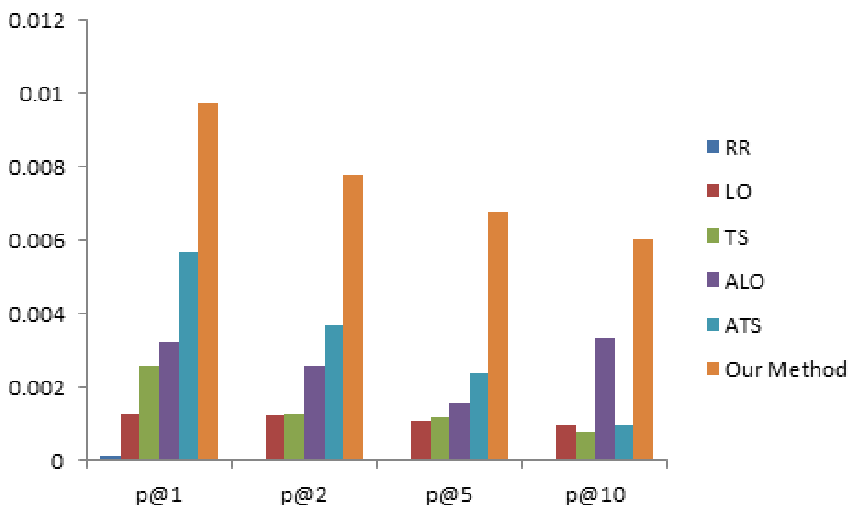 Figure 2: Precision at n (p@n) markers showing the clear lead of the integrated model.
The data suggests that User Activity (the "A" in ALO/ATS) provides a massive boost to baseline precision, confirming that highly active users act as "hubs" in both social and physical networks.
The Regional Factor
A fascinating byproduct of the research was the distribution of user mobility. As shown in the findings, nearly 32% of users are highly "regional," meaning they spend the vast majority of their time in specific locations. This high "spatial stickiness" makes location-based recommendation highly effective for a large segment of the population.
 Figure 5: Analysis of how frequently users stay within their primary locations.
Critical Analysis & Future Outlook
Strengths: The model is elegantly simple and combines three intuitive drivers of human social behavior. It successfully addresses the "real-world needs" that semantic-only models ignore.
Limitations:
- Privacy: Relying on granular location sequences raises significant privacy concerns that aren't addressed.
- Sparsity: Many users do not enable GPS or post frequently enough to establish a reliable location sequence.
- Simplicity of Activity: Using "total post count" as the sole metric for activity is a bit blunt; it doesn't distinguish between high-quality social interaction and automated bot posts.
Future Directions: The authors suggest incorporating hometown information and real-time distance proximity. From a modern AI perspective, the next logical step would be transitioning these handcrafted features into a Graph Neural Network (GNN) that can learn implicit spatio-temporal embeddings.
Takeaway
If you're building the next generation of social apps, don't just look at what people talk about—look at where they go and how often they engage. The intersection of these three vectors is where real-world community is built.