
Enhanced Privacy in mOSNs: Defeating Insider Attacks with Multi-Server Architectures
6283_Location-Sharing Systems With Enhanced Privacy in Mobile Online Social Networks.
The paper introduces a privacy-enhanced location-sharing architecture for Mobile Online Social Networks (mOSNs) featuring multiple location servers to mitigate insider attacks. The core method involves randomly partitioning a user's friend list into subsets distributed across different servers, achieving SOTA outcomes in protecting both location and social network topology privacy.
TL;DR
This research addresses a critical vulnerability in Mobile Online Social Networks (mOSNs): while current systems hide where you are, they fail to hide who you know from the service provider. By introducing a multi-location-server architecture and a randomized friend-set partitioning strategy, the authors prevent service providers from reconstructing your social graph while maintaining sub-second query performance on mobile devices.
Background: The Invisible Leak in Location Sharing
In the era of Foursquare, Google Maps, and mobile "check-ins," Location-Based Services (LBS) are ubiquitous. However, a hidden risk exists: Social Network Privacy. Prior works like Mobishare used dummy identities to provide anonymity, but they had a fatal flaw—linkability. If you query for your nearby friends multiple times, the location server sees the same set of friend IDs (even if they are pseudo-IDs) associated with your request. Over time, the server can map out your entire social circle and eventually deanonymize you through topological analysis.
The Core Innovation: Fragmented Queries
The authors shift the paradigm from a single, all-knowing Location Server (LS) to a distributed model. The protocol follows three key pillars:
- Distributed Identity Management: The Social Network Server () acts as a buffer. It knows your friends but not your exact location. The Location Servers () know location segments but not your full friend list.
- Random Subset Partitioning: When you look for friends nearby, takes your friend list, adds dummies, and randomly splits them into subsets. Each receives only one subset. No single can see the "whole picture" of your social life.
- Checkability (The RDoC Model): To prevent a "lazy" or "malicious" server from returning wrong data to save bandwidth, the authors use the Refereed Delegation of Computation model. By inserting "ringers" (overlapping identities) across different servers, the system can verify if the servers actually performed the distance calculations honestly.
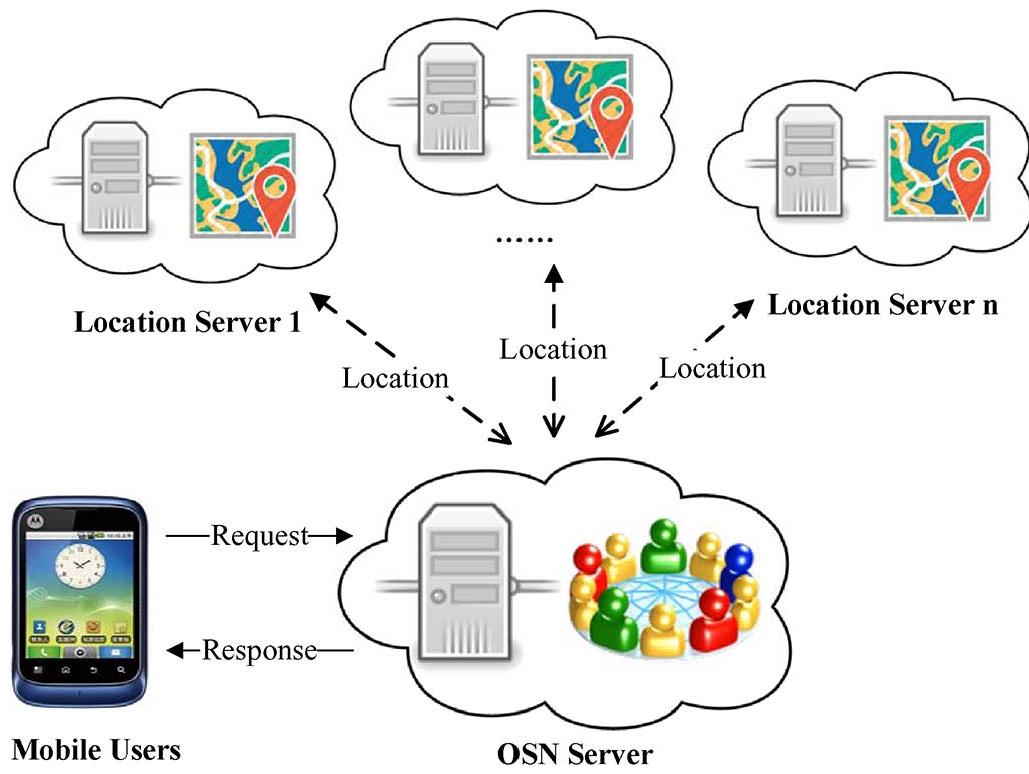 Figure 1: The proposed multi-server architecture for privacy-preserving location sharing.
Methodology and Cryptographic Primitives
The system relies on a sophisticated stack of cryptographic tools:
- Broadcast Encryption (BE): Used for efficient location updates. When a user changes their location, they only need to perform one encryption to update all authorized friends, regardless of the group size.
- Symmetric/Asymmetric Hybrids: AES-CBC for high-speed location data encryption and RSA/BLS signatures for authentication.
- Pseudo-ID Shuffling: Every location update uses a fresh
FID(Fake Identity), preventing long-term tracking.
Performance Benchmarks
Technical efficiency is the "deal-breaker" for mobile apps. The research demonstrates that privacy doesn't have to be slow:
- Mobile Efficiency: On an Android device, encrypting/decrypting friend locations takes ~200ms.
- Server Scalability: The execution time on the server side scales linearly with the number of records. Even with 1000 strangers in the vicinity, a query takes only 30ms.
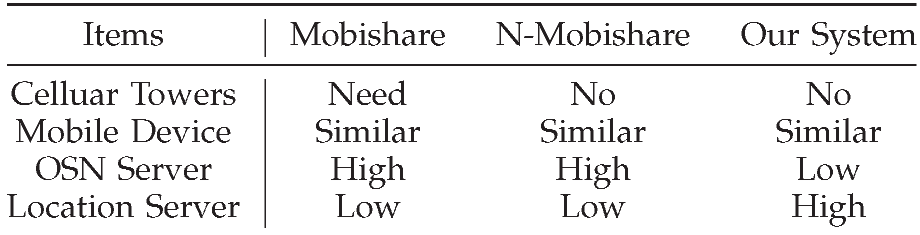 Table 1: Comparison between the proposed system and previous SOTA (Mobishare).
Critical Insight: Why This Matters
The most significant takeaway from this work is the practical implementation of Trust Fragmentation. By ensuring that the location servers and the social network server remain "honest-but-curious" and non-colluding, the system creates a mathematical guarantee of privacy that single-server architectures cannot match.
However, there is a limitation: the system assumes the and will not collude. In a world where giant tech conglomerates often own both the social platform and the infrastructure, this "non-collusion" assumption is a high bar. Future work may need to explore Zero-Knowledge Proofs (ZKPs) or Fully Homomorphic Encryption (FHE) to remove this trust assumption entirely, though likely at a much higher computational cost.
Conclusion
This paper provides a robust blueprint for the next generation of privacy-first social apps. By partitioning social graphs and leveraging multi-server environments, we can enjoy the convenience of "finding friends nearby" without handing the blueprint of our entire social lives over to a single entity.