
LockPic: Reclaiming Privacy in Social Photo Sharing through Selective Encryption
LockPic: Privacy Preserving Photo Sharing in Social Networks
This paper introduces LockPic, a privacy-preserving photo sharing system that enables reversible, region-specific encryption within standard JPEG images. By integrating AES encryption directly into the JPEG encoding/decoding process, it allows users to obfuscate sensitive areas like faces while keeping the rest of the image visible and compatible with existing social networks.
TL;DR
LockPic is a breakthrough framework that allows users to selectively encrypt sensitive regions of a photo (like faces) before uploading them to social networks. Unlike traditional methods that blur or black out areas, LockPic's encryption is reversible for authorized users, maintains standard JPEG compatibility, and uses a decoupled key server to ensure that neither the social network nor the key provider can see the full context without permission.
Background & Motivation: The Public/Private Paradox
In the age of social media, we face a binary choice: share a photo and lose all privacy control, or keep it private and lose social engagement. Standard obfuscation techniques like blurring are permanent and aesthetically displeasing.
The authors identify a critical gap: we need a way to share the vibe of a photo (the background, the event) while protecting the identities (the faces). Previous attempts failed due to:
- Format Incompatibility: Using JPEG2000 which most browsers don't support.
- Weak Security: Simple "scrambling" or sign-flipping can often be reversed by AI or brute-force analysis of neighboring pixels.
- Low Usability: Complex key management that makes sharing difficult for average users.
Methodology: High-Security Partial Encryption
The core innovation of LockPic lies in its "Modified JPEG Pipeline." Instead of encrypting the pixels (which would break compression) or the final file (which would make it unreadable), it operates on the quantized DCT coefficients.
The Encryption Process
- Selection: The user selects a region (e.g., a face via Android's Face Detection API).
- DCT Transformation: The image is broken into 8x8 blocks (MCUs).
- Selective AES: Only the non-zero coefficients within the selected MCUs are encrypted using AES in Output Feedback (OFB) mode.
- Why only non-zero? JPEG compression relies on long runs of zeros. By leaving zeros untouched, the file size remains nearly identical to a standard JPEG.
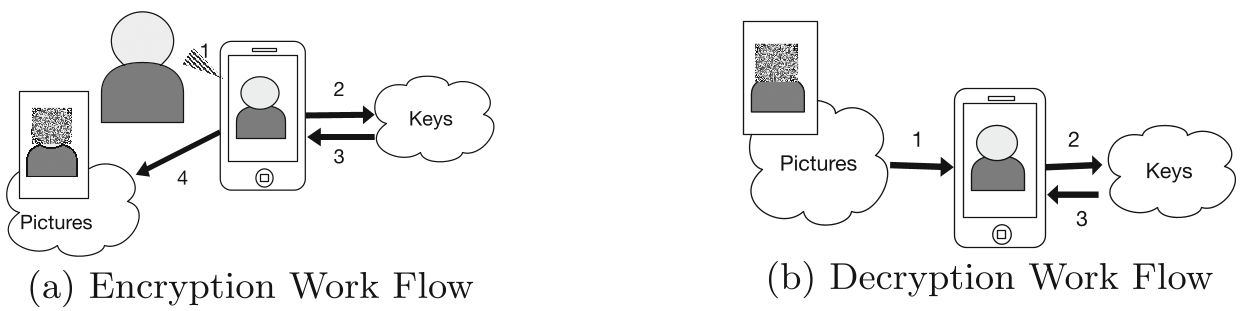 Figure 1: The Encryption and Decryption Workflow across the App and Key Server.
The "Honest-but-Curious" Security Model
LockPic separates the content from the keys:
- Social Network: Only sees the encrypted JPEG (context + scrambled boxes).
- Key Server: Only sees image IDs and access lists; it never sees the image itself.
- The Secret Sauce: Keys are generated using a deterministic hash:
Key = Hash(Master_Secret || Image_ID || Coordinates). This allows the server to manage millions of "keys" without storing more than one master secret per user.
Experimental Insights & Results
The authors evaluated several methods of obfuscation. Traditional pixel randomization (BMP level) resulted in massive file sizes or color distortion when converted back to JPEG.
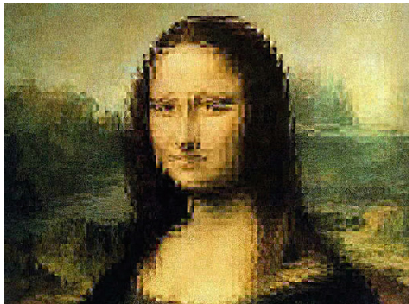 Figure 2: Visual impact of different scrambling techniques. LockPic chooses a middle ground between total obfuscation and maintaining some visual homogeneity.
Key Findings:
- Performance: The C-based library is lightweight enough for real-time mobile use.
- File Size: Encrypted JPEGs show negligible size increases compared to standard ones.
- Security: Unlike "sign-flipping" methods which leave color (DC) information intact, LockPic's AES encryption on all non-zero coefficients effectively hides all recognizable features.
Critical Analysis & The Road Ahead
While LockPic is a major step forward, it faces one significant hurdle: Lossy Re-compression. Many social networks (like Facebook or WhatsApp) re-compress images to save space. Since LockPic relies on the exact mathematical values of DCT coefficients, even a slight change in compression can break the decryption process.
Future Outlook: The authors suggest using external storage (like Dropbox or Google+) that preserves file metadata/integrity as a workaround. However, for LockPic to become a global standard, it will need to evolve into a "Robust Encryption" scheme that can survive the heavy-handed processing of modern social media algorithms.
Conclusion
LockPic proves that we don't have to sacrifice our identities to enjoy social media. By moving encryption into the codec itself, the authors have created a framework that is both cryptographically strong and socially useful.