
Social Network Logic: How Topology Dictates Knowledge and Revolution
A Logic for Knowledge Flow in Social Networks
This paper introduces Social Network Logic (SNL), a multi-agent dynamic epistemic framework that models how information flows through explicit social network topologies. By extending Public Announcement Logic (PAL), the authors enable formal reasoning about localized message posting and network structure modifications (following/unfollowing), achieving a generalization where PAL serves as a special case of SNL.
TL;DR
This paper introduces Social Network Logic (SNL), a formal framework designed to track how knowledge propagates through social ties. Unlike traditional logics that assume everyone hears everything, SNL restricts information flow to "followers." The authors prove that the structure of the network alone can decide whether a group of agents succeeds in coordinating a revolution or fails due to lack of common knowledge.
The "Public Announcement" Fallacy
In classical Dynamic Epistemic Logic (DEL), researchers often use Public Announcement Logic (PAL). In PAL, when a fact is announced, it is assumed to be "common knowledge" instantly.
The Problem: Real social interactions are not global broadcasts. If Alice posts on a social network, only her followers see it. If Bob doesn't follow Alice, he remains ignorant. Furthermore, social networks are dynamic—we "follow" and "unfollow" people constantly. Previous logics lacked the vocabulary to describe these network-shifting actions as first-class logical operators.
Methodology: Bridging Graphs and Kripke Models
The authors solve this by merging two mathematical structures:
- Epistemic Models: The standard Kripke frames representing agents' uncertainty (possible worlds).
- Social Networks: A directed graph representing binary relations (e.g., "Agent gets info from ").
The Action Model for Posting
When an agent posts message , it isn't a global update. The authors utilize Action Models (see below) to define how specific followers update their accessibility relations.
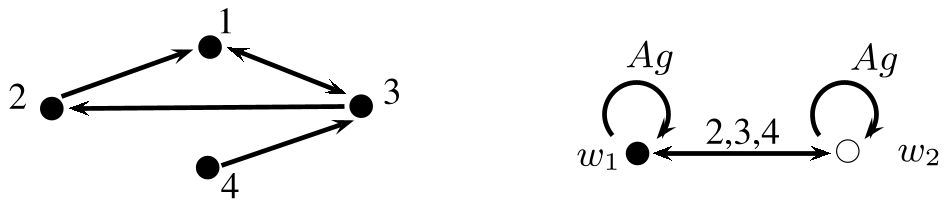 Figure 1: Comparison of action models. Note how a post in a fully connected network (right) mirrors a traditional public announcement.
Dynamic Network Actions
The logic introduces two key operators:
- : After follows , holds.
- : After posts message to their followers, holds.
The "Revolt or Stay-at-home" Experiment
The paper applies SNL to a collective action problem. Four agents (Alice, Bob, Cath, Dave) will only revolt if they know at least two others will join them.
 Figure 2: Two different social network topologies. In the left network, the flow of "knowing that you know" is interrupted.
The Finding:
- In a Sparse/Circular Network (Left), even after everyone posts their intention to revolt, common knowledge is not achieved. Alice knows Bob will revolt, but she doesn't know if Cath knows that Alice knows. Result: Revolution Fails.
- In a Denser Social Network (Right), everyone achieves "Common Knowledge" (). Result: Revolution Succeeds.
Theoretical Insights
The authors provide several "Meta-theorems" to validate SNL:
- PAL Generalization: They prove that PAL is just SNL where every agent follows a special "Announcer" agent. This provides a bridge between old-school broadcast logic and modern social graph logic.
- Order Independence: For propositional facts, the order of posting doesn't matter (Proposition 3). However, if agents post about what they know about others, the order becomes critical—a subtle but vital distinction for security protocols.
Critical Analysis & Conclusion
Takeaway
SNL provides a rigorous way to analyze "Echo Chambers" and "Information Silos." It proves that the bottleneck to collective action is often not a lack of information, but a lack of higher-order knowledge (knowing that others know).
Limitations
A major assumption in this paper is that the Social Network structure is common knowledge. In reality, I might follow you, but your other followers might be hidden from me (e.g., private lists). Future work needs to treat the network itself as a source of uncertainty.
Future Outlook
This framework is a perfect candidate for analyzing blockchain consensus and DAOs, where the propagation of "votes" mimics the message-passing mechanism described here.