
The Logic of Echo Chambers: How Influence and Selection Shape Social Networks
A Logical Analysis of the Interplay Between Social Influence and Friendship Selection
This paper presents a formal logical framework to analyze the co-evolution of social networks through two mechanisms: social influence (behavior change based on neighbors) and friendship selection (link formation based on similarity). Using Dynamic Epistemic Logic (DEL), the authors model these dynamics across multiple topics and positions, achieving a unified system that characterizes the phenomenon of homophily.
TL;DR
Why do social groups become so homogeneous over time? This paper provides a Logical Analysis of Homophily, using Dynamic Epistemic Logic (DEL) to model the "dance" between changing your mind to fit in (Social Influence) and picking friends who are like you (Friendship Selection). By defining these as formal operators, the authors show how clusters of consensus emerge and stabilize.
Problem & Motivation: The Dual Nature of Homophily
In social networks, "birds of a feather flock together." This is known as homophily. Sociologists have long noted that this happens via two distinct paths:
- Selection: You become friends with those who already share your "features" (e.g., liking the same music).
- Influence: You adopt the features of your existing friends to minimize social friction.
The authors observe that while logicians have modeled these separately, the interplay—how selection changes the network, which then changes the influence exerted, which then triggers new selection—has lacked a unified, rigorous logical treatment.
Methodology: Dynamic Logic Operators
The paper introduces a Social Networks Model (SNM) where agents aren't just connected; they are connected on specific Topics () and hold various Positions ().
1. Social Influence ()
An agent updates their position on a topic based on a threshold .
- Intuition: If 50% () of my friends like "Horror movies," I will start liking them too.
- Logical Twist: Unlike some models, this is not purely additive; if your friends stop liking something, you might drop that position too.
2. Friendship Selection ()
Links are redrawn based on a similarity threshold .
- Intuition: If agent agrees with me on 80% of music sub-genres, we become "friends" on the Music topic.
- Formal Property: This operator is idempotent—applying it twice in a row without changing opinions has no further effect on the network.
 Figure 1: Conceptual representation of the SNM where agents hold positions and share social connections.
Experiments: The Intertwining Dynamics
The most compelling part of the paper is the analysis of sequences of actions. When you alternate between and , the social system evolves step-by-step.
The Formation of Equivalence Classes
The authors illustrate a scenario where the combination of these two forces creates a network where:
- The social relation becomes an equivalence relation (reflexive, symmetric, and transitive).
- All connected members reach a perfect consensus.
However, they caution that this is not a universal law. Depending on the thresholds, a system might reach a "stable" state where a network remains non-transitive, or even fail to stabilize if thresholds vary.
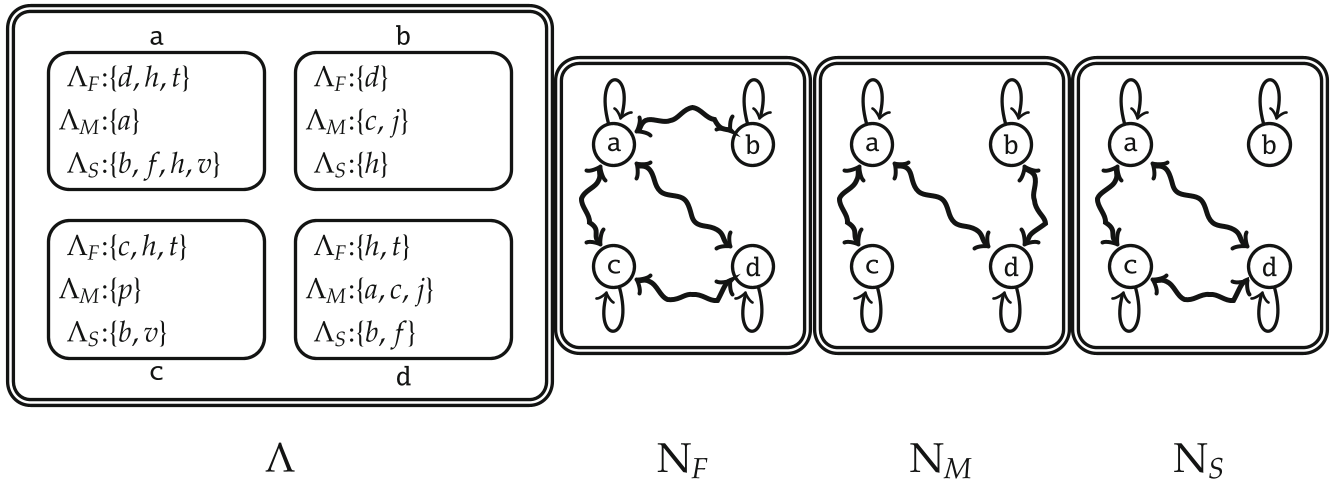 Figure 2: Example of the dynamic process showing how empty relations evolve into bold squiggly edges (new friendships) after a selection step.
Deep Insights: Beyond Simple Networks
The paper extends the core idea with several fascinating variations:
- Extended Influence: What if my friends on the "Film" topic influence my opinions on "Music"? This models cross-topic contamination.
- Restricted Selection: You can only become friends with "friends-of-friends" (using reflexive/transitive closures), modeling the reality that we usually meet new people through our existing social circles.
Conclusion & Limitations
The authors successfully bridge the gap between sociological theory and formal logic. By providing recursion axioms, they prove that even complex social dynamics can be reduced to basic propositional truths.
Limitations: The current model assumes agents have perfect information about their friends' positions. In reality, we often guess what our friends think. The authors identify Epistemic Social Networks (modeling what agents know about each other) as the next frontier for this research.
Takeaway: If you want to understand why social media platforms lead to "filtered bubbles," this paper gives you the mathematical proof: the feedback loop between influence and selection is a powerful engine for social partitioning.