
Deciphering the Digital Duel: Logic vs. Rhetoric in Social Media War
An Investigation into the Use of Logical and Rhetorical Tactics within Eristic Argumentation on the Social Web
The paper introduces the Argumentation on the Social Web Ontology (ASWO), a novel framework that bridges the gap between structured logical modeling and the messy reality of online discourse. By integrating the Argument Interchange Format (AIF) with the Semantically Interlinked Online Communities (SIOC) project, the authors provide a schema to capture both dialectic (problem-solving) and eristic (quarrel-based) argumentation.
TL;DR
Online arguments are rarely just about the facts; they are about winning, status, and community. This paper introduces the Argumentation on the Social Web Ontology (ASWO), a framework that formally models the "dark matter" of online debate: the rhetorical attacks and emotional supports that traditional logic-based models ignore. By analyzing data from Twitter, Reddit, and Facebook, the authors prove that rhetoric isn't just a byproduct—it's a core strategy used by the most active participants.
The Motivation: Why Logic Fails to Describe the Internet
Traditional computational argumentation (the kind used to build AI debating systems) is built on the Dialectic ideal: two people talking rationally to solve a problem. But if you've ever spent five minutes on a political Twitter thread, you know that isn't what's happening.
Most online discourse is Eristic—arguing for the sake of quarreling or winning. Current models like AIF (Argument Interchange Format) are great at mapping premises and conclusions, but they struggle when someone ignores the argument entirely and simply insults their opponent’s character. This paper argues that if we want to build tools to fight anti-social behavior or understand the "Echo Chamber" effect, we must stop treating rhetoric as "bad logic" and start treating it as a measurable structural element.
Methodology: Bridging Social Data and Formal Logic
The authors created ASWO by mashing together two existing standards:
- AIF (Argument Interchange Format): For the "Logic" (Information nodes, Inference nodes).
- SIOC (Semantically Interlinked Online Communities): For the "Social Context" (Posts, Users, Forums).
The secret sauce of this paper is the introduction of Persona Nodes. Instead of just attacking an idea (Logical Conflict), a user can support or attack a Persona (Rhetorical Conflict/Support).
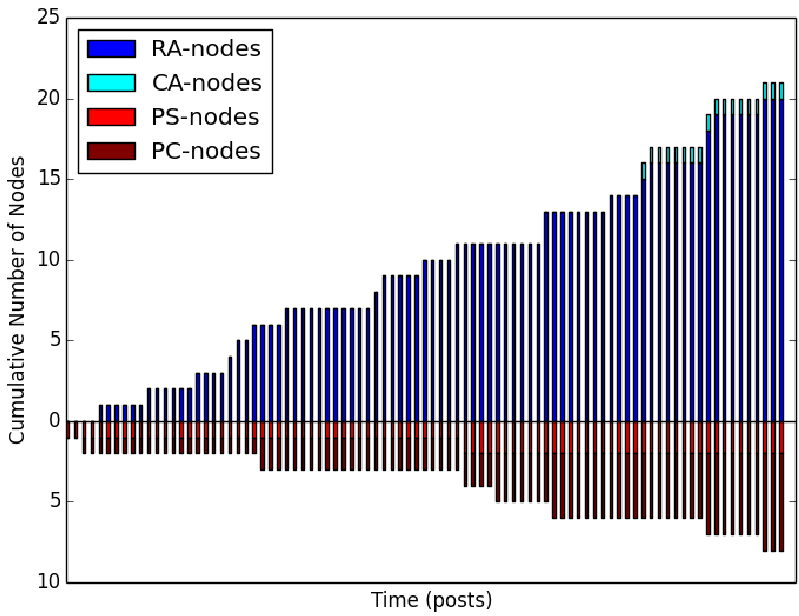 Figure: The charts illustrate how rhetorical tactics (blue) grow in tandem with logical arguments (red) across different social platforms.
Experiments: Twitter, Facebook, and the "Government Shutdown"
To test the model, the authors sampled 270 posts across Twitter, Facebook, and Reddit regarding the 2013 US Government Shutdown.
Key Findings:
- The Persistence of Rhetoric: On Twitter, rhetorical moves aren't an "escalation"—they happen right alongside logical arguments from the very start.
- The "Power User" Paradox: The users who contribute the most logical arguments are also the most likely to use rhetorical tactics. Meanwhile, a subset of users contributes zero logic, existing purely in the rhetorical space to voice support or dissent.
- Conflict Dominates: Across all platforms, Rhetorical Conflict (PC-nodes) dwarf Rhetorical Support (PS-nodes). We are far more likely to attack a person's character than we are to offer non-logical solidarity.
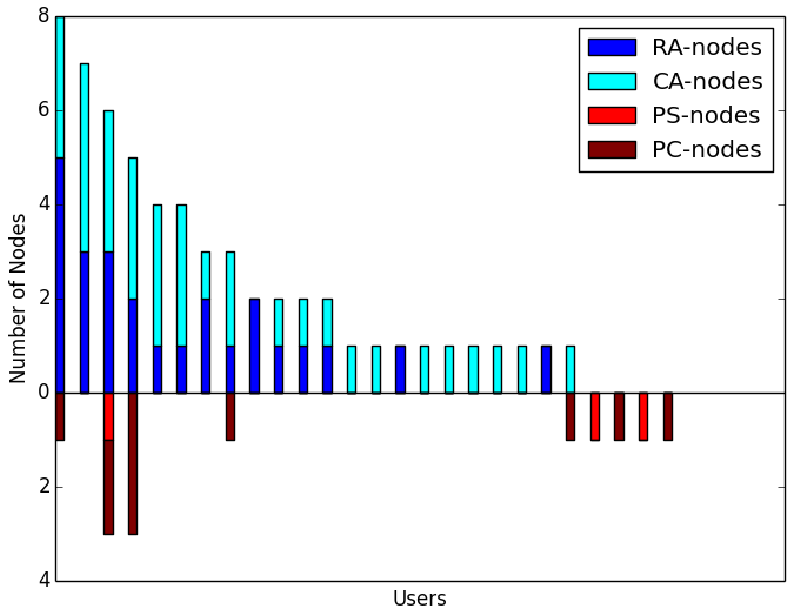 Figure: Scatter plots showing that users who engage in high logic also frequently engage in high rhetoric.
Critical Analysis & Conclusion
The value of this work lies in its Realism. By acknowledging that an "ad hominem" attack or a "thumbs up" carries structural weight in a conversation, ASWO provides a more honest map of the human experience online.
Limitations:
- Subjectivity: The annotation was manual. Identifying rhetorical force (is this an insult or a joke?) remains highly subjective.
- Scalability: Manual annotation is expensive. The next hurdle is training NLP models to recognize these ASWO nodes automatically using markers like expletives and post length.
Takeaway:
We cannot "fix" the social web by forcing it to be purely logical. Instead, we must build models that understand the weight of a user's Persona. Only then can we develop moderation tools that see beyond keywords and understand the actual impact a post has on the health of a discussion.