
Beyond "Friends Only": A Logical Blueprint for Blacklists in Social Networks
A Logical Approach to Restricting Access in Online Social Networks
The paper introduces a formal framework for relationship-based access control (ReBAC) in Online Social Networks (OSNs) by integrating user blacklists. It utilizes a hybrid logic approach, enhanced with a novel path semantics, to define eight distinct "blacklist-restrictions" and provides algorithms for efficient policy enforcement as demonstrated on Facebook datasets.
TL;DR
Researchers have developed a formal way to integrate blacklists into social network privacy settings using Hybrid Logic. By introducing three dimensions—Globality, Generality, and Strength—they've moved beyond simple "block" buttons to nuanced access control that can account for the blacklists of intermediate friends. The result is a system that can be automatically transformed from simple user rules into mathematically rigorous (and enforceable) security policies.
The "Friend of a Blocked Friend" Problem
Most OSNs like Facebook allow you to share content with "Friends of Friends" (FoF). But what happens if Alice shares a photo with Bob’s friends, and Bob has blocked Charlie? Should Charlie still see Alice’s photo because he is Alice's friend, even though he's on Bob's blacklist?
Current systems treat blacklists as an afterthought. This paper argues that blacklists are structural constraints on the social graph. The core difficulty lies in determining how blacklists should propagate across multi-hop relationships (paths) in the network.
Methodology: The Three Dimensions of Restriction
The authors propose that any blacklist policy is actually a combination of three binary decisions:
- Globality (Local vs. Global): Do we only care about the owner's blacklist, or the blacklists of everyone along the path?
- Generality (Limited vs. General): Do we only block the requester, or do we invalidate the entire path if any intermediate node is on the owner's blacklist?
- Strength (Weak vs. Strong): If there are multiple paths to a requester, is access granted if one path is clear (Weak), or must all paths be clear (Strong)?
The Formal Engine: Hybrid Logic & Path Semantics
To make this work, the authors use Hybrid Logic, which allows for "nominals" (naming specific nodes) and the @ operator (jumping to a specific node). They introduced Path Semantics, a way to evaluate logic formulas based on the specific set of edges (paths) that make them true.
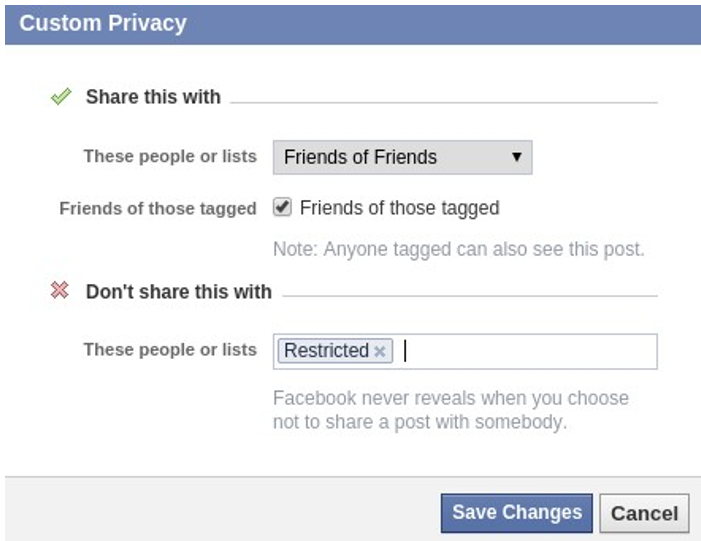 Figure: The conceptual intersection of standard access policies and blacklist constraints.
Syntactical Transformation
The genius of this approach is that it doesn't force users to become logicians. A user picks a simple policy and a restriction "flavor" (e.g., Global-General-Strong). The system then uses a Syntactical Transformation algorithm to rewrite the simple policy into a complex Hybrid Logic formula that explicitly checks for blacklist violations at every step.
Experimental Insights
The team tested their approach on a real-world Facebook dataset. Two major findings emerged:
- Performance Paradox: While "Strong" restrictions are computationally expensive (requiring a search of all possible paths), "Weak" restrictions can actually be faster than standard policies. This is because the algorithm can "prune" (skip) branches of the social graph as soon as it hits a blacklisted node.
- The Power of Strength: The "Strength" dimension has the biggest impact on who actually gets to see your content. Moving from "Weak" to "Strong" denies significantly more users than changing the "Globality" or "Generality."
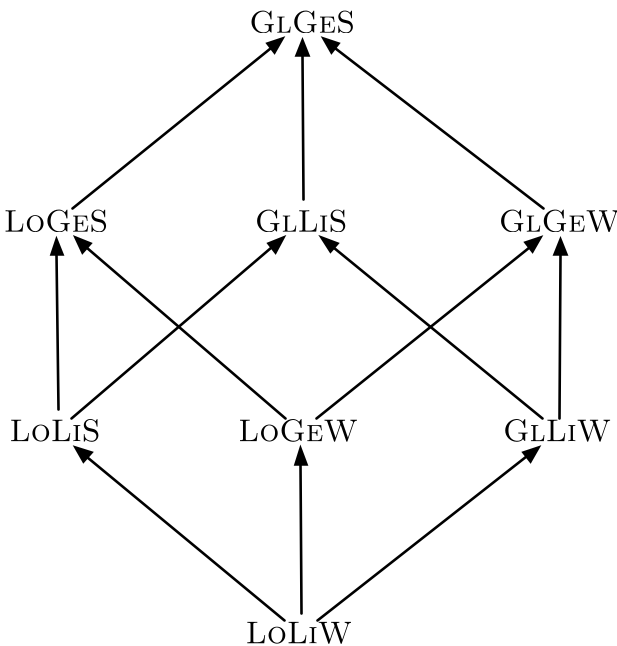 Figure: The Lattice of Eight Restrictions. Movement upward represents stricter privacy.
Conclusion: A User-Friendly Privacy Future
By formalizing blacklists as part of the relationship graph, this research provides a path toward OSNs that actually respect the complex social dynamics of "blocking." While the underlying math involves hybrid logic fixed-point transformations, the end-user experience remains as simple as selecting a privacy level, ensuring that expert-level security is accessible to everyday users.
Limitations: The study primarily focuses on path-length policies (e.g., depth-2 or depth-3). Scaling these logical transformations to more complex, attribute-based policies (e.g., "Friends who are also colleagues") remains a challenge for future work.