
Beyond the Buy: Accounting for the Long-Term Echo of Marketing Contacts
Accounting for the long-term effects of a marketing contact
This paper introduces an Incremental Long-Term Correction () for marketing scoring models, aimed at estimating the true financial value of a customer contact. It demonstrates that traditional models focus only on short-term revenue, whereas a contact also "upgrades" a customer's status (Recency/Frequency), significantly increasing their future lifetime value.
TL;DR
Is your CRM model lying to you? Most "scoring models" used to decide who gets a catalog or an email focus exclusively on the immediate sale. This paper by Edward Malthouse reveals a massive blind spot: when a customer buys today, they don't just give you cash; they reset their loyalty clock. By ignoring the boost in future responsiveness (Incremental CLV), companies are systematically under-investing in their customers.
The "Myopia" Problem in Marketing
In the world of direct marketing, we often play a game of "Solvability Depth." We calculate the expected revenue of a mailing, subtract the cost (e.g., $0.68 for a catalog), and if the result is positive, we send it.
The Flaw: This approach treats every contact as an isolated transaction. The Insight: A marketing contact is an investment in the customer's state. If a "3-year lapsed" donor gives 20 but ignore the fact that the customer is now 5x more likely to give again next year.
Methodology: The Incremental CLV Correction
The author proposes that the true value of a contact is: [Short-term Revenue] + [Incremental Change in Long-Term Value ()]
The Migration Logic
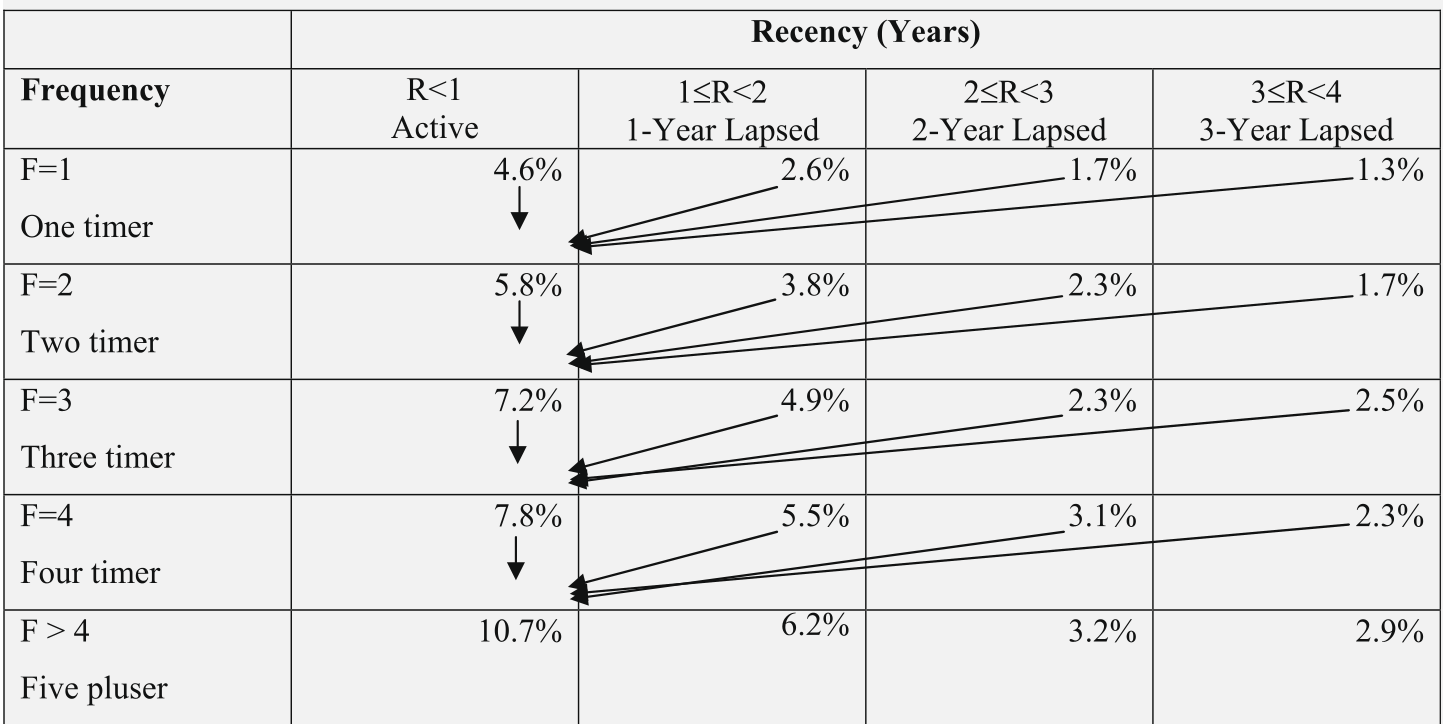
The core of the methodology relies on how customers move between states. As shown in the table below, as Frequency (F) increases and Recency (R) decreases, response rates climb.
The Mathematical Intuition
The paper derives a correction factor based on the Additivity Assumption (the idea that future contacts' effects don't interact too wildly with current RFM).
The simplified formula for the correction is:
Where:
- = Probability of response.
- = Your future value if you buy (Recency becomes 0).
- = Your future value if you don't buy / aren't contacted (Recency grows).
Essentially, it measures the "Gap" between a customer who is re-engaged and one who continues to drift away.
Experimental Results: Doubling the Value
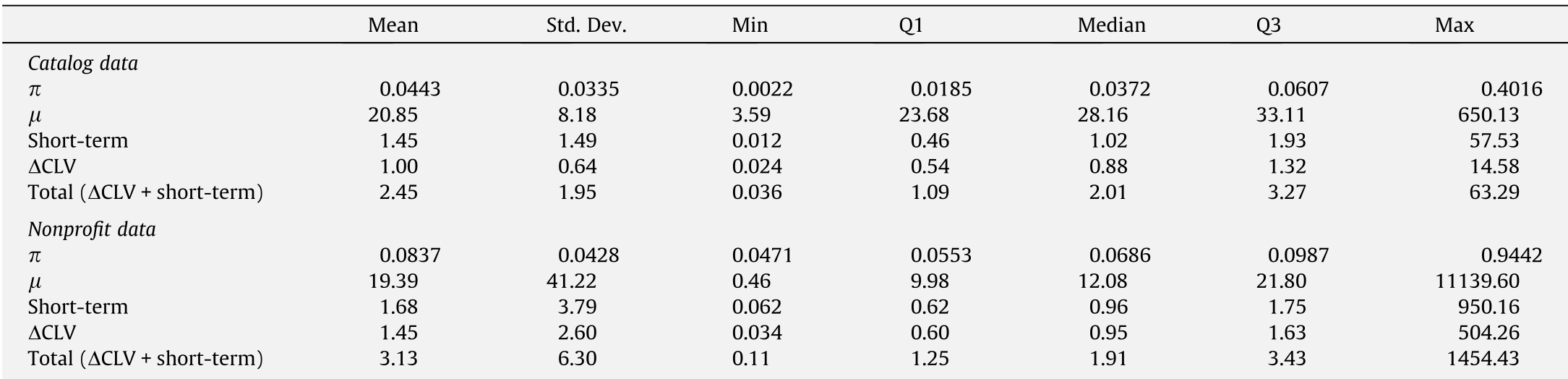
Malthouse tested this theory on two massive datasets: a European Retailer and a US Charity.
Key Findings:
- Value Magnitude: In both industries, the long-term "status upgrade" value was nearly equal to the immediate order value.
- Profitability Shift: For the catalog company, using only short-term metrics suggested 36% of the mailing list was a waste of money. After adding , that number dropped to 14%. Many "marginal" customers are actually high-value long-term bets.
- The Ranking Paradox: Interestingly, the correlation between short-term and long-term value is high (0.62 to 0.94). This means while you might send more mail, the people at the top of your list usually remain the same.
Critical Insight & Conclusion
This paper serves as a bridge between Predictive Modeling (Data Science) and Financial Accountability (CFOs).
The Takeaway: If you are a Marketing Manager, you are likely underestimating your impact by ~50%. By applying this simple correction, you can justify larger budgets and more aggressive customer retention strategies.
Limitations: The author assumes causality—that the act of contacting and the subsequent response creates the high-value state. Critics might argue that responding is merely a signal that the customer was already high-value. Future research into the causal mechanisms of re-engagement is essential to prove that we aren't just "giving treats to the dogs that were going to bark anyway."