
Beyond Deletion: Solving the "Ghost Memories" of Social Media
Longitudinal Privacy Management in Social Media: The Need for Better Controls
This paper investigates "longitudinal privacy" in social media, specifically how users control the exposure of historical data over time. Using a six-year longitudinal study of Twitter, the authors analyze current withdrawal mechanisms—selective deletion, account deletion, and making accounts private—and propose a novel Inactivity-Based Withdrawal scheme to fix inherent flaws in existing systems.
TL;DR
Deleting a tweet doesn't mean it's gone. This research reveals that current social media privacy controls are fundamentally broken because they leave "residual traces" and signal to attackers exactly which content you find embarrassing. The authors propose a shift from manual deletion to Inactivity-Based Withdrawal, a system that lets data fade away naturally once the conversation dies.
The Problem the Industry Ignores: Residual Traces
We often think of privacy as a binary switch: public or deleted. However, this paper introduces the concept of Longitudinal Privacy—the idea that our privacy preferences for a post change as it ages.
The authors discovered that even when an account is nuked, the "shadow" of that user remains. Through @mentions and replies from others, the researchers were able to reconstruct the interests and topics of withdrawn accounts with startling accuracy.
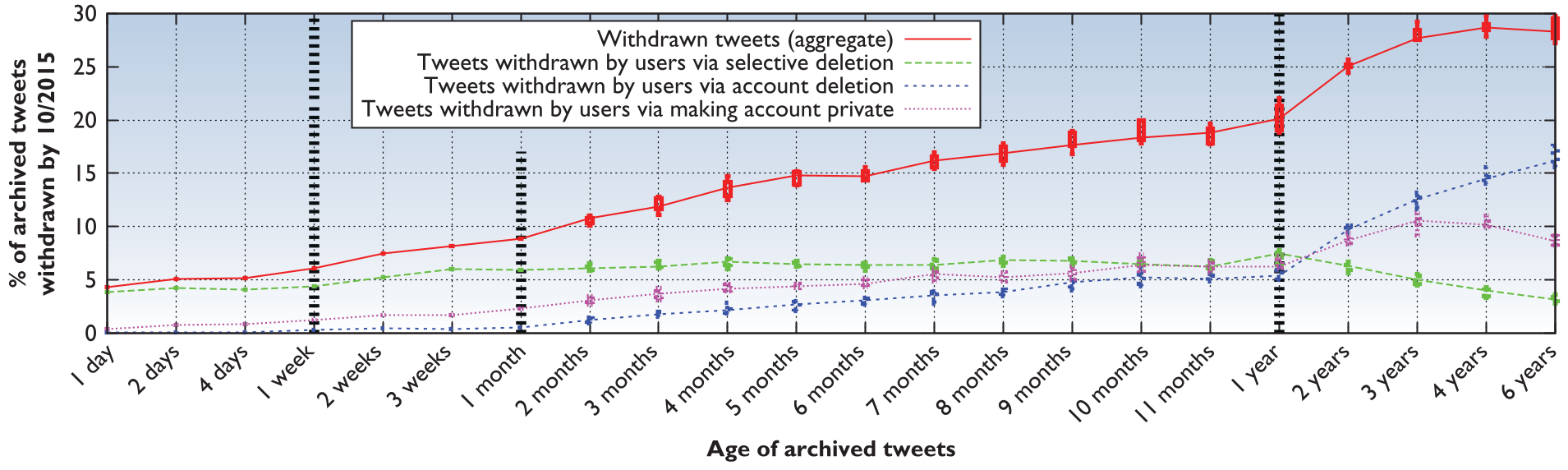 Figure 1: The percentage of withdrawn content scales significantly with time, yet much of it remains "recoverable" via social links.
Two Fatal Flaws in Current Controls
- Limitation I: Residual Activity. If User A deletes their account, User B’s reply to them still exists. By aggregating these "shards," an analyst can determine what User A was talking about, their political leanings, and their social circle.
- Limitation II: The Deletion Signal. Paradoxically, the act of deleting a post tells the world: "This is sensitive!" Services like
Politwoopsspecifically monitor deletion notifications to archive the very things users want gone.
Methodology: The "Smart Decay" Solution
The core contribution of this paper is the Inactivity-Based Withdrawal scheme. Unlike Snapchat, which deletes content based on a rigid timer (Age-based), this method monitors interaction density.
- The Logic: A post remains public as long as it is being retweeted, liked, or viewed.
- The Trigger: Once interaction falls below a threshold for a period T, the system automatically archives it.
- The Benefit: This avoids the "signal" of manual deletion because the withdrawal happens as a routine system process. It also ensures that a viral, high-value thread isn't cut short by an arbitrary timer.
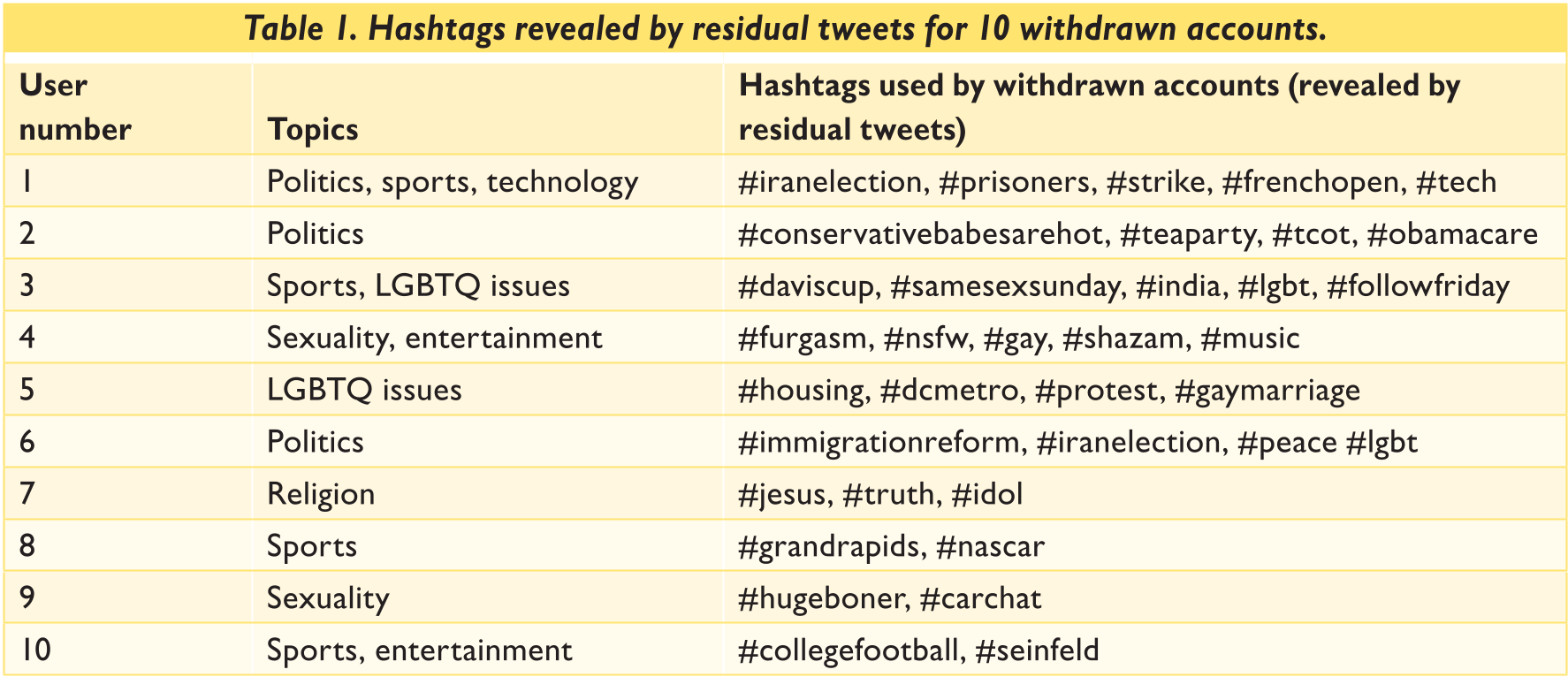 Table 1: Even after deletion, hashtags like #iranelection or #nsfw were legally recoverable through residual mentions, proving current deletion is an illusion.
Experimental Insights
The study analyzed a massive dataset spanning 2009 to 2015. They found that while "Partial Withdrawers" only delete specific tweets, "Complete Withdrawers" (who delete accounts) actually account for 90.3% of all withdrawn content. However, because current systems don't anonymize residual mentions, these "Complete Withdrawers" are still semi-visible to data miners.
Critical Insight & Future Outlook
The genius of this work lies in recognizing that visibility should follow utility. If a post is no longer being used for social interaction, its presence in the public domain provides more risk than value.
The authors' proposal for Content Anonymization (unlinking the user ID from the post instead of deleting the text) offers a middle ground. It preserves the historical "vibe" of the internet without tethering old mistakes to a person's current identity. As we move into an era where AI models are trained on our historical data, these "smart withdrawal" mechanisms may be our only defense against a permanent, unchangeable digital record of our past selves.
Conclusion
We need social media to have a "forgetting" mechanism that mimics human memory—fluid, interaction-based, and quiet. Until platforms adopt inactivity-based triggers, your "deleted" posts are just hidden in plain sight.