
Decoding Brand Loyalty: How Instagram Clusters Reveal the Heart of Fashion Communities
Consideration of the Loyal Customer Sub-communities in a Consumer Community Through Analysis of Social Networking Services - A Case Study of a Fashion Brand
This study investigates the structure of consumer communities for a Japanese fashion brand on Instagram using network analysis. By applying the Fruchterman-Reingold model to follow-follower data, the authors identified a distinct core sub-community consisting of high-loyalty "loyal customers."
TL;DR
This research dives into the digital architecture of "Fashion Brand A," a popular Japanese label, to uncover how loyal customers organize themselves on Instagram. By mapping follow-follower relationships, the study identifies a "Core Community" of high-loyalty users who act as the brand's most powerful advocates, providing a roadmap for brands to move beyond generic ad targeting.
Background: Beyond the "Like" Button
In the hyper-visual world of fashion, a "like" is a shallow metric. The real value for a brand lies in its Consumer Community. While most brands focus on mass-media reach, this paper argues that the secret to effective marketing is understanding the structural "tendencies" of internal sub-communities—specifically, how loyalists differ from general consumers in their networking behavior.
The "Loyalty" Hierarchy
Through interviews with brand staff, the researchers mapped out a three-tier customer structure that exists in the physical world and attempted to find its digital twin on Instagram:
- Core Community: The "Loyalists" who attend pre-sale events and interact directly with shop staff.
- Fan Community: The "Supporters" who actively engage with content.
- General Consumers: The broad audience that sees the brand via mass media or hashtags.
Methodology: Mapping the Mesh
The study collected over 4,000 posts and 2.3 million follow-follower relationships. To make sense of this massive dataset, the authors used the Fruchterman Reingold model, a force-directed layout where nodes (users) that share more connections are pulled closer together.
The Community Heatmap
Users were color-coded by their "degree" (number of connections):
- Blue: 1–4 connections (Peripheral users)
- Green: 5–19 connections (Active participants)
- Red: 20+ connections (The Core/Hubs)
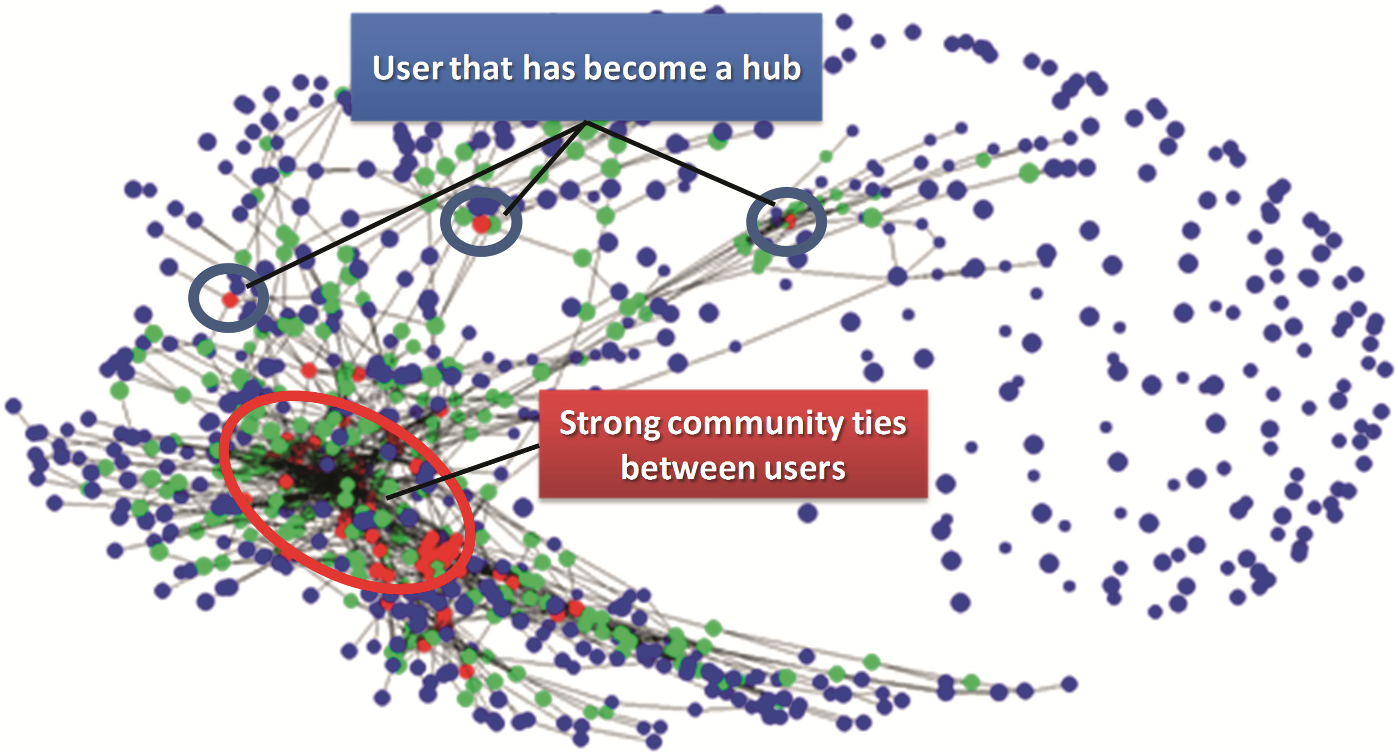 Figure 2: The visualization reveals a dense central cluster of "Red" users—the verified loyalist sub-community.
Key Insights from the Network
The empirical data revealed two critical phenomena:
- The Loyalist Nucleus: A large, dense community exists at the center of the network. Verification with brand staff confirmed these participants are indeed the "Loyal Customers" who are frequently invited to exclusive fashion events.
- The Bridge Effect: While the overall network is sparse (Density: 0.002), certain high-degree users exist outside the central cluster. These "hubs" connect the general consumer (blue users) to the brand's core, acting as vital bridges for information flow.
 Table 2: Descriptive statistics showing the disparity between median and average follower counts, highlighting the influence of a few "Keyusers".
Critical Analysis & Future Outlook
While the study successfully identifies that a loyalist community exists, it opens the door for deeper questions about Influence Pathing.
Limitations: The current study focuses on the "Who" (network structure) but not the "What" (content). A user might have many followers but low-quality engagement.
The Takeaway for Brands: Don't treat your SNS followers as a monolith. Marketing strategies should be bifurcated: nurture the "Core" with exclusive event-driven content to spark organic "shares," and leverage "Bridge" users to reach the peripheral "General" community.
Future research will likely integrate NLP (Natural Language Processing) to analyze the sentiment of tags and replies, providing a 360-degree view of brand health beyond just follow counts.